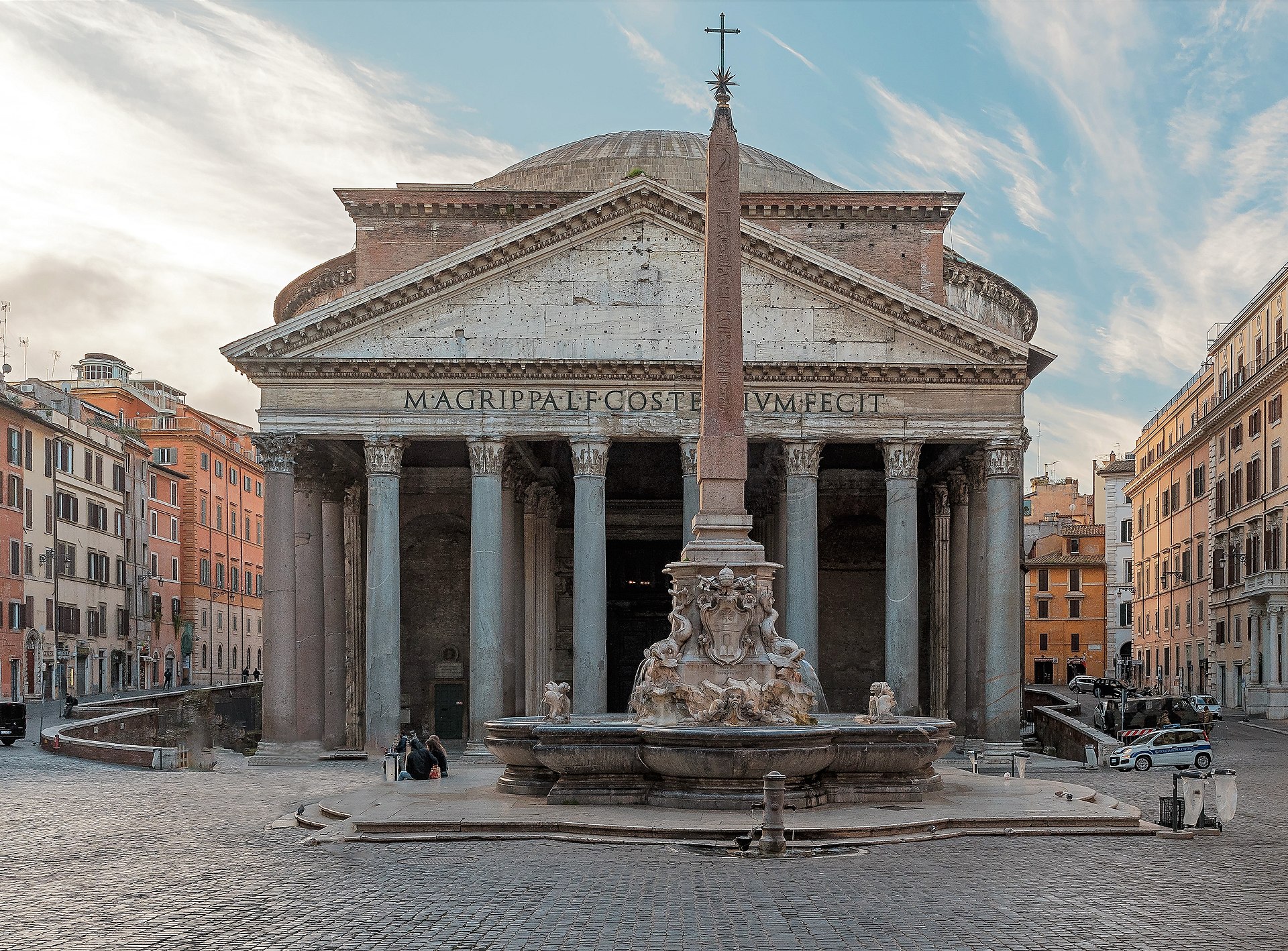
The Pantheon is a Roman temple constructed during the reign of Emperor Hadrian between 118 and 125 CE on the site of an earlier structure commissioned by Marcus Agrippa. Dedicated to all gods, it combined a traditional columned portico with a circular domed rotunda. In 609 CE the building was converted into a Christian church, contributing to its continuous preservation. Its unreinforced concrete dome, spanning 43.3 meters in diameter, remains one of the most significant achievements of Roman engineering.
Key Facts
- Materials
- Unreinforced concrete, Brick, Granite columns, Marble revetment
- Civilization
- Roman Empire
- Accessibility
- Wheelchair accessible at ground level
- Date(s)
- 118-125 CE
- Condition
- Well-preserved; active Catholic church since 609 CE
- Original Function
- Temple dedicated to all gods
- Key Figures
- Marcus Agrippa, Emperor Hadrian, Pope Boniface IV
Agrippan Predecessor
27-25 BCEMarcus Agrippa constructed the original Pantheon during the reign of Augustus. That structure was damaged by fire and later rebuilt before being destroyed again in the early 2nd century CE.
Hadrianic Reconstruction
118-125 CEEmperor Hadrian commissioned the present structure, retaining Agrippa’s inscription on the portico. The design introduced a massive concrete dome with a central oculus, integrating traditional temple form with innovative engineering.
Conversion to Church
609 CEThe building was consecrated as the Church of Santa Maria ad Martyres under Pope Boniface IV. Its continuous religious use helped ensure preservation through the medieval period.
Renaissance and Early Modern Period
15th-18th centuriesThe Pantheon became a site of artistic and civic importance, serving as the burial place of figures such as Raphael and later Italian monarchs. Modifications included the addition and later removal of bell towers.
Modern Conservation
19th century - presentThe building has undergone restoration campaigns addressing structural stability, water infiltration, and surface preservation. It remains one of Rome’s most intact ancient monuments.
Cultural Significance
The Pantheon exemplifies Roman mastery of concrete construction and spatial engineering. Its dome influenced architectural developments from Late Antiquity through the Renaissance and into modern civic and religious architecture. The structure’s continuous adaptation—from pagan temple to Christian church—demonstrates the layered religious and political history of Rome.
Interpretive Notes
Scholarly debates and areas of uncertainty
Scholars debate the precise ritual function of the original Pantheon and whether it served exclusively as a temple or also as a dynastic monument linked to imperial ideology. The symbolic interpretation of the dome and oculus—particularly their cosmological significance—remains an area of ongoing academic discussion.
Visiting Information
Entry Rules
Timed ticket required. Open daily with modified hours for religious services and public holidays. Modest dress required as it remains an active church.
Best Times to Visit
Early morning entry reduces crowd density. Midday sunlight through the oculus creates direct illumination within the rotunda.
Photography
Personal photography permitted without flash. Tripods and commercial photography require authorization.
Preservation Notes
Do not touch marble surfaces or interior chapels. The oculus allows rainwater into the structure; drainage channels are integrated into the floor.
Nearby POIs
11 shownSources & Further Reading
- [1]The Pantheon: Design, Meaning, and Progeny — William L. MacDonald. Harvard University Press (1976)
- [2]Rome: An Oxford Archaeological Guide — Amanda Claridge. Oxford University Press (2010)
- [3]Hadrian and the City of Rome — Mary T. Boatwright. Princeton University Press (1987)
Key Facts
- Materials
- Unreinforced concrete, Brick, Granite columns, Marble revetment
- Civilization
- Roman Empire
- Accessibility
- Wheelchair accessible at ground level
- Date(s)
- 118-125 CE
- Condition
- Well-preserved; active Catholic church since 609 CE
- Original Function
- Temple dedicated to all gods
- Key Figures
- Marcus Agrippa, Emperor Hadrian, Pope Boniface IV