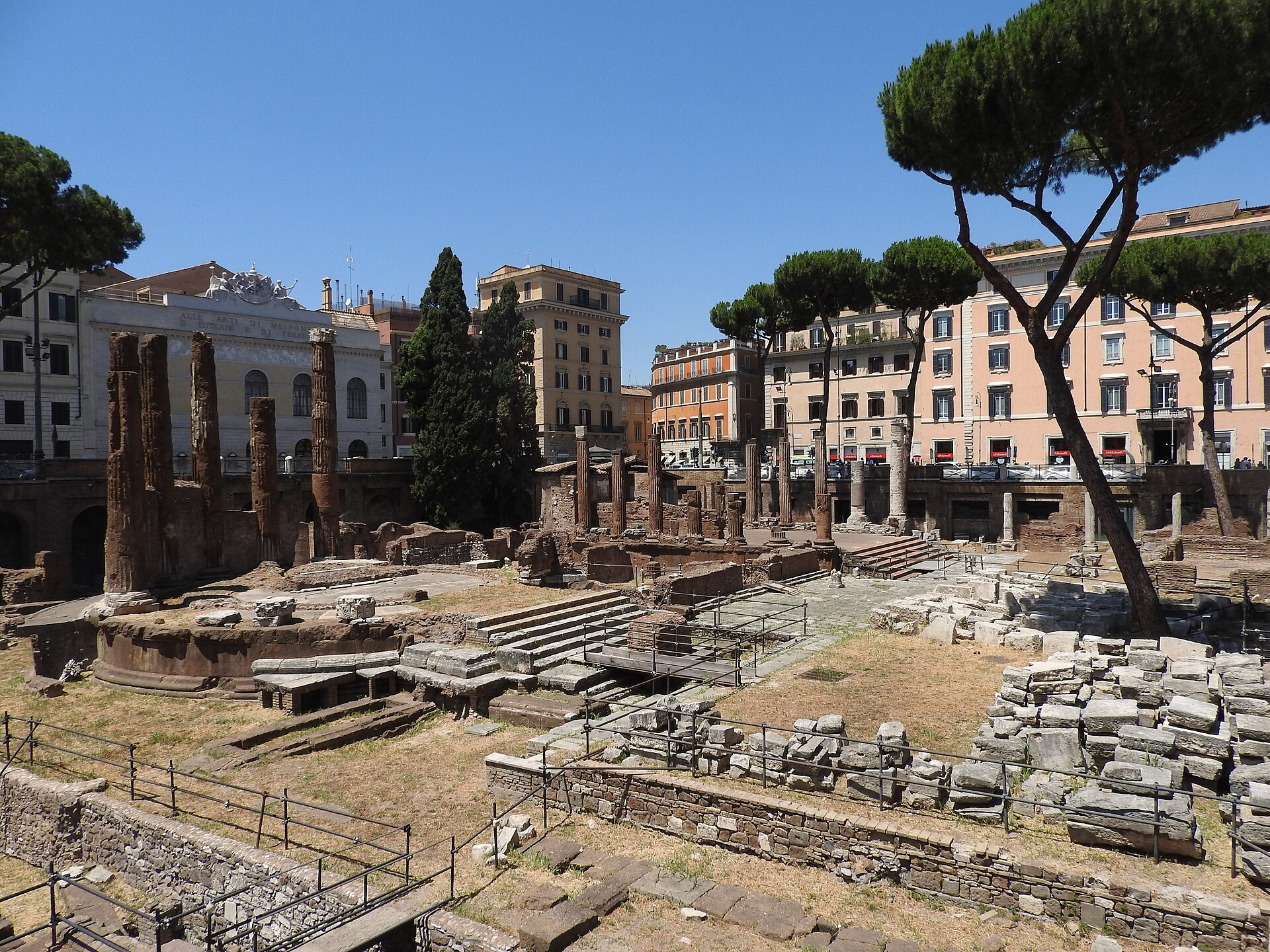
The Area Sacra di Largo Argentina is an archaeological site in Rome containing the remains of four Roman Republican temples and the ruins of the Theatre of Pompey. Discovered during urban demolition in the late 1920s, the site provides a rare glimpse into the monumental architecture of the mid-to-late Roman Republic, a period often overshadowed by the later Imperial structures of the city.
The site is perhaps most famous for the Curia of Pompey, a hall within the theatre complex where the Roman Senate met. It was here that Julius Caesar was assassinated on the Ides of March in 44 BCE. Today, the site is situated significantly below modern street level and serves as both an archaeological park and a protected sanctuary for a local colony of stray cats.
Key Facts
- Materials
- Tufa, Travertine, Concrete
- Civilization
- Roman
- Accessibility
- Viewable from street level; elevated walkway access available
- Date(s)
- 4th century BCE - 1st century BCE
- Condition
- Excavated ruins, partially restored
- Original Function
- Religious temples and theatre complex
- Key Figures
- Julius Caesar, Pompey the Great
Republican Construction
4th - 2nd century BCEThe four temples, designated A, B, C, and D, were constructed at different times during the Republican era. Temple C is the oldest, dating to the 4th or 3rd century BCE, while Temple B, a circular structure, is the most recent, dating to the early 1st century BCE.
The Theatre of Pompey
55 BCEPompey the Great constructed a massive theatre complex nearby. The Curia of Pompey, a meeting hall attached to the portico of the theatre, became the site of the Roman Senate's meetings while the Curia Julia was under construction.
Assassination of Caesar
44 BCEOn March 15, 44 BCE, Julius Caesar was assassinated by a group of senators inside the Curia of Pompey. This event marked a turning point in the transition from the Roman Republic to the Roman Empire.
Modern Discovery
1926 - 1929The ruins were uncovered during a major urban renewal project in Rome. The demolition of medieval and Renaissance buildings revealed the ancient podiums and columns that had been buried for centuries.
Cultural Significance
The site holds immense historical weight as the location of the assassination of Julius Caesar, a defining moment in Western history. Beyond its political significance, it represents the architectural evolution of the Roman Republic, showcasing the transition from traditional Italic temple styles to more Hellenized forms.
In contemporary Roman culture, the site is uniquely recognized for its long-standing cat sanctuary. The integration of a protected animal habitat within a major archaeological site has become a point of local pride and a distinct feature of the visitor experience.
Interpretive Notes
Scholarly debates and areas of uncertainty
The identification of the four temples remains a subject of academic discussion. While they are labeled A through D, scholars have proposed various deities for each, including Juturna, Feronia, and the Lares Permarini, based on the Roman calendar and ancient literary sources, though no definitive epigraphic evidence has confirmed these attributions.
Visiting Information
Entry Rules
The site is open to the public via a raised walkway. Tickets are required for access to the walkway level. Standard operating hours apply; please check the official site for seasonal variations.
Best Times to Visit
Early morning or late afternoon to avoid the intense Roman sun, as the site is an open-air excavation with limited shade.
Photography
Personal photography is permitted. Commercial photography requires authorization from the Sovrintendenza Capitolina.
Preservation Notes
The site is an active archaeological area. Visitors must remain on the designated walkways and are strictly prohibited from entering the lower excavation levels or disturbing the resident cat colony.
Nearby POIs
11 shownSources & Further Reading
- [1]The Theatre of Pompey and the Curia — John E. Stambaugh. The Ancient Roman City (1988)
- [2]Largo Argentina: The Republican Temples — Filippo Coarelli. Rome and Environs: An Archaeological Guide (2014)
Key Facts
- Materials
- Tufa, Travertine, Concrete
- Civilization
- Roman
- Accessibility
- Viewable from street level; elevated walkway access available
- Date(s)
- 4th century BCE - 1st century BCE
- Condition
- Excavated ruins, partially restored
- Original Function
- Religious temples and theatre complex
- Key Figures
- Julius Caesar, Pompey the Great