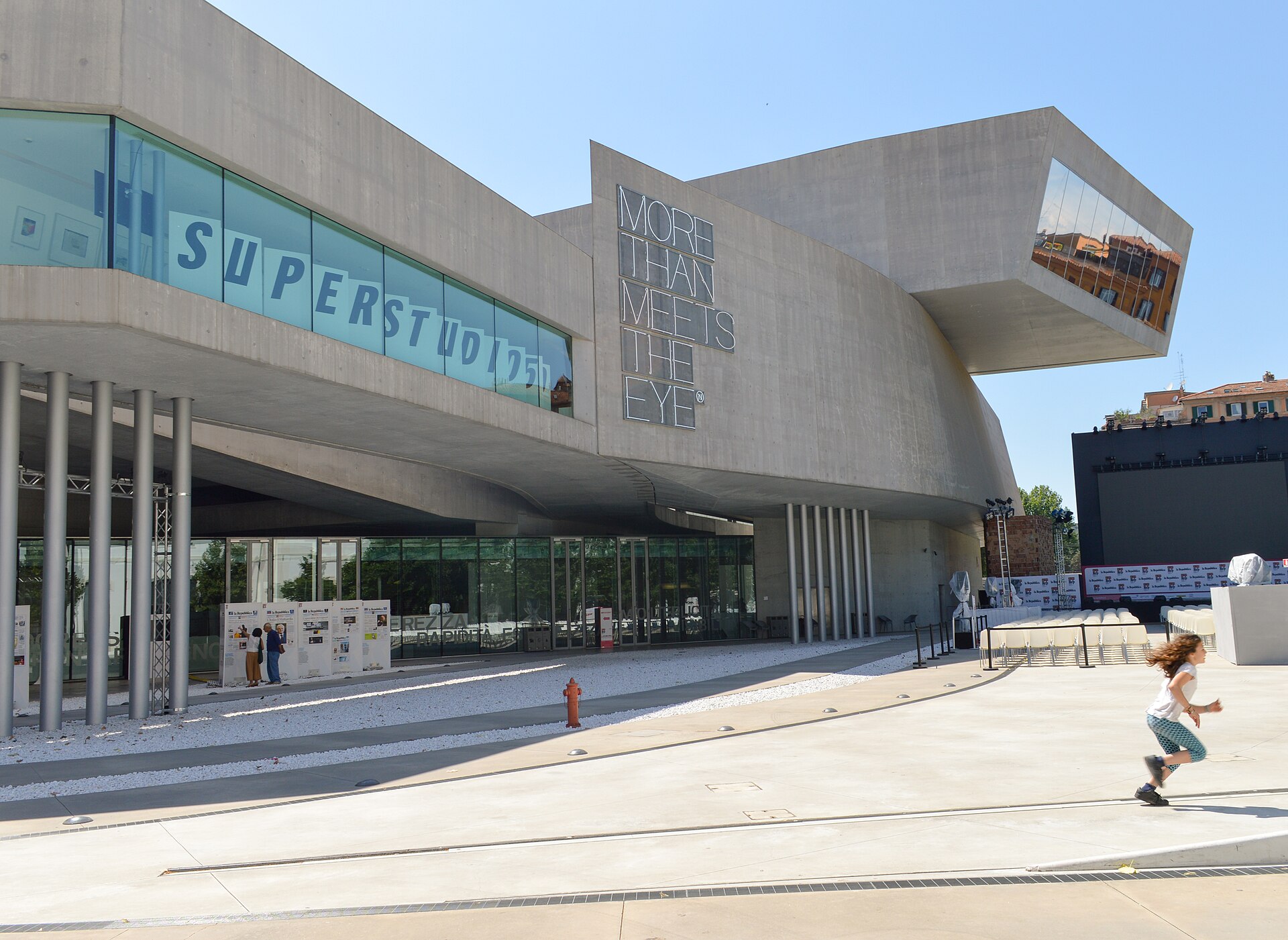
MAXXI (Museo nazionale delle arti del XXI secolo) is Italy's first national institution dedicated to contemporary creativity. Located in the Flaminio district of Rome, the museum was designed by architect Zaha Hadid and opened to the public in 2010. The building is celebrated for its fluid, deconstructivist design, which utilizes concrete curves and overlapping volumes to create a dynamic space that challenges traditional museum layouts.
The museum is divided into two main sections: MAXXI Art and MAXXI Architecture. Its permanent collection features works by prominent international and Italian artists, while the architecture wing houses an extensive archive of drawings, models, and photographs documenting the evolution of 20th and 21st-century design. The site serves as a multidisciplinary hub for exhibitions, research, and public events.
Key Facts
- Materials
- Self-compacting concrete, Steel, Glass
- Civilization
- Modern Italian
- Accessibility
- Fully wheelchair accessible
- Date(s)
- 2003-2010
- Condition
- Active museum
- Original Function
- National Museum of Contemporary Art and Architecture
- Key Figures
- Zaha Hadid, Pio Baldi, Margherita Guccione
Design Competition
1998-2000The Italian Ministry of Culture launched an international design competition to transform the former Montello military barracks into a new national museum. Zaha Hadid's proposal was selected for its innovative approach to urban integration and spatial flow.
Construction Phase
2003-2010Construction faced several delays due to the complexity of the cast-in-place concrete structures and the integration of advanced lighting systems. The project was completed in 2010, marking a significant architectural milestone in contemporary Rome.
Inauguration and Evolution
2010-PresentSince its opening, MAXXI has established itself as a primary venue for contemporary art in Italy. It has expanded its reach through the creation of the MAXXI Foundation and the development of satellite locations, including MAXXI L'Aquila.
Cultural Significance
MAXXI represents a departure from Rome's classical and baroque architectural heritage, signaling the city's commitment to contemporary cultural production. It serves as a laboratory for experimental art and architecture, fostering dialogue between historical urban fabric and modern design languages.
Interpretive Notes
Scholarly debates and areas of uncertainty
The museum's interior design is frequently debated by curators and critics. While the fluid, non-linear spaces are praised for their aesthetic impact, some argue that the lack of traditional 'white cube' gallery walls makes the installation of certain types of contemporary art challenging.
Visiting Information
Entry Rules
Open Tuesday to Sunday. Tickets can be purchased online or at the museum entrance. Concessions are available for students and seniors. Visitors are required to leave large bags in the cloakroom.
Best Times to Visit
Weekday mornings are generally quieter. The museum often hosts evening events and public talks, which provide a different perspective on the architectural lighting.
Photography
Personal photography is permitted for non-commercial use. Flash and tripods are prohibited. Professional photography requires prior authorization from the museum press office.
Preservation Notes
The exposed concrete surfaces are sensitive to environmental factors. Visitors are asked not to touch the walls or structural elements. The museum maintains a strict climate control system to protect the permanent collection.
Nearby POIs
11 shownSources & Further Reading
- [1]Zaha Hadid: MAXXI National Museum of XXI Century Arts — Giuseppe Parisi. Electa (2010)
- [2]The MAXXI Museum: A New Landmark for Rome — Luca Molinari. Skira (2012)
Key Facts
- Materials
- Self-compacting concrete, Steel, Glass
- Civilization
- Modern Italian
- Accessibility
- Fully wheelchair accessible
- Date(s)
- 2003-2010
- Condition
- Active museum
- Original Function
- National Museum of Contemporary Art and Architecture
- Key Figures
- Zaha Hadid, Pio Baldi, Margherita Guccione