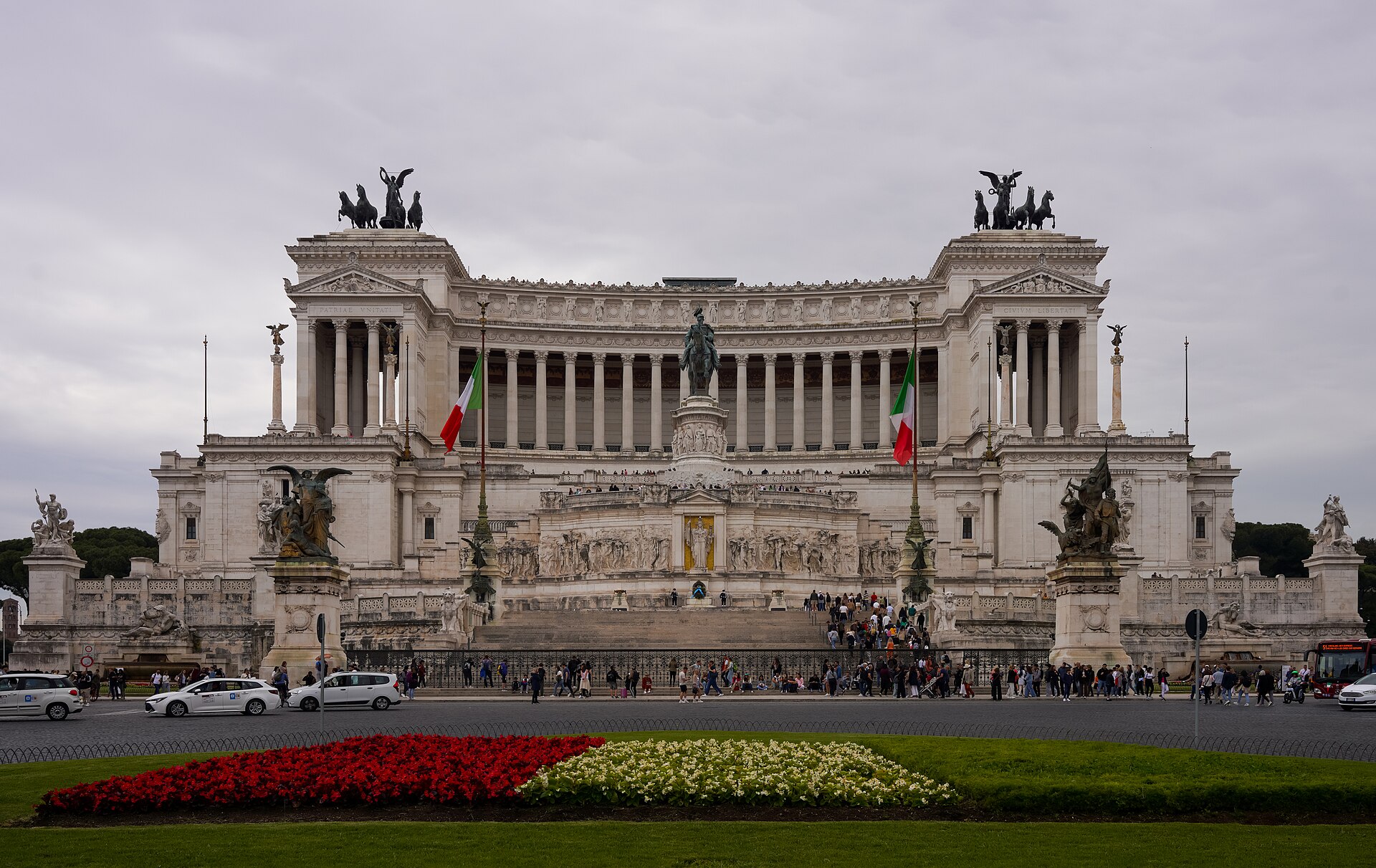
The Monument to Victor Emmanuel II, also known as the Altare della Patria, is a colossal national monument located in Rome between the Piazza Venezia and the Capitoline Hill. Designed by Giuseppe Sacconi in 1885 and inaugurated in 1911, it was built to honor the first king of unified Italy and to serve as a symbol of the Italian Risorgimento.
The structure is characterized by its massive scale and use of white Botticino marble, which contrasts sharply with the surrounding Roman architecture. It features a grand staircase, Corinthian columns, and numerous allegorical sculptures representing Italian values and regions. The monument also houses the Tomb of the Unknown Soldier, established in 1921 to commemorate fallen soldiers of World War I.
Key Facts
- Materials
- Botticino marble, Bronze, Travertine
- Civilization
- Modern Italy
- Accessibility
- Elevator access to the terrace available
- Date(s)
- 1885-1935
- Condition
- Well-preserved, active memorial site
- Original Function
- National monument and symbol of unification
- Key Figures
- Victor Emmanuel II, Giuseppe Sacconi, Gaetano Koch
Conception and Competition
1878-1885Following the death of King Victor Emmanuel II in 1878, the Italian government held an international competition to design a monument honoring the 'Father of the Fatherland.' Giuseppe Sacconi's design was selected for its grand, neoclassical vision.
Construction Phase
1885-1911Construction required the demolition of a significant medieval and Renaissance neighborhood on the slopes of the Capitoline Hill. The monument was inaugurated in 1911 during the 50th anniversary of the Unification of Italy, though work continued for decades.
The Tomb of the Unknown Soldier
1921In 1921, the remains of an unidentified Italian soldier from World War I were interred at the base of the monument. This addition transformed the site from a purely political monument into a sacred national shrine.
Modern Restoration
2000-presentIn the early 21st century, the monument underwent extensive cleaning and restoration to remove decades of pollution and weathering. It remains a central site for state ceremonies and national holidays.
Cultural Significance
The monument serves as the primary site for Italian national identity and state commemoration. It is the focal point for celebrations on Liberation Day (April 25) and Republic Day (June 2), where the President of Italy lays a wreath at the Tomb of the Unknown Soldier.
Despite its national importance, the monument has historically faced criticism from Romans who viewed its massive scale as an intrusion into the historic urban fabric of the city, often referring to it disparagingly as the 'wedding cake' or 'typewriter' due to its shape and bright white color.
Interpretive Notes
Scholarly debates and areas of uncertainty
Architectural historians frequently debate the monument's stylistic choices, specifically whether its heavy, eclectic neoclassical design was an appropriate choice for the heart of Rome. Some argue it represents a successful attempt to create a modern 'Roman' identity, while others view it as an aesthetic failure that clashes with the surrounding ancient ruins.
Visiting Information
Entry Rules
Open daily. Entry to the main terrace and the Tomb of the Unknown Soldier is free. There is a fee for the panoramic elevator that provides access to the top terrace for views of the city.
Best Times to Visit
Early morning or late afternoon to avoid the intense heat of the marble surfaces during summer. Sunset offers excellent views of the Roman Forum and the city skyline.
Photography
Personal photography is permitted in public areas. Tripods and commercial equipment require prior authorization from the monument administration.
Preservation Notes
The white marble is highly susceptible to air pollution and acid rain. Visitors are requested to stay within designated areas and refrain from sitting on the monument's steps or decorative elements.
Nearby POIs
11 shownSources & Further Reading
- [1]The Victor Emmanuel Monument in Rome — Christopher A. P. Binns. Journal of Modern Italian Studies (2002)View
- [2]Rome: A Cultural and Literary History — Jonathan Boardman. Signal Books (2000)
Key Facts
- Materials
- Botticino marble, Bronze, Travertine
- Civilization
- Modern Italy
- Accessibility
- Elevator access to the terrace available
- Date(s)
- 1885-1935
- Condition
- Well-preserved, active memorial site
- Original Function
- National monument and symbol of unification
- Key Figures
- Victor Emmanuel II, Giuseppe Sacconi, Gaetano Koch