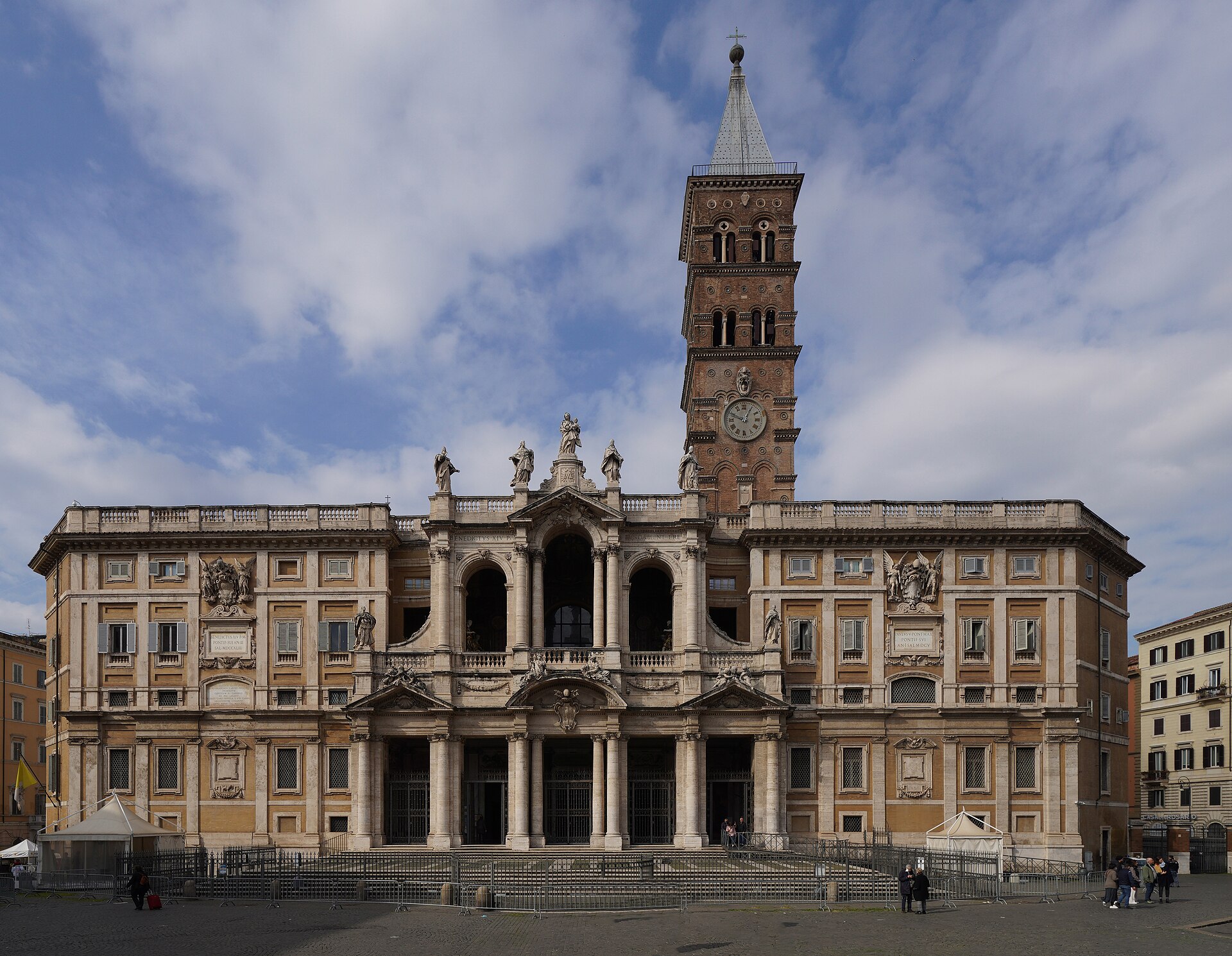
The Basilica di Santa Maria Maggiore is one of the four papal basilicas in Rome and the largest church in the city dedicated to the Virgin Mary. Founded in the 5th century under Pope Sixtus III, it is renowned for its well-preserved Early Christian mosaics and its status as the first Marian sanctuary in the Western world. The basilica holds a unique position in Roman ecclesiastical history, serving as a major pilgrimage site and a repository of significant religious relics.
The structure displays a complex architectural evolution, featuring a 5th-century nave, a 13th-century Romanesque campanile—the tallest in Rome—and extensive Renaissance and Baroque additions. Its interior is celebrated for the 5th-century mosaics depicting Old Testament scenes, the intricate Cosmatesque floor, and the ornate coffered ceiling, which is said to be gilded with gold brought from the Americas by Christopher Columbus.
Key Facts
- Materials
- Marble, Gold leaf, Brick, Mosaic tesserae
- Civilization
- Roman/Papal
- Accessibility
- Wheelchair accessible via side entrance
- Date(s)
- 432-440 CE
- Condition
- Active basilica, well-preserved
- Original Function
- Basilica dedicated to the Virgin Mary
- Key Figures
- Pope Sixtus III, Pope Nicholas IV, Gian Lorenzo Bernini, Giuliano da Sangallo
Founding and Early Mosaics
5th CenturyCommissioned by Pope Sixtus III following the Council of Ephesus, the basilica was built to honor the Virgin Mary. The original nave mosaics, which remain largely intact, represent some of the oldest surviving depictions of biblical narratives in a Christian context.
Medieval Expansion
13th CenturyDuring the 13th century, the basilica underwent significant renovations, including the construction of the Romanesque bell tower and the addition of the apse mosaics by Jacopo Torriti, which depict the Coronation of the Virgin.
Renaissance and Baroque Transformations
15th-17th CenturyThe basilica was heavily modified during the Renaissance and Baroque periods. Notable additions include the coffered ceiling designed by Giuliano da Sangallo and the elaborate Sistine and Pauline chapels, which house the tombs of several popes.
Cultural Significance
As the 'mother of all sanctuaries' dedicated to Mary, the basilica is central to Roman Catholic devotion. It houses the relic of the Holy Crib, drawing thousands of pilgrims annually, particularly during the feast of the Dedication of the Basilica on August 5th, which commemorates a legendary snowfall on the site.
Interpretive Notes
Scholarly debates and areas of uncertainty
The exact provenance of the original 5th-century mosaic program remains a subject of study, particularly regarding the influence of imperial Roman art versus emerging Christian iconography. Additionally, the extent of the structural modifications made during the 18th-century facade renovation by Ferdinando Fuga continues to be debated by architectural historians.
Visiting Information
Entry Rules
Open daily. Entry is free. Visitors are expected to dress modestly (shoulders and knees covered). Security screening is mandatory at the entrance.
Best Times to Visit
Early morning or late afternoon to avoid peak tourist crowds. Weekdays are generally quieter than weekends.
Photography
Personal photography is permitted without flash or tripods. Professional photography requires prior authorization from the Vatican authorities.
Preservation Notes
The basilica is an active place of worship; maintain silence and respect ongoing liturgical services. Do not touch the mosaics or historical marble surfaces.
Nearby POIs
11 shownSources & Further Reading
- [1]The Mosaics of Santa Maria Maggiore — Margaret R. Miles. University of California Press (2008)
- [2]Rome: An Oxford Archaeological Guide — Amanda Claridge. Oxford University Press (2010)
Key Facts
- Materials
- Marble, Gold leaf, Brick, Mosaic tesserae
- Civilization
- Roman/Papal
- Accessibility
- Wheelchair accessible via side entrance
- Date(s)
- 432-440 CE
- Condition
- Active basilica, well-preserved
- Original Function
- Basilica dedicated to the Virgin Mary
- Key Figures
- Pope Sixtus III, Pope Nicholas IV, Gian Lorenzo Bernini, Giuliano da Sangallo