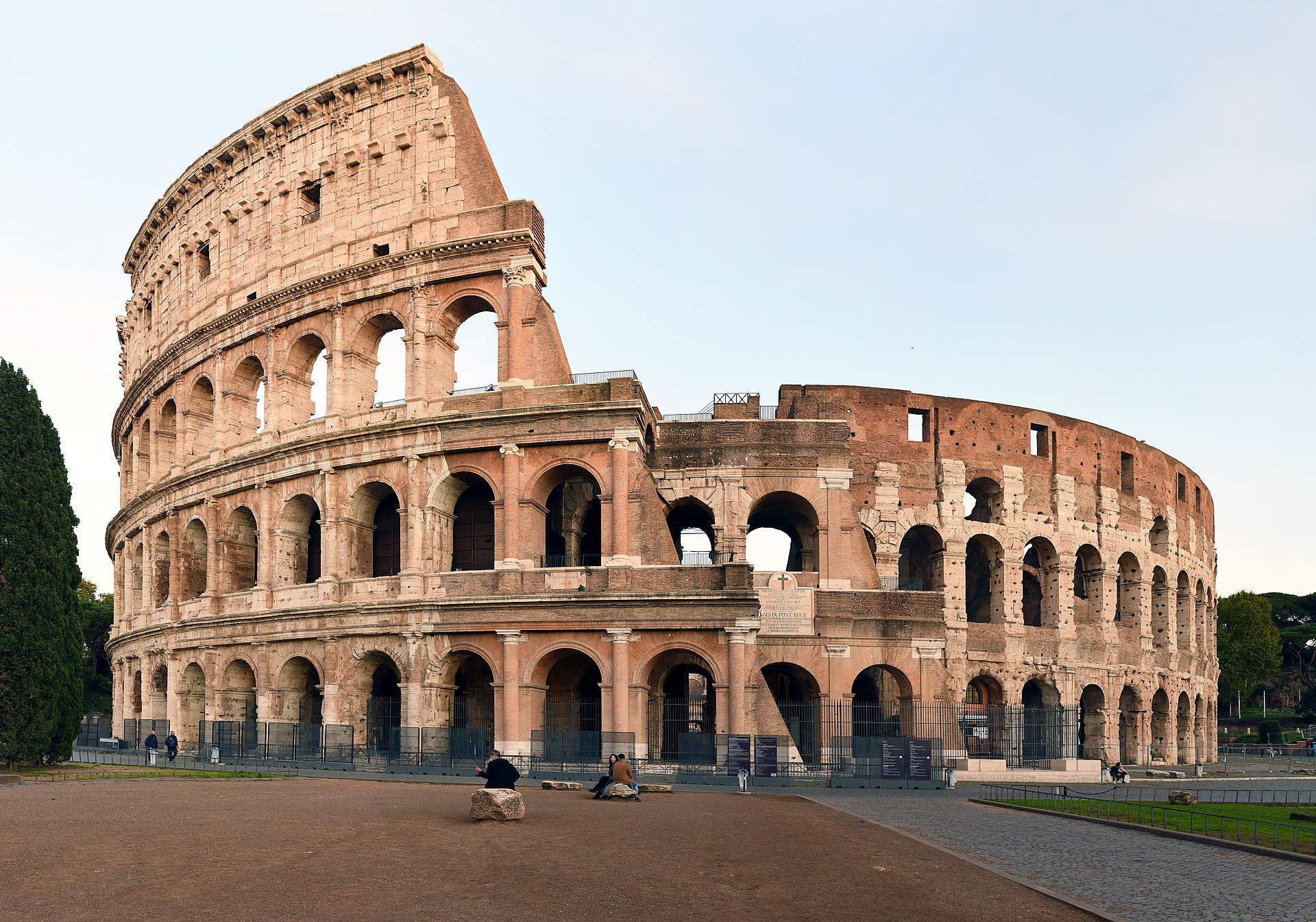
The Colosseum, originally known as the Flavian Amphitheatre, was constructed between 72 and 80 CE under the emperors Vespasian and Titus. Located east of the Roman Forum, it was built on the site of Nero’s former lake as part of a broader Flavian program to reassert public authority after the Julio-Claudian dynasty. Designed to host large-scale spectacles, including gladiatorial contests, animal hunts, and staged executions, the amphitheatre could accommodate tens of thousands of spectators. Its structural system of concrete vaulting, travertine piers, and tiered seating exemplifies Roman engineering and the political function of mass entertainment in the imperial capital.
Key Facts
- Materials
- Travertine, Tuff, Brick-faced concrete, Marble
- Dimensions
- Approximately 189m long; 156m wide; height 48m
- Civilization
- Roman
- Date(s)
- 72-80 CE (modified 81-96 CE)
- Condition
- Partially preserved ruin; major tourist site under active conservation
- Original Function
- Amphitheatre for public spectacles
- Key Figures
- Vespasian, Titus, Domitian
Flavian Construction
72-80 CECommissioned by Emperor Vespasian following the civil wars of 69 CE, the amphitheatre was financed in part by spoils from the Jewish War. It symbolically replaced Nero’s private palace complex with a public entertainment venue. Titus inaugurated the structure in 80 CE with games reportedly lasting 100 days.
Domitianic Modifications
81-96 CEEmperor Domitian completed the hypogeum, a complex network of subterranean corridors, cages, and mechanical lifts used to stage spectacles. He also expanded seating arrangements to refine social hierarchy within the audience.
Late Antique Use and Decline
4th-6th centuryGladiatorial games declined in the 5th century, and animal hunts continued intermittently until at least the early 6th century. Earthquakes in 847 and 1349 caused major structural collapses. Stone was subsequently quarried for use in other Roman buildings.
Medieval and Early Modern Transformations
Middle Ages-18th centuryThe structure was reused for housing, workshops, and fortifications under the Frangipani family. In the 18th century, Pope Benedict XIV consecrated the site as associated with Christian martyrdom, establishing devotional stations within the arena.
Archaeological Conservation
19th century - presentSystematic stabilization began in the 19th century, including buttressing of outer walls. Modern conservation addresses pollution, vibration, and visitor pressure. The Colosseum is administered as part of the Parco Archeologico del Colosseo.
Cultural Significance
The Colosseum embodied imperial authority and the Roman state’s capacity to organize mass spectacle. Seating arrangements reflected rigid social stratification, reinforcing hierarchy through spatial organization. Public games served political functions, strengthening loyalty to the emperor and distributing symbolic benefits to the urban population. In modern contexts, the monument has become a global symbol of Roman civilization. It also serves as a site of contemporary cultural and political messaging, including international campaigns against capital punishment.
Interpretive Notes
Scholarly debates and areas of uncertainty
The scale and frequency of spectacles remain debated, particularly regarding the total number of casualties associated with gladiatorial games. Literary sources may exaggerate figures for rhetorical effect. The extent to which the Colosseum functioned as a primary site of Christian martyrdom is also contested. While later Christian tradition associates the monument with persecution narratives, archaeological evidence for systematic executions specifically within the amphitheatre remains limited.
Visiting Information
Entry Rules
Paid admission required. Ticket typically combined with Roman Forum and Palatine Hill and valid for 24 hours. Timed entry system in place. Security screening required.
Best Times to Visit
Early morning entry slots provide reduced crowd density. Summer afternoons experience high heat exposure. Weekdays outside major tourist seasons offer shorter queues.
Photography
Personal photography permitted. Tripods, drones, and commercial filming require prior authorization from park authorities.
Preservation Notes
Do not lean or sit on fragile stone surfaces. Certain upper tiers and underground areas require special access tickets. Ongoing restoration may restrict movement in some sections.
Nearby POIs
11 shownSources & Further Reading
- [1]The Colosseum — Keith Hopkins and Mary Beard. Harvard University Press (2005)
- [2]The Roman Amphitheatre: From Its Origins to the Colosseum — Katherine E. Welch. Cambridge University Press (2007)
- [3]Roman Architecture — Frank Sear. Cornell University Press (1982)
Key Facts
- Materials
- Travertine, Tuff, Brick-faced concrete, Marble
- Dimensions
- Approximately 189m long; 156m wide; height 48m
- Civilization
- Roman
- Date(s)
- 72-80 CE (modified 81-96 CE)
- Condition
- Partially preserved ruin; major tourist site under active conservation
- Original Function
- Amphitheatre for public spectacles
- Key Figures
- Vespasian, Titus, Domitian