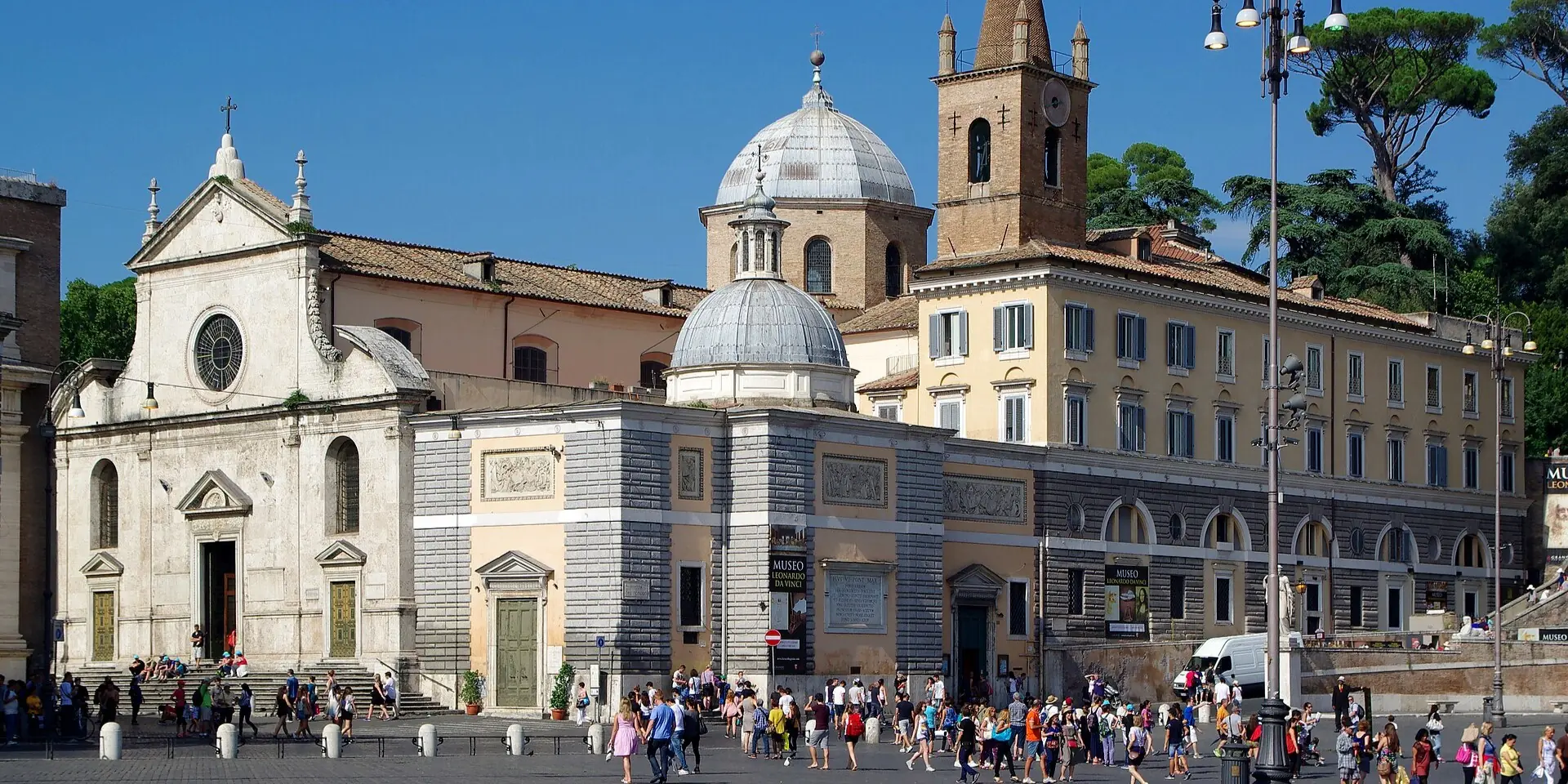
The Basilica of Santa Maria del Popolo is a titular church located on the north side of Piazza del Popolo in Rome. Originally founded in 1099 by Pope Paschal II, the current structure was largely rebuilt during the Renaissance under the patronage of Pope Sixtus IV. It serves as a significant repository of Roman art, housing masterpieces by artists such as Raphael, Caravaggio, Bernini, and Pinturicchio.
The church is particularly noted for the Chigi Chapel, designed by Raphael, and the Cerasi Chapel, which contains two iconic paintings by Caravaggio: The Conversion of Saint Paul and The Crucifixion of Saint Peter. Its architectural evolution reflects the transition from early Renaissance design to the elaborate decorative styles of the Baroque period.
Key Facts
- Materials
- Travertine, Brick, Marble, Stucco
- Civilization
- Italian
- Accessibility
- Ground level access, limited interior space
- Date(s)
- 1472-1477 (Renaissance reconstruction)
- Condition
- Active basilica
- Original Function
- Augustinian church
- Key Figures
- Pope Paschal II, Pope Sixtus IV, Raphael, Caravaggio, Gian Lorenzo Bernini
Origins and Medieval Foundation
1099The original chapel was built by Pope Paschal II to appease the local population, who believed the site was haunted by the ghost of Emperor Nero. It was dedicated to the Virgin Mary and eventually entrusted to the Augustinian order.
Renaissance Reconstruction
1472-1477Pope Sixtus IV commissioned the reconstruction of the church as part of his urban renewal program for Rome. The work was carried out by architects Baccio Pontelli and Andrea Bregno, establishing the church's current Renaissance layout.
Baroque Embellishments
17th centuryDuring the 17th century, the interior underwent significant modifications under the direction of Gian Lorenzo Bernini, who added Baroque decorative elements to the nave and side chapels, further enhancing the church's artistic collection.
Cultural Significance
The basilica is a cornerstone of Roman religious and artistic history. Its role as a 'first church' for travelers entering Rome from the north via the Via Flaminia established it as a symbolic gateway to the city. The presence of works by the most prominent artists of the Renaissance and Baroque eras makes it a vital site for the study of Western art history.
Beyond its artistic value, the church remains an active place of worship and a titular church for Cardinals, maintaining its historical connection to the Augustinian tradition and the papacy's historical patronage of the arts.
Interpretive Notes
Scholarly debates and areas of uncertainty
The attribution of certain architectural elements in the early Renaissance phases remains a subject of minor debate among art historians, particularly regarding the extent of Baccio Pontelli's involvement versus other contemporary architects of the Sixtine circle.
Visiting Information
Entry Rules
Open daily. Entry is free. Visitors are requested to maintain silence and respect ongoing religious services. Modest dress is required (shoulders and knees must be covered).
Best Times to Visit
Early morning or late afternoon on weekdays to avoid large tour groups. The Caravaggio paintings are best viewed during daylight hours for natural illumination.
Photography
Personal photography is permitted without flash. Tripods and professional equipment are prohibited.
Preservation Notes
The church contains fragile frescoes and oil paintings; do not touch surfaces or use flash photography. Some areas may be restricted during liturgical services.
Nearby POIs
11 shownSources & Further Reading
- [1]Santa Maria del Popolo: A History — Laurie Nussdorfer. Journal of the Society of Architectural Historians (1992)View
- [2]The Churches of Rome — Filippo Titi. Edizioni dell'Elefante (1987)
Key Facts
- Materials
- Travertine, Brick, Marble, Stucco
- Civilization
- Italian
- Accessibility
- Ground level access, limited interior space
- Date(s)
- 1472-1477 (Renaissance reconstruction)
- Condition
- Active basilica
- Original Function
- Augustinian church
- Key Figures
- Pope Paschal II, Pope Sixtus IV, Raphael, Caravaggio, Gian Lorenzo Bernini