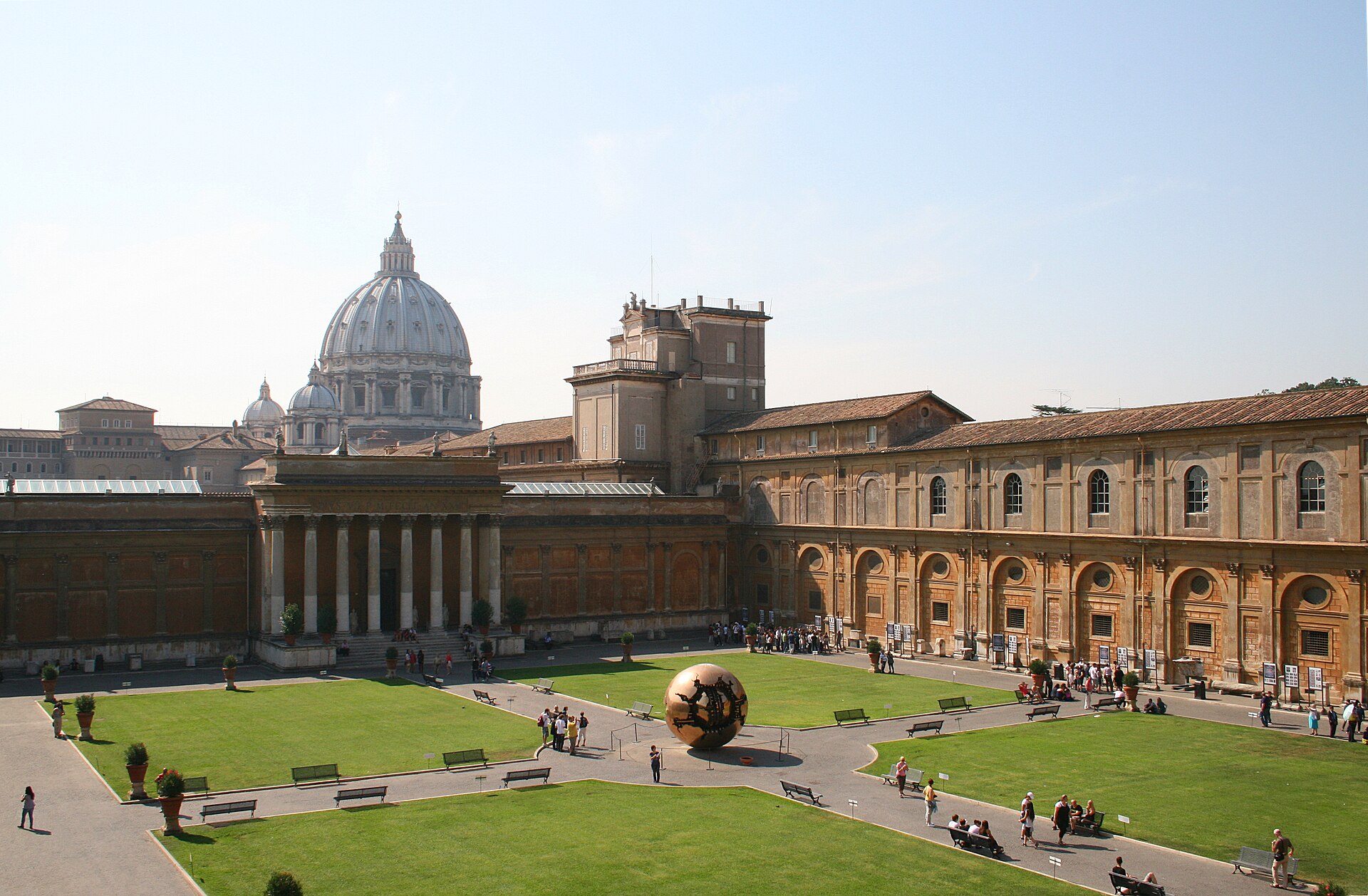
The Vatican Museums are a complex of art and historical museums located within the Vatican City, housing one of the most significant art collections in the world. Founded by Pope Julius II in the early 16th century, the museums display works amassed by the Catholic Church and the papacy over several centuries, including renowned Roman sculptures and masterpieces of Renaissance art.
The collection spans over 70,000 works, of which approximately 20,000 are on display. The museum route culminates in the Sistine Chapel, famous for its ceiling painted by Michelangelo, and the Stanze di Raffaello, which feature frescoes by Raphael. The institution serves as a repository of Western cultural history, integrating religious artifacts with classical and secular art.
Key Facts
- Materials
- Travertine, Brick, Marble, Stucco
- Civilization
- Papal States / Vatican City
- Accessibility
- Partially accessible; specific routes for visitors with mobility impairments
- Date(s)
- 1506 - present
- Condition
- Well-preserved, active museum and religious site
- Original Function
- Papal art collection and residence
- Key Figures
- Pope Julius II, Michelangelo, Raphael, Donato Bramante
Foundations
1506The museums trace their origin to the purchase of the sculpture Laocoön and His Sons, which was discovered in a vineyard near the Basilica of Santa Maria Maggiore. Pope Julius II placed the sculpture on public display in the Octagonal Court, marking the beginning of the papal collection.
Expansion and Patronage
16th - 18th centurySuccessive popes expanded the collection by commissioning works from leading artists of the era, including Raphael and Michelangelo. During the 18th century, Pope Clement XIV and Pope Pius VI established the Pio-Clementine Museum to house classical antiquities, formalizing the museum structure.
Modernization
19th - 20th centuryThe museums underwent significant expansion to accommodate growing collections, including the Gregorian Egyptian Museum and the Ethnological Museum. In 1932, a new monumental entrance was constructed to manage the increasing number of visitors.
Contemporary Status
21st centuryToday, the Vatican Museums are among the most visited institutions globally. Ongoing conservation efforts, particularly in the Sistine Chapel, utilize advanced technology to preserve fragile frescoes while managing the impact of millions of annual visitors.
Cultural Significance
The Vatican Museums represent the intersection of religious authority and artistic patronage. They are central to the identity of the Catholic Church, serving as a visual narrative of its historical influence and theological development. The site is a cornerstone of Western art history, preserving the aesthetic standards of the Renaissance and the classical tradition.
Beyond their religious role, the museums are a focal point for international cultural diplomacy. The preservation of these works is a matter of global heritage, and the institution plays a critical role in the study and restoration of classical and Renaissance techniques.
Interpretive Notes
Scholarly debates and areas of uncertainty
Debates persist regarding the ethics of the acquisition of certain artifacts during the colonial era and the management of visitor traffic versus the preservation of the frescoes. Additionally, scholars frequently discuss the original intended lighting and viewing angles of the Sistine Chapel ceiling, which have been altered by centuries of structural changes.
Visiting Information
Entry Rules
Entry requires a pre-booked ticket. Visitors must pass through security screening. Modest dress is strictly enforced: shoulders and knees must be covered. Large bags and umbrellas must be left in the cloakroom.
Best Times to Visit
Early morning or late afternoon on weekdays during the off-season (November to February) to avoid peak tourist crowds. Avoid weekends and religious holidays.
Photography
Photography is permitted in most areas without flash or tripods. Photography is strictly prohibited inside the Sistine Chapel.
Preservation Notes
Do not touch any surfaces or artworks. Maintain a quiet demeanor. Follow the designated one-way paths to ensure the safety of the collection and the comfort of other visitors.
Nearby POIs
11 shown- Basilica di San Pietro0.5 km
- Castel Sant'Angelo1.2 km
- Museo Napoleonico di Roma1.7 km
- Museo Nazionale Romano1.8 km
- Villa Farnesina1.9 km
- Piazza Navona1.9 km
- Basilica of Santa Maria del Popolo2.1 km
- Roman Pantheon2.2 km
- Basilica di Santa Maria in Trastevere2.3 km
- Area Sacra di Largo Argentina2.3 km
- Galleria Doria Pamphilj2.6 km
Sources & Further Reading
- [1]The Vatican Museums: The History and the Art — Pietrangeli, Carlo. Vatican Museums Publications (1993)
- [2]The Sistine Chapel: A Glorious Restoration — Pietrangeli, Carlo. Harry N. Abrams (1994)
Key Facts
- Materials
- Travertine, Brick, Marble, Stucco
- Civilization
- Papal States / Vatican City
- Accessibility
- Partially accessible; specific routes for visitors with mobility impairments
- Date(s)
- 1506 - present
- Condition
- Well-preserved, active museum and religious site
- Original Function
- Papal art collection and residence
- Key Figures
- Pope Julius II, Michelangelo, Raphael, Donato Bramante
Nearby POIs
11 shown- Basilica di San Pietro0.5 km
- Castel Sant'Angelo1.2 km
- Museo Napoleonico di Roma1.7 km
- Museo Nazionale Romano1.8 km
- Villa Farnesina1.9 km
- Piazza Navona1.9 km
- Basilica of Santa Maria del Popolo2.1 km
- Roman Pantheon2.2 km
- Basilica di Santa Maria in Trastevere2.3 km
- Area Sacra di Largo Argentina2.3 km
- Galleria Doria Pamphilj2.6 km