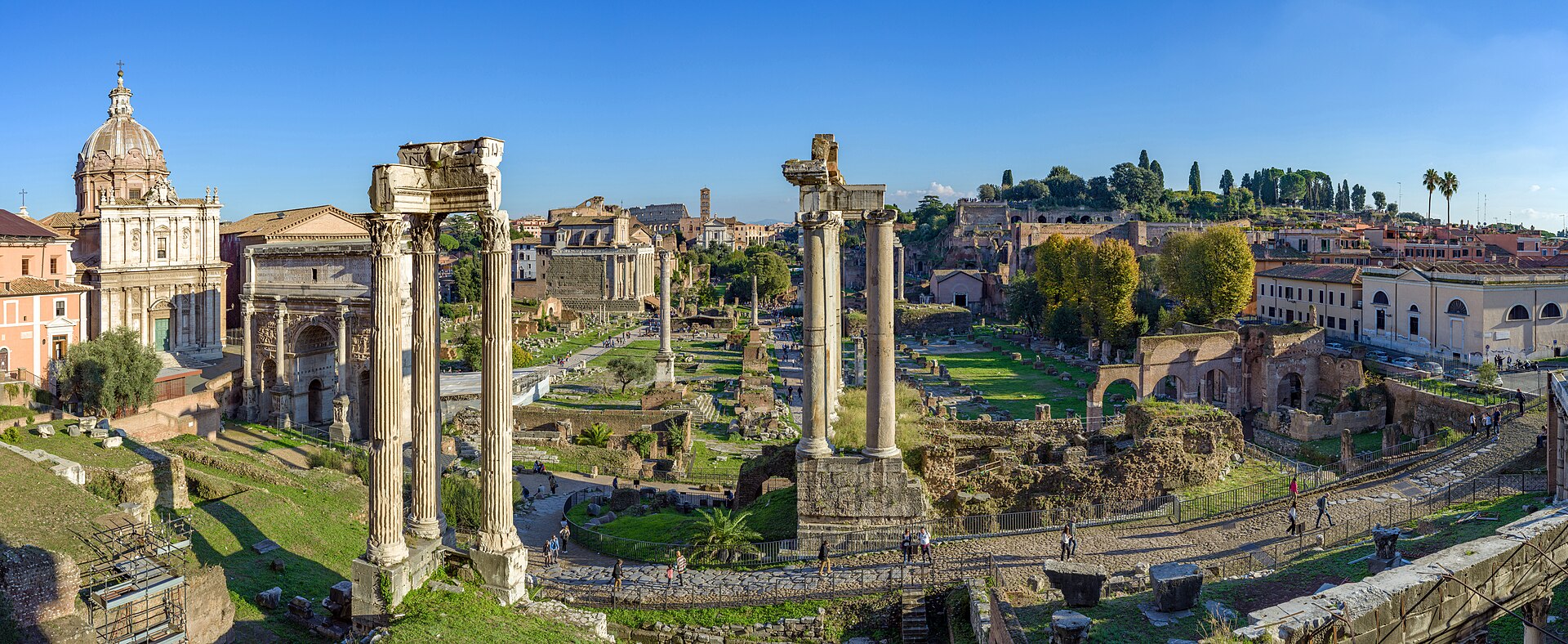
The Roman Forum (Forum Romanum) was the central public space of ancient Rome, functioning as the political, religious, and judicial heart of the city. Located between the Palatine and Capitoline hills, the area evolved from a marshy valley in the early monarchy into a monumental civic complex. Over centuries, temples, basilicas, triumphal arches, and administrative buildings accumulated within the Forum, reflecting shifts in political authority from kings to republic to empire. The surviving ruins preserve the spatial organization of Roman public life and document the architectural language of state power.
Key Facts
- Materials
- Tuff, Travertine, Marble, Concrete
- Dimensions
- Approximately 250m long; 170m wide at widest point
- Civilization
- Roman
- Date(s)
- Developed from 7th century BCE onward
- Condition
- Archaeological ruins integrated within the Parco Archeologico del Colosseo
- Original Function
- Civic, political, religious, and commercial center
- Key Figures
- Romulus, Julius Caesar, Augustus, Septimius Severus
Origins in the Regal Period
7th-6th century BCEOriginally a marshy valley, the area was drained through the construction of the Cloaca Maxima under early Roman kings. The Forum became a central gathering place, housing early religious structures such as the Temple of Vesta and political spaces including the Comitium.
Republican Expansion
509-27 BCEDuring the Republic, the Forum developed into the core of Roman civic life. Basilicas such as the Basilica Aemilia and Basilica Julia were constructed to accommodate legal and commercial activity. Temples commemorated military victories and political authority, while the Curia housed the Senate.
Imperial Monumentalization
27 BCE - 4th century CEUnder Augustus and subsequent emperors, the Forum was reshaped with new temples, arches, and commemorative monuments. The Temple of Divus Julius marked the deification of Caesar. Later additions, including the Arch of Septimius Severus and the Column of Phocas, reflect continued imperial presence even as political focus shifted to purpose-built imperial fora.
Late Antiquity and Decline
5th-8th centuryFollowing the decline of imperial administration in the West, many structures fell into disuse or were repurposed as churches. Earthquakes and material spoliation accelerated deterioration. By the medieval period, the area became known as the 'Campo Vaccino' and was used for grazing livestock.
Archaeological Rediscovery
18th century - presentSystematic excavation began in the 18th and 19th centuries, revealing stratified layers of Roman urban history. Modern conservation addresses structural stabilization and interpretation within the broader archaeological park that includes the Colosseum and Palatine Hill.
Cultural Significance
The Roman Forum was the stage for elections, triumphal processions, public trials, and state rituals. It embodied the integration of religion and governance characteristic of Roman political culture. Monuments within the Forum materialized collective memory, commemorating victories, treaties, and deified leaders. In modern scholarship and public imagination, the Forum represents the institutional foundations of Roman law, republican governance, and imperial authority. Its spatial organization has influenced urban planning and neoclassical architecture across Europe and the Americas.
Interpretive Notes
Scholarly debates and areas of uncertainty
Debate continues regarding the precise locations and phases of the earliest regal-period structures, as archaeological layers are complex and often disturbed by later construction. Interpretations of the Comitium and early Curia remain subject to revision. Scholars also reassess the extent to which the Forum retained practical civic functions during Late Antiquity, questioning whether its decline was gradual transformation rather than abrupt abandonment.
Visiting Information
Entry Rules
Paid admission required. Ticket typically combined with Colosseum and Palatine Hill and valid for 24 hours. Timed entry may apply during peak seasons.
Best Times to Visit
Early morning entry reduces congestion, particularly during high season. Summer midday temperatures are elevated with limited shade. Avoid major Italian national holidays for shorter queues.
Photography
Personal photography permitted. Tripods and commercial filming require authorization from the Parco Archeologico del Colosseo. Drone use prohibited.
Preservation Notes
Stay on designated pathways and do not climb on ruins. Many marble surfaces are heavily weathered. Sections may close periodically for stabilization or excavation.
Nearby POIs
11 shownSources & Further Reading
- [1]The Roman Forum: A Reconstruction and Architectural Guide — Gilbert J. Gorski and James E. Packer. Cambridge University Press (2015)
- [2]Roman Public Architecture — Amanda Claridge. Oxford University Press (1998)
- [3]The Roman Forum — David Watkin. Harvard University Press (2009)
Key Facts
- Materials
- Tuff, Travertine, Marble, Concrete
- Dimensions
- Approximately 250m long; 170m wide at widest point
- Civilization
- Roman
- Date(s)
- Developed from 7th century BCE onward
- Condition
- Archaeological ruins integrated within the Parco Archeologico del Colosseo
- Original Function
- Civic, political, religious, and commercial center
- Key Figures
- Romulus, Julius Caesar, Augustus, Septimius Severus