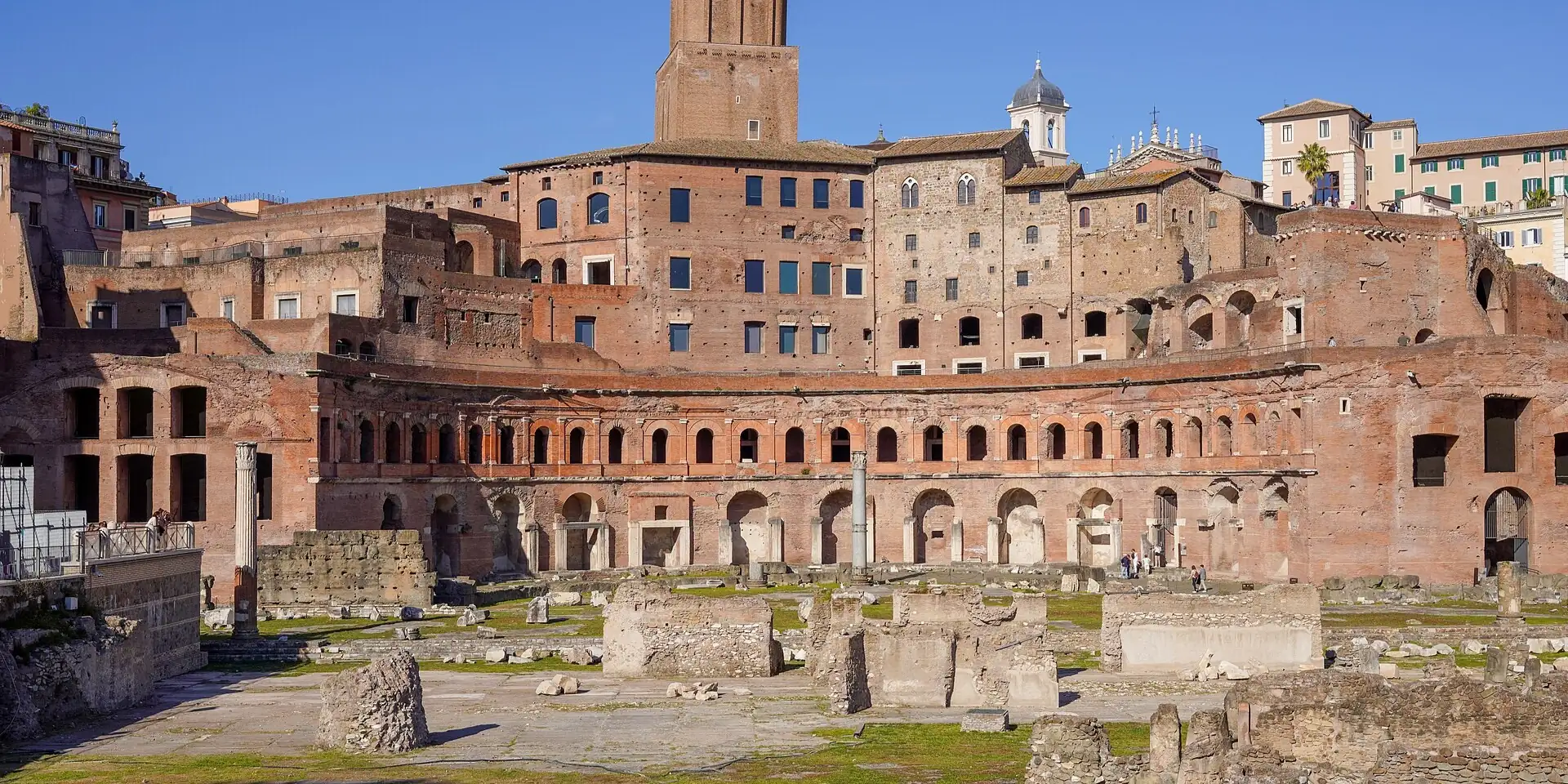
Trajan's Market is a large complex of ruins located on the Via dei Fori Imperiali in Rome, Italy. Often cited as the world's oldest shopping mall, the site consists of a multi-level structure built into the flank of the Quirinal Hill, serving as a sophisticated administrative and commercial hub during the reign of Emperor Trajan.
The complex was designed by Apollodorus of Damascus and completed around 110 CE. It features a series of tabernae (shops) and administrative offices arranged in a semi-circular facade that mirrors the shape of the adjacent Forum of Trajan. The architecture demonstrates advanced Roman engineering, utilizing concrete and brick to create a functional, multi-story urban space that integrated commerce with the imperial administrative apparatus.
Key Facts
- Materials
- Brick, Concrete, Travertine
- Civilization
- Roman
- Accessibility
- Partially accessible; some areas involve uneven terrain and stairs
- Date(s)
- 100-110 CE
- Condition
- Well-preserved ruins, partially converted into a museum
- Original Function
- Commercial and administrative center
- Key Figures
- Emperor Trajan, Apollodorus of Damascus
Construction and Design
100-110 CECommissioned by Emperor Trajan and designed by his architect Apollodorus of Damascus, the market was built to facilitate the expansion of the Roman Forum. The construction required the excavation of a significant portion of the Quirinal Hill, resulting in a complex that integrated seamlessly with the surrounding imperial forums.
Imperial Function
2nd-4th century CEThe complex served as a bustling center for the distribution of food and goods, as well as a hub for imperial administration. The lower levels housed shops, while the upper levels contained offices for officials managing the grain supply and other state-run services.
Medieval Transformation
Middle AgesFollowing the decline of the Roman Empire, the site was repurposed for residential and defensive use. The Torre delle Milizie was constructed atop the ruins in the 13th century, and the site was integrated into a convent, which significantly altered the original layout.
Modern Restoration
20th century - presentExtensive excavations and restoration efforts in the early 20th century removed later medieval additions to reveal the original Roman structure. Today, the site houses the Museum of the Imperial Forums, which displays artifacts recovered from the surrounding archaeological areas.
Cultural Significance
Trajan's Market stands as a testament to the sophistication of Roman urban planning and the integration of commercial and civic life. It represents the pinnacle of Roman architectural ingenuity, showcasing how the state managed the logistical needs of a massive, growing capital city.
In contemporary Rome, the site serves as a vital link between the ancient imperial forums and the modern city. Its role as a museum allows visitors to engage directly with the material culture of the Roman Empire, reinforcing the city's identity as a living repository of classical history.
Interpretive Notes
Scholarly debates and areas of uncertainty
While traditionally referred to as a 'market,' some scholars argue that the term is an oversimplification. Many researchers suggest the complex functioned primarily as an administrative center for the imperial bureaucracy rather than a retail space for the general public, given its proximity to the Forum of Trajan.
Visiting Information
Entry Rules
Open daily. Tickets can be purchased at the entrance or online. Visitors are advised to check official hours as they may vary seasonally. No specific dress code is required, but comfortable walking shoes are recommended due to the uneven ancient surfaces.
Best Times to Visit
Early morning or late afternoon to avoid the heat of the day and peak tourist crowds. Weekdays are generally quieter than weekends.
Photography
Personal photography is permitted without flash or tripods. Professional photography requires prior authorization from the Sovrintendenza Capitolina.
Preservation Notes
Do not climb on or touch the ancient walls. Stay within the designated visitor paths to protect the fragile brickwork and archaeological remains. The site is an active excavation and restoration zone; some areas may be closed periodically.
Nearby POIs
11 shownSources & Further Reading
- [1]
- [2]Trajan's Market: The Architecture of the Imperial Forums — Lucia Ungaro. Electa (2007)
Key Facts
- Materials
- Brick, Concrete, Travertine
- Civilization
- Roman
- Accessibility
- Partially accessible; some areas involve uneven terrain and stairs
- Date(s)
- 100-110 CE
- Condition
- Well-preserved ruins, partially converted into a museum
- Original Function
- Commercial and administrative center
- Key Figures
- Emperor Trajan, Apollodorus of Damascus