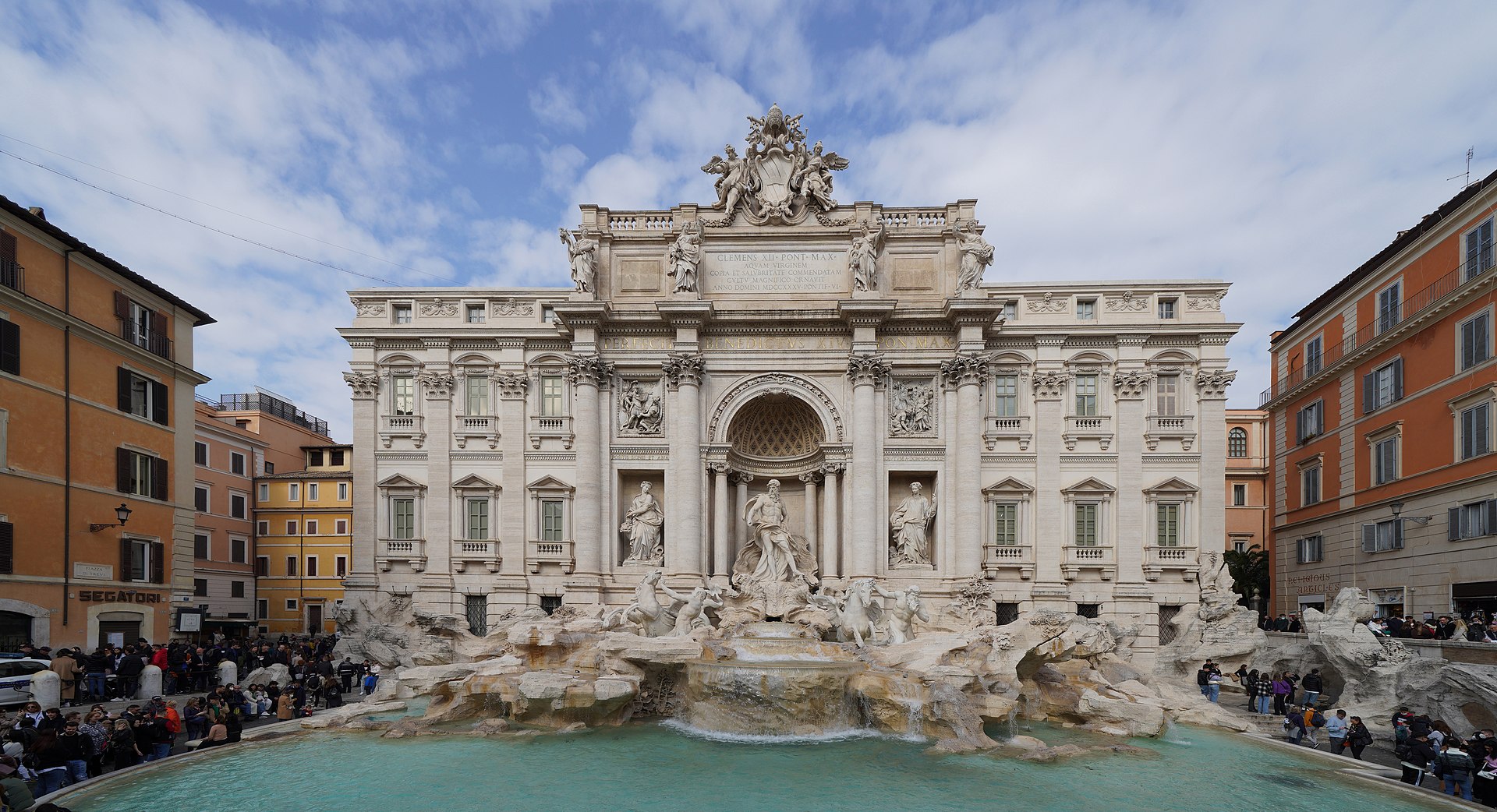
The Fontana di Trevi is an 18th-century monumental fountain located at the terminus of the Aqua Virgo aqueduct in Rome. The current structure was designed by Nicola Salvi and completed in 1762 under Pope Clement XIII. Built against the façade of the Palazzo Poli, the fountain integrates sculpture, architecture, and hydraulic engineering. It marks the ancient aqueduct’s endpoint, continuing a tradition of monumental water displays that began in the Roman Imperial period.
Key Facts
- Materials
- Travertine, Carrara marble
- Civilization
- Papal States
- Date(s)
- 1732-1762 CE
- Condition
- Restored and operational public fountain
- Original Function
- Terminal fountain of the Aqua Virgo aqueduct
- Key Figures
- Nicola Salvi, Giuseppe Pannini, Pope Clement XII
Ancient Aqueduct Origins
19 BCEThe Aqua Virgo aqueduct was constructed under Marcus Agrippa to supply water to Rome. It terminated in the Campus Martius area, where decorative fountains marked its endpoint.
Medieval and Renaissance Predecessors
15th-17th centuriesAs Rome’s water systems were restored during the Renaissance, earlier fountain structures were installed at the aqueduct’s terminus. Pope Urban VIII commissioned preliminary designs, though they were not executed.
Baroque Construction
1732-1762Nicola Salvi won a papal design competition in 1732. The fountain’s central figure of Oceanus is set within a triumphal arch motif, flanked by allegorical statues representing Abundance and Salubrity. Construction continued after Salvi’s death and was completed by Giuseppe Pannini.
Modern Conservation
20th-21st centuryThe fountain has undergone multiple restoration campaigns to address structural stress, pollution damage, and water system maintenance. It remains connected to the restored Aqua Virgo, now known as Acqua Vergine.
Cultural Significance
The Fontana di Trevi represents the continuation of Roman hydraulic tradition through Baroque monumental design. It combines ancient infrastructure with early modern papal patronage, symbolizing Rome’s layered historical identity. The fountain also functions as a civic ritual site, where coin-throwing traditions generate funds used for charitable purposes within the city.
Interpretive Notes
Scholarly debates and areas of uncertainty
Scholars examine the integration of architecture and sculpture in the fountain’s façade, particularly how it transforms a palace wall into a theatrical urban stage set. Debate also surrounds conservation strategies, balancing the fountain’s active hydraulic function with preservation of delicate marble surfaces exposed to pollution and heavy tourism.
Visiting Information
Entry Rules
Free access at all hours. Swimming or entering the fountain basin is prohibited and subject to fines.
Best Times to Visit
Early morning (before 9:00) or late evening for reduced crowd density. Midday visitation is typically congested year-round.
Photography
Personal photography permitted. Tripods and commercial filming require municipal authorization. Drone use prohibited.
Preservation Notes
Do not sit or climb on the sculptural elements. Coins are periodically collected by municipal authorities. The fountain undergoes routine maintenance closures.
Nearby POIs
11 shownSources & Further Reading
- [1]The Trevi Fountain — Marvin Trachtenberg. Art Bulletin
- [2]Rome: An Oxford Archaeological Guide — Amanda Claridge. Oxford University Press (2010)
- [3]The Aqua Virgo and Roman Water Supply — Katherine W. Rinne. Yale University Press (2010)
Key Facts
- Materials
- Travertine, Carrara marble
- Civilization
- Papal States
- Date(s)
- 1732-1762 CE
- Condition
- Restored and operational public fountain
- Original Function
- Terminal fountain of the Aqua Virgo aqueduct
- Key Figures
- Nicola Salvi, Giuseppe Pannini, Pope Clement XII