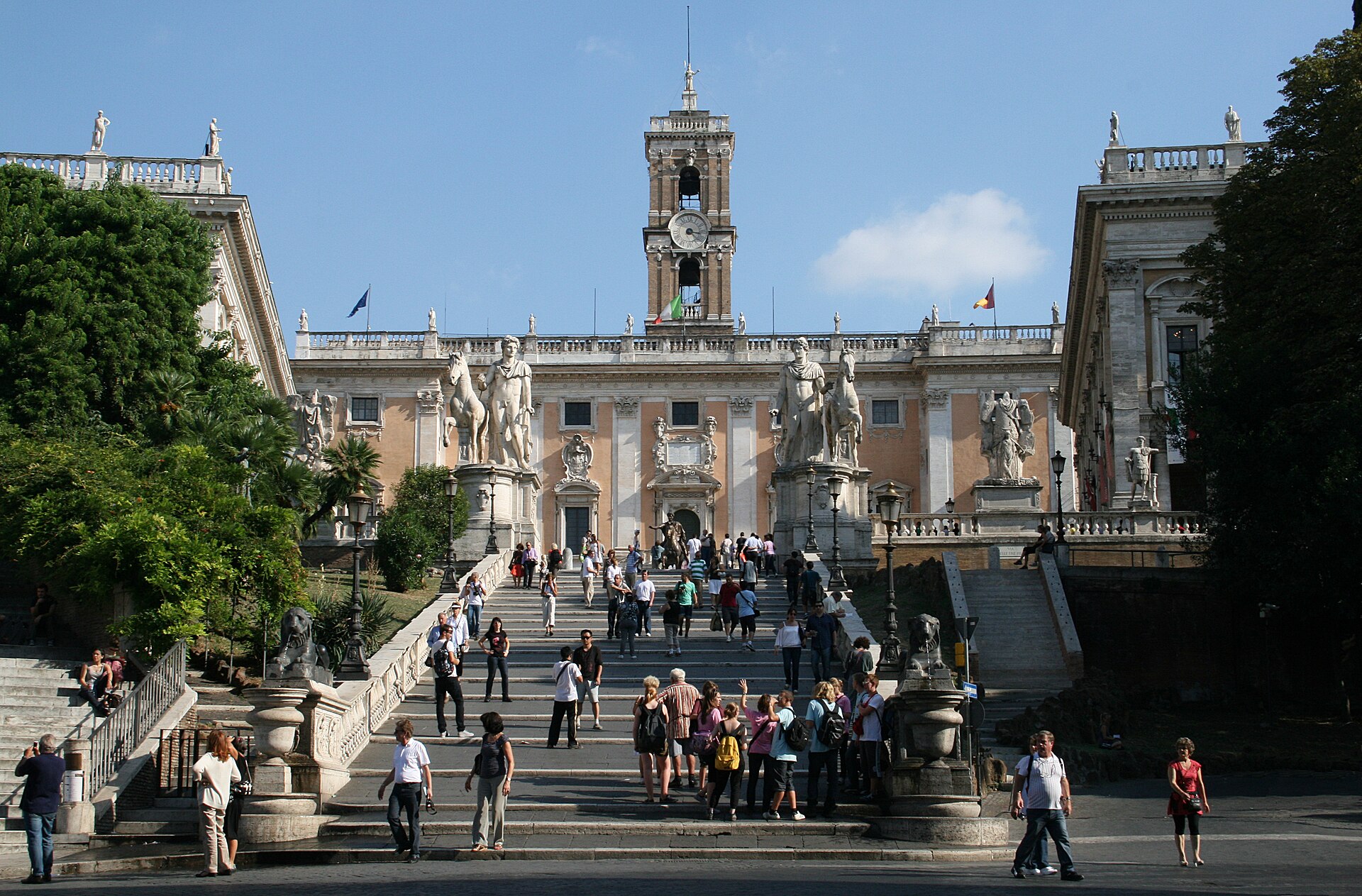
The Capitoline Museums are a group of art and archaeological museums located on the Capitoline Hill in Rome, overlooking the Roman Forum. Established in 1471 when Pope Sixtus IV donated a collection of important ancient bronzes to the people of Rome, the institution is widely considered the oldest public museum in the world.
The museum complex is housed within two main buildings, the Palazzo dei Conservatori and the Palazzo Nuovo, which are connected by an underground gallery. The site is renowned for its extensive collection of Roman statues, inscriptions, and artifacts, including the iconic Capitoline Wolf and the equestrian statue of Marcus Aurelius.
Key Facts
- Materials
- Travertine, Marble, Brick
- Civilization
- Roman
- Accessibility
- Wheelchair accessible via elevator
- Date(s)
- 1471 (Museum foundation); 16th century (Palazzo architecture)
- Condition
- Well-preserved, active museum
- Original Function
- Civic administration and papal art collection
- Key Figures
- Pope Sixtus IV, Michelangelo Buonarroti, Pope Paul III
Foundation and Papal Donation
1471Pope Sixtus IV donated a collection of bronze sculptures, including the Capitoline Wolf, to the city of Rome. This act transformed the Capitoline Hill into a public space for art, marking the birth of the modern museum concept.
Architectural Redesign
16th centuryPope Paul III commissioned Michelangelo to redesign the Piazza del Campidoglio. His plan included the renovation of the Palazzo dei Conservatori and the construction of the Palazzo Nuovo, creating the symmetrical facade seen today.
Expansion and Modernization
18th-20th centuryThe museum continued to grow through the acquisition of private collections and archaeological finds from Rome. In the 20th century, the Galleria Lapidaria was constructed to connect the two palaces beneath the piazza.
Cultural Significance
The Capitoline Museums serve as the primary repository for the history of Rome, bridging the gap between the city's ancient past and its Renaissance revival. The site is central to the identity of Rome, housing artifacts that define the visual history of the Roman Empire.
Beyond its collection, the architecture of the Piazza del Campidoglio, designed by Michelangelo, remains a masterpiece of urban planning. It represents the transition from medieval civic space to the ordered, human-centric design of the Renaissance.
Interpretive Notes
Scholarly debates and areas of uncertainty
The dating of the Capitoline Wolf has been a subject of significant debate. While traditionally attributed to the Etruscan period (5th century BCE), radiocarbon dating conducted in 2008 suggested a medieval origin (11th-12th century CE), sparking intense academic discussion regarding the authenticity of the iconic symbol of Rome.
Visiting Information
Entry Rules
Open daily. Tickets can be purchased online or at the entrance. Security screening is mandatory for all visitors.
Best Times to Visit
Weekday mornings are recommended to avoid weekend crowds. The museum is particularly quiet during the winter months.
Photography
Personal photography is permitted without flash or tripods. Professional photography requires prior authorization.
Preservation Notes
Do not touch the exhibits. Flash photography is strictly prohibited to protect light-sensitive artifacts.
Nearby POIs
11 shownSources & Further Reading
- [1]
- [2]Michelangelo and the Campidoglio — Howard Hibbard. Oxford University Press (1974)
Key Facts
- Materials
- Travertine, Marble, Brick
- Civilization
- Roman
- Accessibility
- Wheelchair accessible via elevator
- Date(s)
- 1471 (Museum foundation); 16th century (Palazzo architecture)
- Condition
- Well-preserved, active museum
- Original Function
- Civic administration and papal art collection
- Key Figures
- Pope Sixtus IV, Michelangelo Buonarroti, Pope Paul III