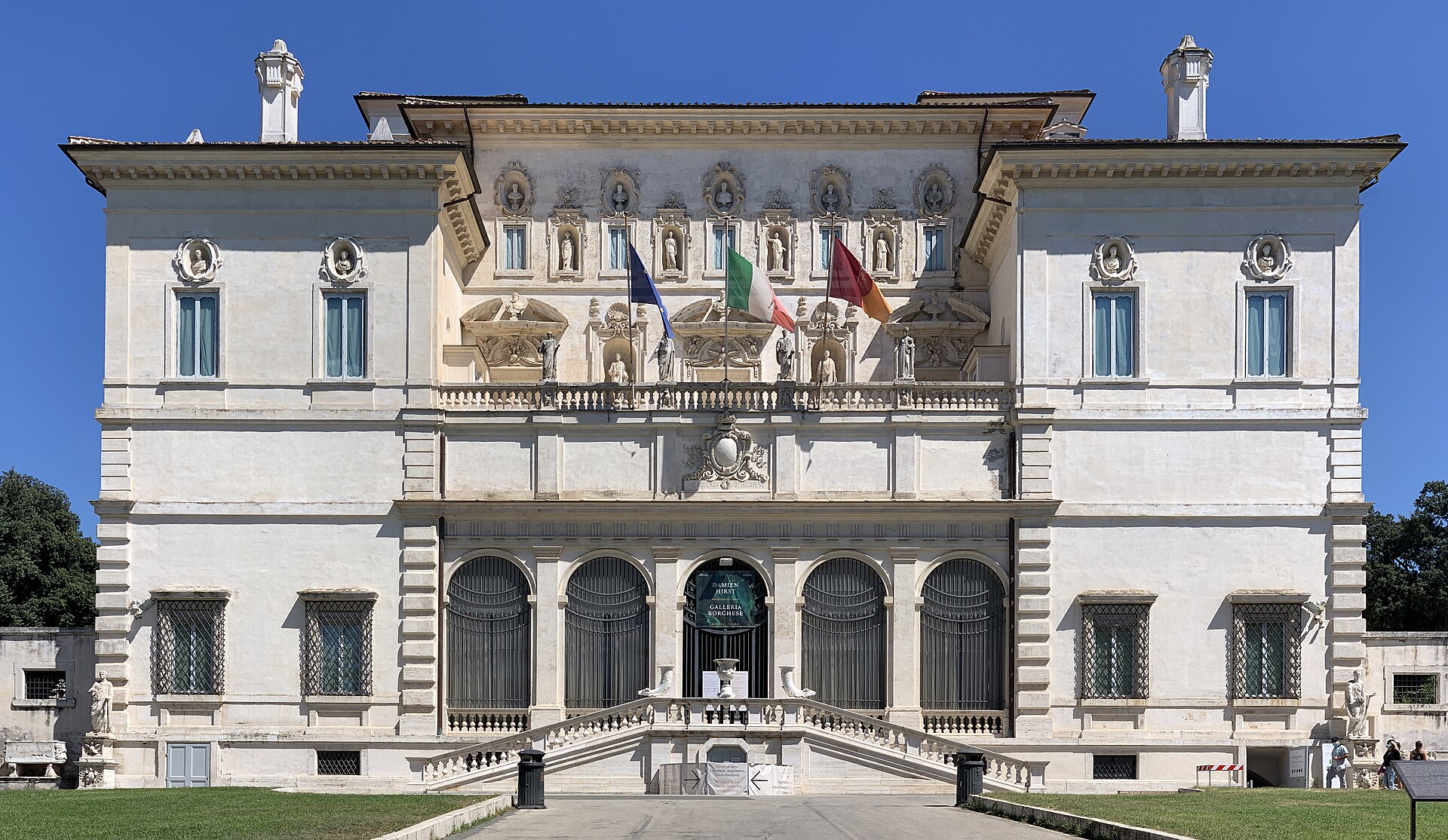
The Galleria Borghese is an art museum housed in the Villa Borghese Pinciana, a suburban villa commissioned by Cardinal Scipione Borghese in the early 17th century. The building was designed to serve as a private gallery for the Cardinal's extensive collection of antiquities, paintings, and sculptures, reflecting his status as one of the most influential patrons of the Baroque era.
The collection is renowned for its significant holdings of works by Gian Lorenzo Bernini, Caravaggio, and Titian. The villa itself is set within the expansive Villa Borghese gardens, and the interior remains a prime example of Roman Baroque decorative art, featuring elaborate frescoes and marble ornamentation that complement the masterpieces on display.
Key Facts
- Materials
- Travertine, Marble, Stucco, Brick
- Civilization
- Italian
- Accessibility
- Wheelchair accessible with elevator access to upper floors
- Date(s)
- 1607-1613
- Condition
- Well-preserved, active museum
- Original Function
- Private art gallery and suburban villa
- Key Figures
- Cardinal Scipione Borghese, Gian Lorenzo Bernini, Flaminio Ponzio
Commission and Construction
1607-1613Cardinal Scipione Borghese commissioned the architect Flaminio Ponzio to build the villa as a 'casino' for his art collection. The structure was intended to showcase his vast array of classical sculptures and contemporary commissions.
The Golden Age of Patronage
17th CenturyDuring this period, the gallery became the center of Roman artistic life. Scipione Borghese acted as the primary patron for Gian Lorenzo Bernini, whose major sculptural works, including 'Apollo and Daphne' and 'The Rape of Proserpina', were created specifically for the villa's rooms.
Acquisition by the State
1902After centuries of private ownership, the villa and its collection were purchased by the Italian State in 1902. This transition ensured the preservation of the collection as a public institution, preventing the dispersal of the works.
Modern Restoration
1990s-PresentA major restoration project was completed in the late 1990s, which cleaned the frescoes and stabilized the structural integrity of the villa. Today, the gallery operates under a strict reservation system to manage visitor flow and preserve the delicate environment.
Cultural Significance
The Galleria Borghese is central to the understanding of Baroque art and the history of collecting. It represents the pinnacle of 17th-century aristocratic patronage, where the architecture, interior design, and art collection were conceived as a unified aesthetic experience. It remains a primary destination for scholars and enthusiasts of Italian art history.
Beyond its artistic value, the villa serves as a symbol of the Borghese family's historical influence in Rome. Its integration into the public park system of Rome highlights the evolution of private aristocratic estates into vital urban green spaces and cultural hubs.
Interpretive Notes
Scholarly debates and areas of uncertainty
Debates often center on the original placement of certain sculptures within the villa, as the interior layout has been modified over the centuries. Scholars also discuss the extent to which Scipione Borghese's acquisition methods—sometimes involving aggressive pressure on artists and collectors—influenced the composition of the collection.
Visiting Information
Entry Rules
Entry is by mandatory reservation only. Tickets must be booked in advance online or by phone. Visitors are admitted in two-hour time slots. Large bags and backpacks must be left in the cloakroom.
Best Times to Visit
Weekday mornings are generally less crowded. The gallery is closed on Mondays.
Photography
Personal photography is permitted without flash or tripods. Professional photography requires prior authorization.
Preservation Notes
Do not touch the sculptures or paintings. Maintain a quiet environment to respect the museum's atmosphere. Flash photography is strictly prohibited to prevent light damage to the artworks.
Nearby POIs
11 shown- Basilica of Santa Maria del Popolo1.3 km
- Palazzo Massimo alle Terme1.5 km
- Fontana di Trevi1.6 km
- Basilica di Santa Maria Maggiore1.9 km
- Galleria Doria Pamphilj2 km
- Basilica di Santa Prassede2.1 km
- Mercati di Traiano2.1 km
- Roman Pantheon2.1 km
- Palazzo Valentini2.1 km
- Museo Nazionale Romano2.1 km
- Museo Napoleonico di Roma2.1 km
Sources & Further Reading
- [1]The Borghese Gallery: The Masterpieces — Anna Coliva. Skira (2007)
- [2]Bernini and the Birth of Baroque Portrait Sculpture — Andrea Bacchi. Officina Libraria (2008)
Key Facts
- Materials
- Travertine, Marble, Stucco, Brick
- Civilization
- Italian
- Accessibility
- Wheelchair accessible with elevator access to upper floors
- Date(s)
- 1607-1613
- Condition
- Well-preserved, active museum
- Original Function
- Private art gallery and suburban villa
- Key Figures
- Cardinal Scipione Borghese, Gian Lorenzo Bernini, Flaminio Ponzio
Nearby POIs
11 shown- Basilica of Santa Maria del Popolo1.3 km
- Palazzo Massimo alle Terme1.5 km
- Fontana di Trevi1.6 km
- Basilica di Santa Maria Maggiore1.9 km
- Galleria Doria Pamphilj2 km
- Basilica di Santa Prassede2.1 km
- Mercati di Traiano2.1 km
- Roman Pantheon2.1 km
- Palazzo Valentini2.1 km
- Museo Nazionale Romano2.1 km
- Museo Napoleonico di Roma2.1 km