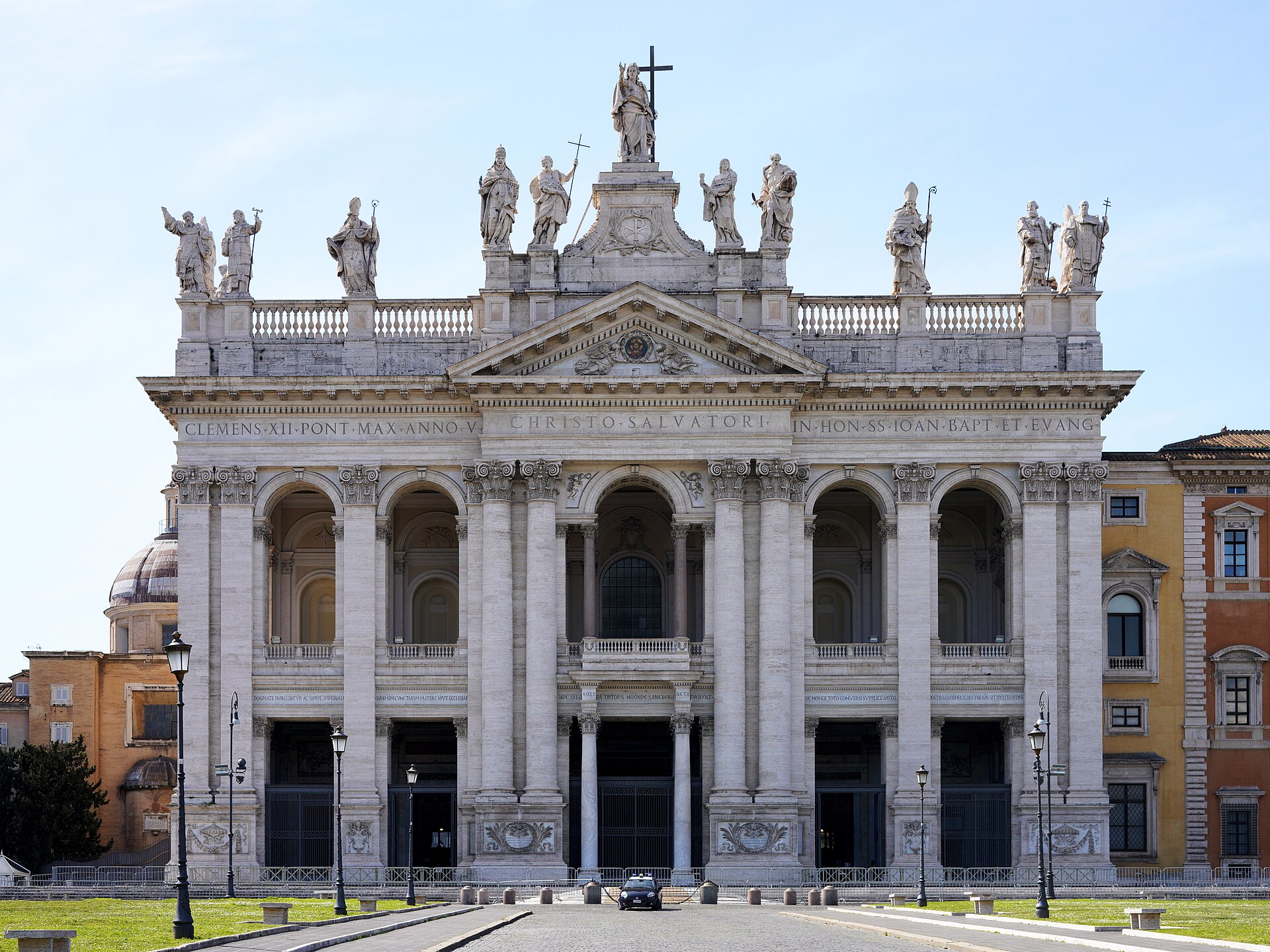
The Archbasilica of Saint John Lateran is the cathedral church of the Diocese of Rome and serves as the official ecclesiastical seat of the Pope. Founded in the 4th century by Emperor Constantine the Great, it holds the unique title of 'archbasilica,' ranking above all other churches in the Roman Catholic Church, including St. Peter's Basilica.
The current structure is a complex architectural layering of history, featuring a massive 18th-century Baroque facade designed by Alessandro Galilei. The interior preserves significant elements from earlier iterations, including a Cosmatesque floor, a 14th-century Gothic baldacchino, and a 16th-century wooden ceiling, reflecting centuries of continuous liturgical use and artistic patronage.
Key Facts
- Materials
- Travertine, Marble, Brick, Gilded wood
- Civilization
- Roman / Papal States
- Accessibility
- Wheelchair accessible via side entrances
- Date(s)
- 313-324 CE
- Condition
- Active, well-preserved
- Original Function
- Cathedral of Rome
- Key Figures
- Emperor Constantine, Pope Sylvester I, Francesco Borromini, Alessandro Galilei
Constantinian Foundation
4th Century CECommissioned by Emperor Constantine the Great on the site of the former barracks of the Equites Singulares Augusti, the original basilica was consecrated by Pope Sylvester I in 324 CE. It served as the primary residence of the Popes for nearly a millennium.
Medieval Reconstruction
10th-14th CenturyThe basilica suffered extensive damage from earthquakes and fires, most notably in 897 and 1308. It was rebuilt multiple times, incorporating the distinctive Cosmatesque marble floor and the Gothic-style tabernacle that houses relics of Saints Peter and Paul.
Baroque Transformation
17th-18th CenturyPope Innocent X commissioned Francesco Borromini to renovate the interior for the 1650 Jubilee. Borromini encased the ancient columns in massive piers, creating the current nave structure. In 1735, the monumental facade by Alessandro Galilei was completed.
Cultural Significance
As the 'Mother and Head of all the churches of the City and the World,' the Archbasilica is central to the identity of the Roman Catholic Church. It represents the transition of Christianity from a persecuted sect to the official religion of the Roman Empire.
Beyond its religious status, the site is a repository of Roman art history, housing works ranging from ancient Roman spolia to High Baroque sculpture. It remains a focal point for papal ceremonies and the historical seat of the Bishop of Rome.
Interpretive Notes
Scholarly debates and areas of uncertainty
The extent of the original Constantinian floor plan remains a subject of archaeological investigation. While the general layout is understood, the exact configuration of the original baptistery and its relationship to the main basilica continue to be refined through ongoing excavations.
Visiting Information
Entry Rules
Open daily. Entry to the basilica is free. Modest dress (shoulders and knees covered) is strictly enforced. Security screening is required at the entrance.
Best Times to Visit
Early morning or late afternoon to avoid large tour groups. Weekday mornings are generally quieter for those wishing to observe the architecture.
Photography
Personal photography is permitted without flash or tripods. Professional photography requires prior authorization from the Vicariate of Rome.
Preservation Notes
The site is an active place of worship; please maintain silence. Do not touch the marble surfaces or historical artifacts. Restoration work is periodic; some areas may be temporarily restricted.
Nearby POIs
11 shownSources & Further Reading
- [1]The Basilica of St. John Lateran to 1600 — L.E. Boyle. Pontifical Institute of Mediaeval Studies (1973)
- [2]Borromini and the Roman Oratory — Joseph Connors. MIT Press (1980)
Key Facts
- Materials
- Travertine, Marble, Brick, Gilded wood
- Civilization
- Roman / Papal States
- Accessibility
- Wheelchair accessible via side entrances
- Date(s)
- 313-324 CE
- Condition
- Active, well-preserved
- Original Function
- Cathedral of Rome
- Key Figures
- Emperor Constantine, Pope Sylvester I, Francesco Borromini, Alessandro Galilei