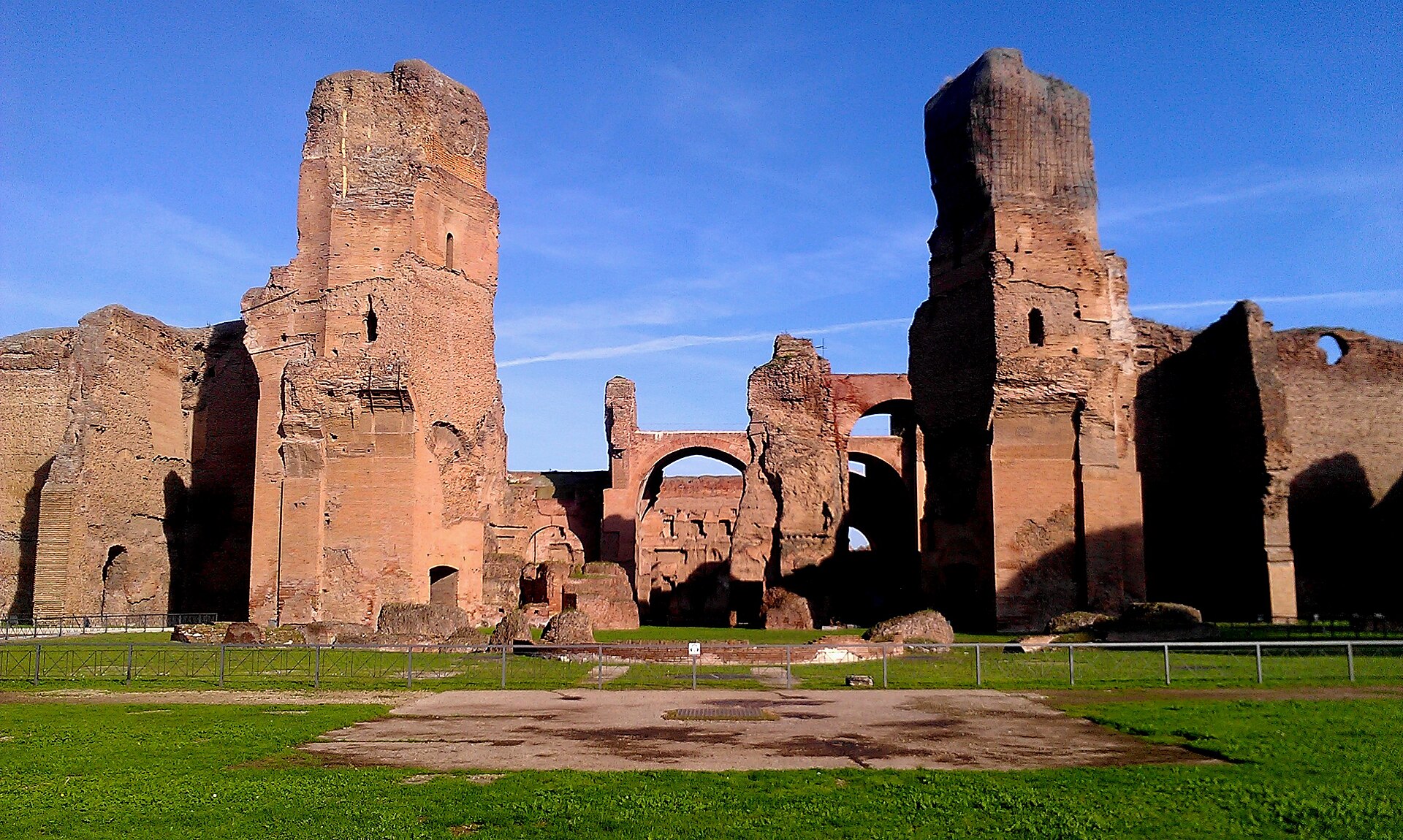
The Baths of Caracalla, or Thermae Antoninianae, were one of the largest and most sophisticated public bathing complexes in ancient Rome. Constructed between 212 and 216 CE under the reign of Emperor Caracalla, the facility served as a social and recreational hub for the city's population, capable of accommodating thousands of bathers simultaneously.
The complex featured an elaborate sequence of hot, warm, and cold rooms, alongside gymnasia, libraries, and gardens. Although the baths ceased operation in the 6th century following the destruction of the aqueducts, the massive brick-faced concrete ruins remain a significant example of Roman engineering and architectural scale, influencing later structures such as the Pennsylvania Station in New York.
Key Facts
- Materials
- Brick, Concrete, Marble, Mosaic tiles
- Civilization
- Roman
- Accessibility
- Partially accessible; some areas feature uneven terrain
- Date(s)
- 212-216 CE
- Condition
- Extensive ruins, partially preserved walls and mosaics
- Original Function
- Public baths and leisure complex
- Key Figures
- Emperor Caracalla, Septimius Severus
Construction and Inauguration
212-216 CECommissioned by Emperor Caracalla, the baths were built on a massive scale on the Aventine Hill. The project required the diversion of a branch of the Aqua Marcia aqueduct to supply the immense volume of water needed for the heating systems and pools.
Operation and Social Use
3rd-5th century CEFor centuries, the baths functioned as a center for Roman social life, offering not only bathing facilities but also exercise grounds, libraries, and art galleries. The interior was lavishly decorated with marble, mosaics, and famous sculptures such as the Farnese Bull.
Decline and Abandonment
6th century CEThe complex fell into disuse during the Gothic War in 537 CE when the Ostrogoths destroyed the aqueducts supplying the city, rendering the baths non-functional. The site was subsequently used as a quarry for building materials.
Excavation and Modern Era
16th century - presentSystematic excavations began in the 16th century, leading to the recovery of major artworks. Today, the site is a protected archaeological park and occasionally hosts open-air opera performances during the summer months.
Cultural Significance
The Baths of Caracalla represent the zenith of Roman public architecture, reflecting the state's commitment to providing leisure and infrastructure to its citizens. The site serves as a testament to the Roman mastery of concrete and vaulted construction, which allowed for the creation of vast, unobstructed interior spaces.
Beyond its historical utility, the site has held a profound influence on Western architecture. Its monumental design served as a direct inspiration for the Beaux-Arts movement, most notably in the design of the original Pennsylvania Station in New York City, bridging the gap between ancient Roman civic planning and modern urban transit hubs.
Interpretive Notes
Scholarly debates and areas of uncertainty
There is ongoing debate regarding the exact layout of the upper floors and the specific function of certain peripheral rooms. While some scholars argue for a strictly utilitarian interpretation of the smaller chambers, others suggest they served as specialized spaces for philosophical discourse or private meetings.
Visiting Information
Entry Rules
Open daily. Tickets are required for entry. Visitors are advised to check the official website for seasonal opening hours, as they vary throughout the year.
Best Times to Visit
Early morning or late afternoon to avoid the heat, as the site is largely exposed to the sun. Spring and autumn offer the most comfortable temperatures for walking the extensive grounds.
Photography
Personal photography is permitted. Professional or commercial photography requires prior authorization from the Soprintendenza Speciale di Roma.
Preservation Notes
Stay on designated paths to protect fragile mosaic floors. Do not climb on or lean against ancient walls. The site is an active archaeological zone; some areas may be closed for maintenance.
Nearby POIs
11 shownSources & Further Reading
- [1]The Baths of Caracalla: A Study in the Design, Construction, and Decoration of Roman Thermae — Janet DeLaine. Journal of Roman Archaeology (1997)View
- [2]Roman Baths and Bathing — Fikret Yegül. University of Pennsylvania Press (1992)
Key Facts
- Materials
- Brick, Concrete, Marble, Mosaic tiles
- Civilization
- Roman
- Accessibility
- Partially accessible; some areas feature uneven terrain
- Date(s)
- 212-216 CE
- Condition
- Extensive ruins, partially preserved walls and mosaics
- Original Function
- Public baths and leisure complex
- Key Figures
- Emperor Caracalla, Septimius Severus