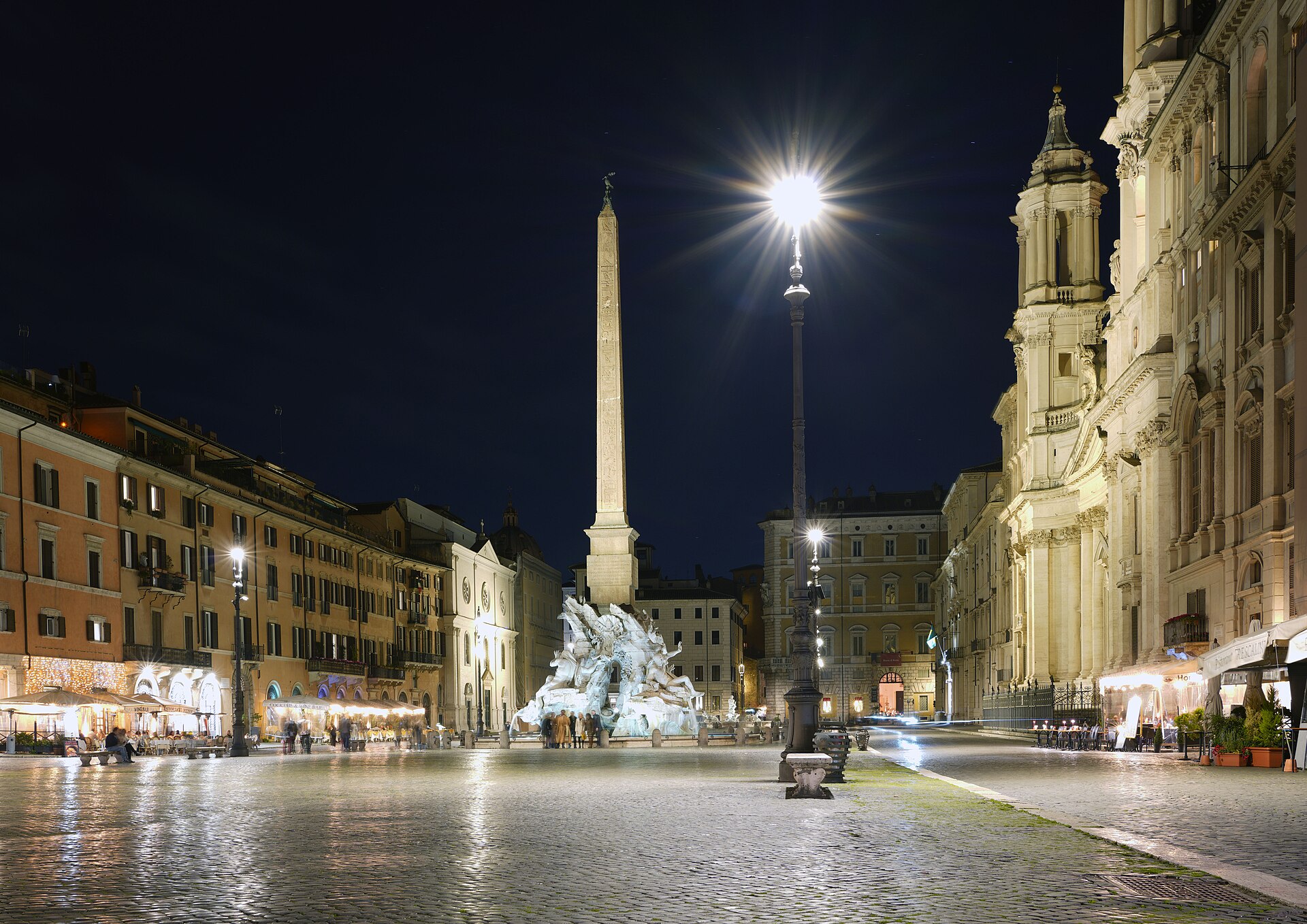
Piazza Navona is a Baroque public square in Rome constructed over the remains of the Stadium of Domitian, built in the 1st century CE. The elongated oval shape of the piazza preserves the footprint of the ancient athletic arena. During the 17th century, the space was transformed into a monumental Baroque ensemble featuring fountains, churches, and palatial façades, most notably Gian Lorenzo Bernini’s Fountain of the Four Rivers and Francesco Borromini’s Church of Sant’Agnese in Agone.
Key Facts
- Materials
- Travertine, Marble, Brick
- Civilization
- Roman Empire; Papal States
- Date(s)
- Stadium of Domitian: c. 86 CE; Baroque redevelopment: 17th century
- Condition
- Active public square preserving ancient stadium footprint
- Original Function
- Athletic stadium (Stadium of Domitian)
- Key Figures
- Emperor Domitian, Pope Innocent X, Gian Lorenzo Bernini, Francesco Borromini
Stadium of Domitian
86 CEEmperor Domitian constructed a permanent masonry stadium for athletic competitions modeled on Greek games. The arena could accommodate approximately 30,000 spectators.
Medieval Transformation
5th-15th centuriesFollowing the decline of the Roman Empire, the stadium fell into disuse. Residential structures gradually filled the seating areas while preserving the oval outline of the original structure.
Baroque Redevelopment
1640s-1670sUnder Pope Innocent X, the piazza was redesigned as a monumental Baroque space. Bernini designed the Fountain of the Four Rivers (1651), while Borromini contributed the façade of Sant’Agnese in Agone.
Modern Public Space
19th century - presentThe piazza functions as a civic and cultural gathering space, hosting markets, festivals, and public events while preserving its layered architectural history.
Cultural Significance
Piazza Navona represents the continuity of urban space in Rome, preserving the footprint of an ancient Roman stadium within a Baroque civic environment. The artistic rivalry between Bernini and Borromini embodied in the piazza’s monuments illustrates the political and aesthetic dynamics of 17th-century Rome.
Interpretive Notes
Scholarly debates and areas of uncertainty
Scholars debate the extent to which Baroque interventions intentionally referenced the ancient stadium versus adapting to existing urban constraints. Archaeological research continues to examine the surviving substructures of the Stadium of Domitian beneath the modern piazza.
Visiting Information
Entry Rules
Open public space accessible at all times. Entry to Sant’Agnese in Agone and underground archaeological areas subject to specific visiting hours and regulations.
Best Times to Visit
Early morning reduces pedestrian congestion. December hosts a seasonal market in the piazza.
Photography
Photography permitted in public areas. Interior photography in churches subject to local regulations.
Preservation Notes
Do not climb on fountains or monuments. Respect barriers protecting sculptural elements and archaeological remains.
Nearby POIs
11 shownSources & Further Reading
- [1]Rome: An Oxford Archaeological Guide — Amanda Claridge. Oxford University Press (2010)
- [2]Bernini: His Life and His Rome — Franco Mormando. University of Chicago Press (2011)
- [3]Borromini and the Roman Oratory — Joseph Connors. MIT Press (1980)
Key Facts
- Materials
- Travertine, Marble, Brick
- Civilization
- Roman Empire; Papal States
- Date(s)
- Stadium of Domitian: c. 86 CE; Baroque redevelopment: 17th century
- Condition
- Active public square preserving ancient stadium footprint
- Original Function
- Athletic stadium (Stadium of Domitian)
- Key Figures
- Emperor Domitian, Pope Innocent X, Gian Lorenzo Bernini, Francesco Borromini