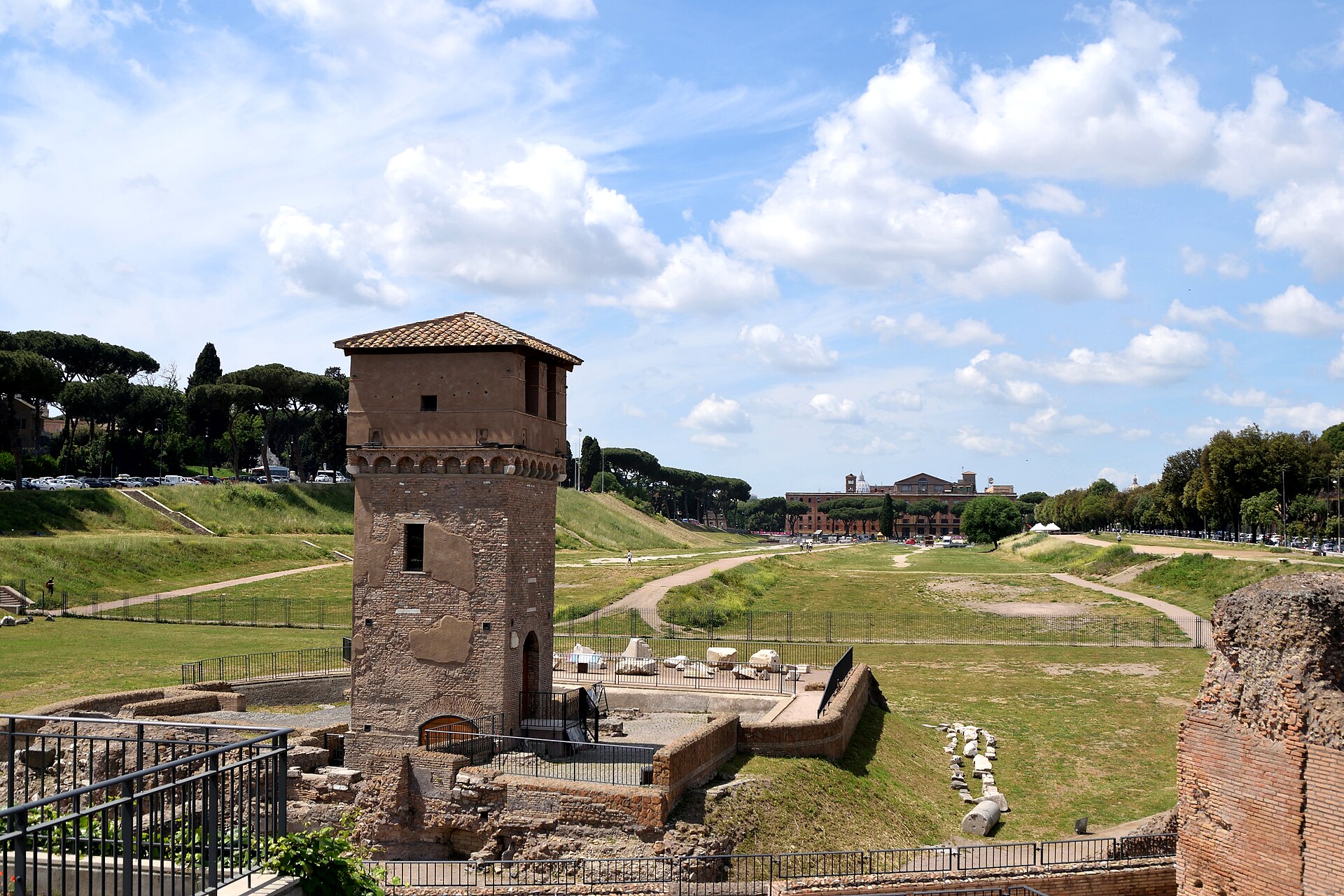
The Circus Maximus was the largest chariot-racing stadium in ancient Rome, situated in the valley between the Aventine and Palatine hills. Measuring approximately 621 meters in length and 118 meters in width, it could accommodate an estimated 150,000 to 250,000 spectators at its peak. It served as the primary venue for the Ludi Romani, the city's most important religious and civic games.
While the site originated as a simple wooden track in the early regal period, it underwent numerous expansions and reconstructions under various emperors, most notably Julius Caesar and Trajan. Today, the site functions as a public park, preserving the elongated footprint of the original track while retaining limited structural remains of the seating tiers and the central spina.
Key Facts
- Materials
- Tufa, Travertine, Concrete, Brick, Marble
- Civilization
- Roman
- Accessibility
- Ground level, mostly flat terrain
- Date(s)
- 6th century BCE - 2nd century CE
- Condition
- Archaeological park with visible track layout and partial ruins
- Original Function
- Chariot racing and public games
- Key Figures
- Tarquinius Priscus, Julius Caesar, Augustus, Trajan
Origins and Early Development
6th century BCEAccording to tradition, the site was first laid out by the Roman king Tarquinius Priscus. Initially, it consisted of a simple track with wooden seating for the plebeians, serving as a venue for horse races and athletic competitions.
Expansion under the Republic
2nd century BCE - 1st century BCEThe stadium was significantly upgraded during the Republican era. Permanent starting gates (carceres) were installed in 329 BCE, and the first stone seating sections were constructed to replace the earlier wooden structures.
Imperial Grandeur
1st century CE - 2nd century CEFollowing a series of fires, the Circus was rebuilt on a massive scale. Augustus added the imperial box, and Trajan oversaw the final major expansion, which utilized concrete and stone to create the monumental structure described by ancient writers.
Decline and Modern Use
6th century CE - presentThe last recorded games were held in 549 CE. During the Middle Ages, the site was used for agriculture and as a cemetery. In the modern era, it has been excavated and integrated into the city's urban landscape as a public park and event space.
Cultural Significance
The Circus Maximus was the heart of Roman public entertainment and a vital tool for political engagement. By providing 'bread and circuses,' the Roman state maintained social order and demonstrated the emperor's generosity to the populace. The scale of the venue reflected the immense power and logistical capability of the Roman Empire.
In contemporary Rome, the site remains a significant cultural landmark. It is frequently used for large-scale public events, concerts, and celebrations, bridging the gap between its ancient role as a communal gathering space and its modern function in the city's social life.
Interpretive Notes
Scholarly debates and areas of uncertainty
The exact seating capacity of the Circus Maximus remains a subject of intense academic debate. While ancient sources like Pliny the Elder suggest figures as high as 250,000, modern archaeological estimates based on the physical dimensions of the seating tiers often propose a more conservative range of 150,000 to 180,000.
Visiting Information
Entry Rules
The site is an open public park and is accessible 24 hours a day. Certain areas of the archaeological excavations may require a ticket for guided access during specific events or maintenance periods.
Best Times to Visit
Early morning or late afternoon to avoid the heat, as the site is an open field with minimal shade. Spring and autumn offer the most comfortable weather for walking the track perimeter.
Photography
Personal photography is permitted. Commercial photography or the use of drones requires prior authorization from the Sovrintendenza Capitolina ai Beni Culturali.
Preservation Notes
Visitors are requested to stay on designated paths and respect the archaeological remains. Do not climb on the ruins or remove any stones from the site.
Nearby POIs
11 shownKey Facts
- Materials
- Tufa, Travertine, Concrete, Brick, Marble
- Civilization
- Roman
- Accessibility
- Ground level, mostly flat terrain
- Date(s)
- 6th century BCE - 2nd century CE
- Condition
- Archaeological park with visible track layout and partial ruins
- Original Function
- Chariot racing and public games
- Key Figures
- Tarquinius Priscus, Julius Caesar, Augustus, Trajan