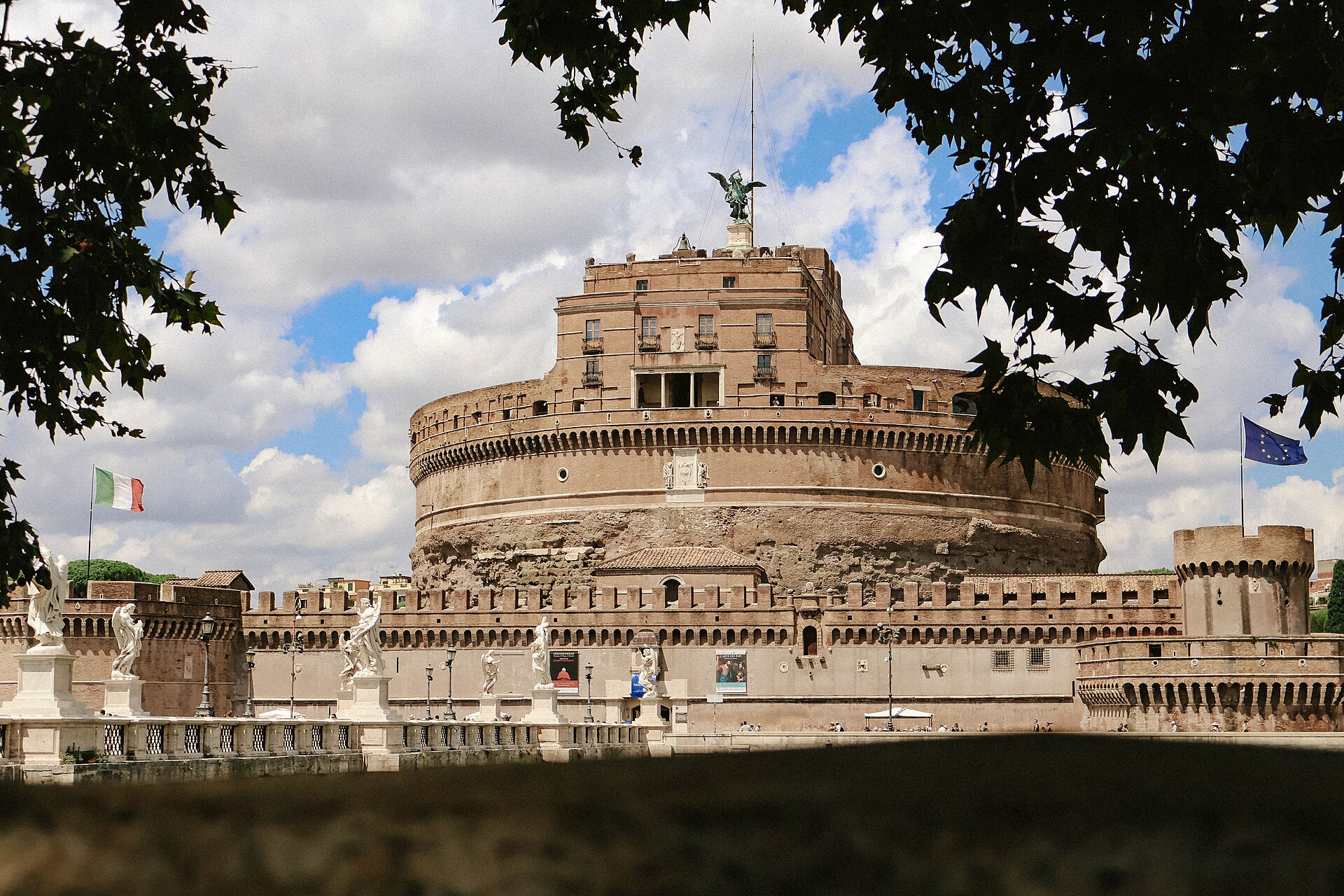
Castel Sant'Angelo, originally commissioned by the Roman Emperor Hadrian as a mausoleum for himself and his family, is a towering cylindrical structure located on the right bank of the Tiber River in Rome. Completed in 139 CE, the building served as a tomb before being converted into a fortress and castle by the popes in the 14th century.
Throughout its history, the site has functioned as a prison, a papal residence, and a strategic military stronghold. Today, it operates as the Museo Nazionale di Castel Sant'Angelo, housing a vast collection of art, weaponry, and historical artifacts that reflect its multifaceted role in Roman history.
Key Facts
- Materials
- Travertine, Tuff, Brick, Marble
- Civilization
- Roman
- Accessibility
- Partially accessible; some areas involve stairs
- Date(s)
- 135-139 CE
- Condition
- Well-preserved museum
- Original Function
- Mausoleum
- Key Figures
- Emperor Hadrian, Pope Clement VII, Gian Lorenzo Bernini
Hadrian's Mausoleum
135-139 CECommissioned by Emperor Hadrian as a monumental tomb for himself and his successors, the structure was modeled after the Mausoleum of Augustus. It originally featured a large garden-topped tumulus and a bronze chariot driven by Hadrian.
Military Conversion
5th-14th centuryFollowing the fall of the Western Roman Empire, the tomb was integrated into the Aurelian Walls. Its strategic position made it a vital defensive fortification for the city, eventually coming under the control of the Papacy.
Papal Fortress
14th-16th centuryPopes transformed the structure into a fortified residence, adding the Passetto di Borgo—a secret elevated corridor connecting the castle to the Vatican. It served as a refuge for popes during times of siege, most notably for Clement VII during the Sack of Rome in 1527.
Museum and Modern Era
1901-presentAfter serving as a military prison for centuries, the site was decommissioned and underwent extensive restoration. It was opened to the public as a national museum in 1901, showcasing its architectural evolution and historical significance.
Cultural Significance
Castel Sant'Angelo is a symbol of the transition from Roman imperial power to the temporal authority of the Papacy. Its silhouette, dominated by the statue of the Archangel Michael, is an iconic element of the Roman skyline and represents the city's layered history of defense and faith.
The site is deeply embedded in the cultural memory of Rome, appearing in numerous literary works and operas, most famously in the final act of Puccini's 'Tosca', where the protagonist leaps from the castle's ramparts.
Interpretive Notes
Scholarly debates and areas of uncertainty
The exact original appearance of the mausoleum's upper level remains a subject of academic debate. While historical descriptions suggest a tumulus with trees and a chariot, archaeological evidence is insufficient to confirm the precise configuration of the decorative elements.
Visiting Information
Entry Rules
Open daily. Tickets are required for entry and can be purchased online or at the box office. Visitors must pass through security screening. Modest dress is recommended.
Best Times to Visit
Early morning or late afternoon to avoid peak tourist crowds and the intense heat of the Roman summer. The ramparts offer excellent views of the city during sunset.
Photography
Personal photography is permitted without flash or tripods. Commercial photography requires prior authorization from the museum administration.
Preservation Notes
The site is a protected historical monument. Visitors are requested to stay on marked paths and refrain from touching the ancient masonry or historical exhibits.
Nearby POIs
11 shownSources & Further Reading
- [1]Hadrian's Mausoleum: The History of Castel Sant'Angelo — Maria Grazia Tolomeo. Electa (2005)
- [2]The Architecture of the Roman Mausoleum — Fred S. Kleiner. Oxford University Press (2010)
Key Facts
- Materials
- Travertine, Tuff, Brick, Marble
- Civilization
- Roman
- Accessibility
- Partially accessible; some areas involve stairs
- Date(s)
- 135-139 CE
- Condition
- Well-preserved museum
- Original Function
- Mausoleum
- Key Figures
- Emperor Hadrian, Pope Clement VII, Gian Lorenzo Bernini