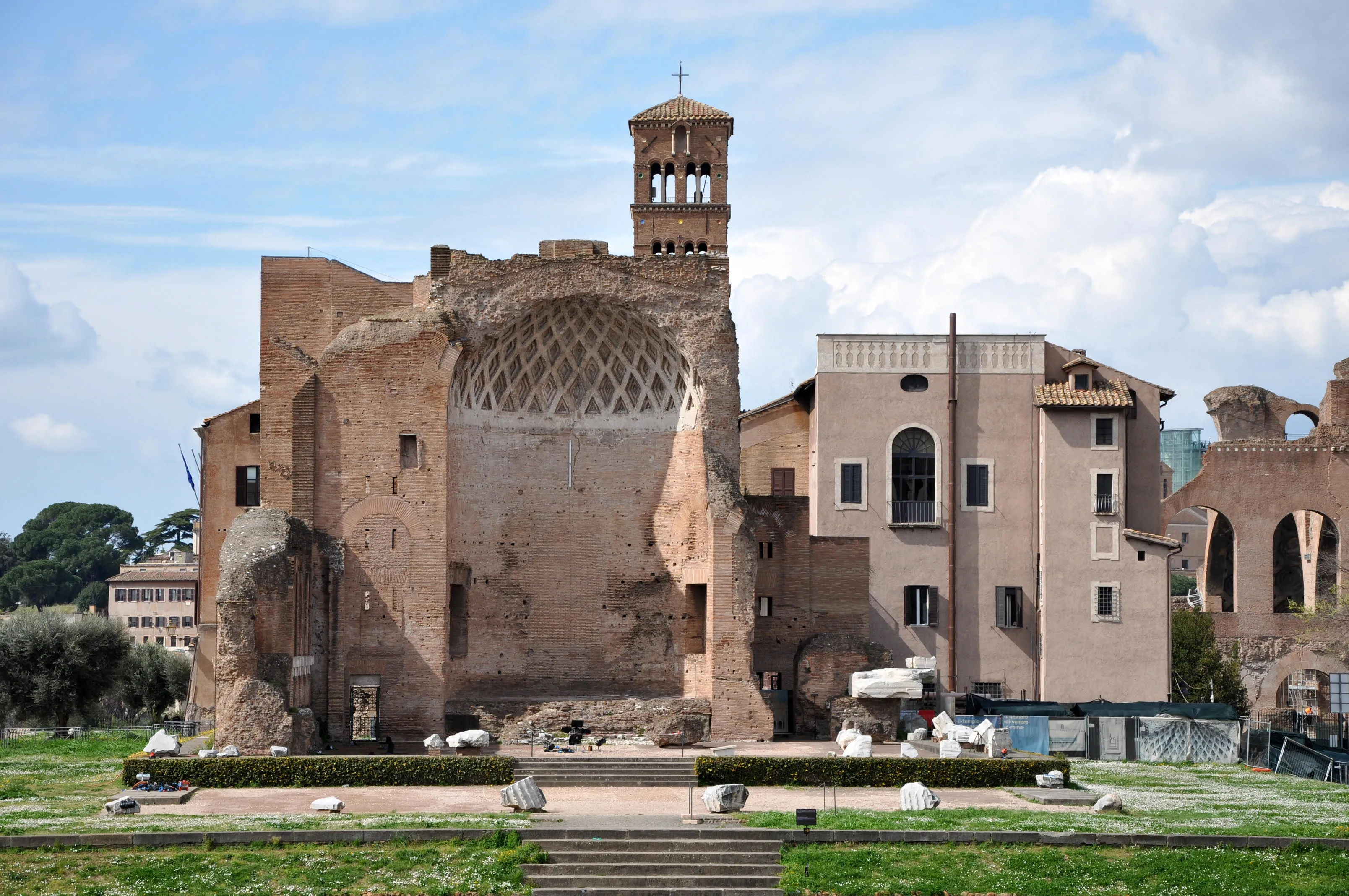
The Domus Aurea, or 'Golden House,' was an expansive villa complex built by Emperor Nero in the heart of Rome following the Great Fire of 64 CE. Designed to showcase the emperor's immense wealth and power, the palace featured lavishly decorated rooms, vaulted ceilings, and an innovative octagonal hall that utilized concrete in unprecedented ways. The grounds included an artificial lake, sprawling gardens, and a colossal bronze statue of Nero, the Colossus Neronis.
Following Nero's death in 68 CE, the complex was largely dismantled, buried, or repurposed by subsequent Flavian emperors to distance themselves from his legacy. The site was eventually built over by the Baths of Trajan, which inadvertently preserved the subterranean remains of the palace. Rediscovered during the Renaissance, the site's wall paintings—known as 'grotesques'—profoundly influenced the art of Raphael and his contemporaries.
Key Facts
- Materials
- Concrete, Brick, Marble, Gold leaf, Stucco
- Civilization
- Roman
- Accessibility
- Guided tours only, requires advance booking
- Date(s)
- 64-68 CE
- Condition
- Subterranean ruins undergoing active conservation
- Original Function
- Imperial residence and pleasure palace
- Key Figures
- Nero, Severus, Celer, Trajan
Construction and Design
64-68 CECommissioned by Nero after the Great Fire, the palace was designed by the architects Severus and Celer. It was intended to be a 'golden' city-within-a-city, integrating nature and architecture through innovative use of light and space.
Damnatio Memoriae and Burial
68-104 CEAfter Nero's suicide, the Flavian dynasty sought to erase his memory. The palace was stripped of its treasures, the lake was drained to build the Colosseum, and the remaining structures were filled with rubble to serve as foundations for the Baths of Trajan.
Renaissance Rediscovery
15th centuryArtists like Raphael and Michelangelo were lowered into the ruins, which they believed to be caves or 'grottoes.' The intricate wall paintings they discovered there became the primary inspiration for the 'grotesque' style of Renaissance decoration.
Modern Conservation
20th century - presentThe site has faced significant structural challenges due to water infiltration and the weight of the park above. Extensive restoration efforts, including the use of high-tech monitoring and drainage systems, are ongoing to stabilize the fragile frescoes.
Cultural Significance
The Domus Aurea represents the pinnacle of Roman architectural ambition and the excesses of the Julio-Claudian dynasty. Its design, particularly the octagonal room, marked a transition toward the complex vaulted architecture that would define later Roman imperial monuments.
Culturally, the site serves as a bridge between antiquity and the Renaissance. The accidental discovery of its frescoes fundamentally altered the trajectory of Western decorative arts, establishing the 'grotesque' as a standard motif in European interior design for centuries.
Interpretive Notes
Scholarly debates and areas of uncertainty
The extent of Nero's personal involvement in the design remains a subject of debate, with some scholars arguing the architects Severus and Celer were the true innovators. Additionally, the original layout of the entire 80-hectare complex is still being reconstructed by archaeologists, as much of it remains buried beneath modern Rome.
Visiting Information
Entry Rules
Access is strictly limited to guided tours booked in advance. Visitors must wear protective helmets provided by the site due to ongoing restoration work. The site is closed on certain weekdays; check the official website for current availability.
Best Times to Visit
Weekday mornings are recommended to avoid weekend crowds and ensure availability for the limited-capacity guided tours.
Photography
Personal photography is permitted without flash. Tripods and professional equipment require prior authorization.
Preservation Notes
The site is extremely fragile. Visitors must remain with the guide at all times and avoid touching the walls or ceiling surfaces. The environment is cool and damp; appropriate clothing is advised.
Nearby POIs
11 shownSources & Further Reading
- [1]The Golden House of Nero — Axel Boëthius. University of Michigan Press (1960)
- [2]Nero's Domus Aurea: The Architecture of the Golden House — Larry F. Ball. Cambridge University Press (2003)
Key Facts
- Materials
- Concrete, Brick, Marble, Gold leaf, Stucco
- Civilization
- Roman
- Accessibility
- Guided tours only, requires advance booking
- Date(s)
- 64-68 CE
- Condition
- Subterranean ruins undergoing active conservation
- Original Function
- Imperial residence and pleasure palace
- Key Figures
- Nero, Severus, Celer, Trajan