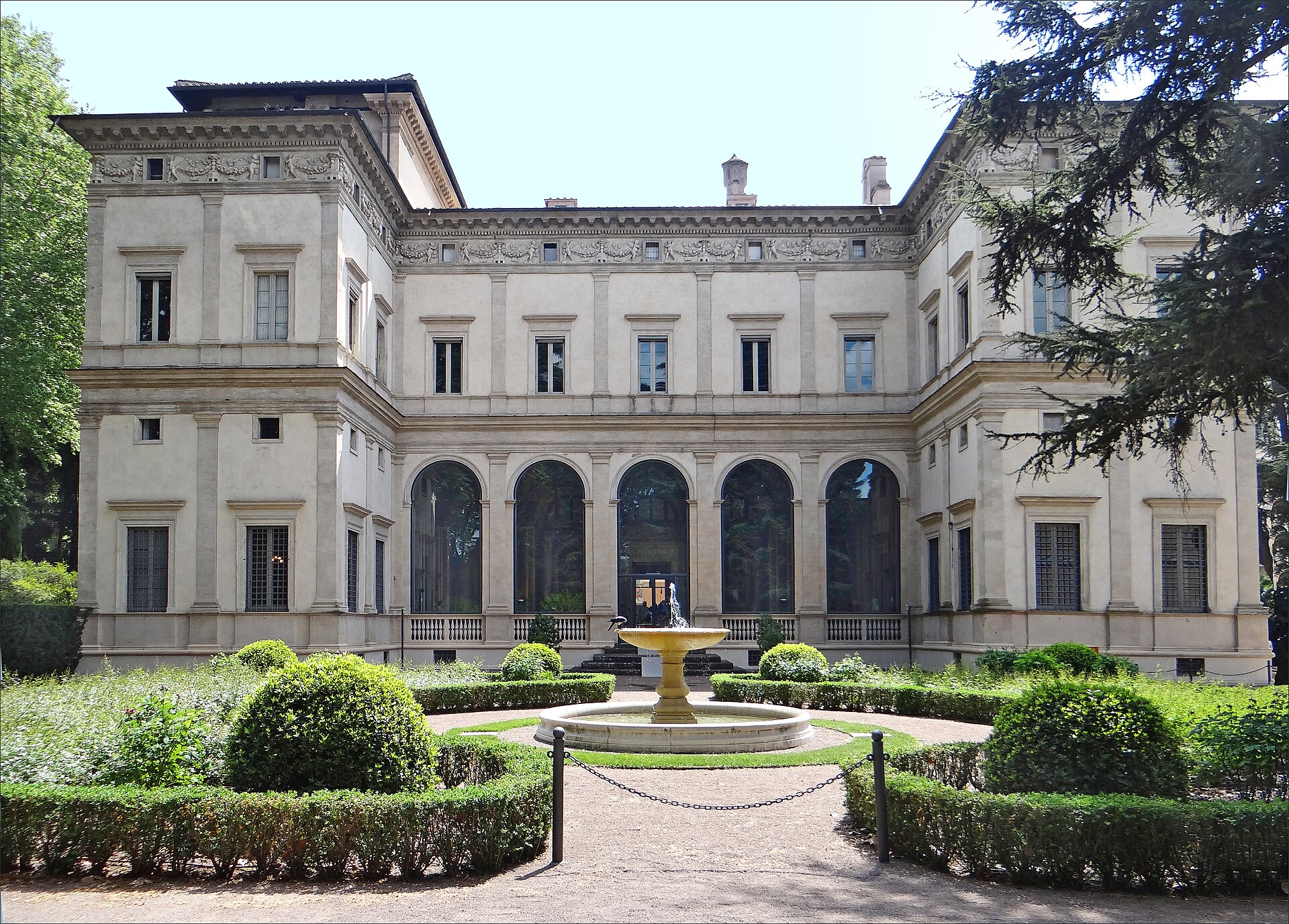
Villa Farnesina is a suburban villa located in the Trastevere district of Rome, commissioned by the Sienese banker Agostino Chigi and constructed between 1506 and 1510. Designed by the architect Baldassarre Peruzzi, the building serves as a quintessential example of High Renaissance architecture, emphasizing symmetry, proportion, and a harmonious integration with its surrounding gardens.
The villa is primarily celebrated for its interior decoration, which features extensive fresco cycles by masters including Raphael, Sebastiano del Piombo, and Giovanni Antonio Bazzi (Il Sodoma). These works, particularly Raphael's 'Loggia of Cupid and Psyche' and 'The Triumph of Galatea', represent the pinnacle of Renaissance decorative art and remain in their original architectural context.
Key Facts
- Materials
- Brick, Stucco, Travertine
- Civilization
- Italian Renaissance
- Accessibility
- Ground floor accessible, upper floors restricted
- Date(s)
- 1506-1510
- Condition
- Well-preserved, serves as a museum and seat of the Accademia dei Lincei
- Original Function
- Suburban pleasure villa
- Key Figures
- Agostino Chigi, Baldassarre Peruzzi, Raphael, Pope Leo X
Commission and Construction
1506-1510Agostino Chigi, a wealthy banker and patron of the arts, commissioned Baldassarre Peruzzi to design a suburban villa that would reflect his status and provide a venue for lavish social gatherings. The structure was built on the banks of the Tiber River, designed to bridge the gap between urban living and rural leisure.
Artistic Decoration
1510-1520The interior was decorated by the most prominent artists of the era. Raphael and his workshop were responsible for the iconic frescoes in the Loggia of Galatea and the Loggia of Cupid and Psyche, which utilized classical mythology to celebrate the patron's life and marriage.
Acquisition by the Farnese
1577The villa was purchased by Cardinal Alessandro Farnese in 1577, from whom it derives its current name. The property remained in the Farnese family for generations, during which time it was maintained as a private residence and art collection.
Modern Institutional Use
20th century - presentIn the early 20th century, the villa was acquired by the Italian state. It now serves as the headquarters for the Accademia dei Lincei, one of the oldest scientific academies in the world, and is open to the public as a museum.
Cultural Significance
Villa Farnesina stands as a testament to the intersection of banking wealth and artistic patronage during the Roman High Renaissance. It represents a shift in architectural design where the villa was no longer merely a defensive structure or a farm, but a sophisticated stage for humanistic discourse and social display.
Its preservation of original fresco cycles in situ provides scholars and visitors with a rare, immersive experience of Renaissance interior design. The villa remains a focal point for the study of Raphael's secular works and the influence of classical antiquity on 16th-century Italian aesthetics.
Interpretive Notes
Scholarly debates and areas of uncertainty
There is ongoing scholarly discussion regarding the extent of Raphael's personal involvement versus that of his workshop in the execution of the 'Loggia of Cupid and Psyche'. While the designs are attributed to Raphael, the degree of execution by his assistants, such as Giulio Romano and Giovanni Francesco Penni, continues to be analyzed through stylistic comparisons.
Visiting Information
Entry Rules
Open Monday to Saturday. Tickets can be purchased at the entrance or online. Guided tours are available for groups. Visitors are expected to maintain a quiet demeanor as the building also functions as an academic institution.
Best Times to Visit
Weekday mornings are generally quieter. The villa is particularly pleasant in the spring when the surrounding gardens are in bloom.
Photography
Personal photography is permitted without flash or tripods. Professional photography requires prior authorization from the Accademia dei Lincei.
Preservation Notes
The frescoes are highly sensitive to environmental changes. Visitors must refrain from touching the walls or using flash photography, which can accelerate pigment degradation.
Nearby POIs
11 shownSources & Further Reading
- [1]Raphael's Farnesina: A Study in the High Renaissance — Charles L. Stinger. Journal of the Warburg and Courtauld Institutes (1998)
- [2]The Villa Farnesina in Rome — Christoph L. Frommel. Accademia Nazionale dei Lincei (2003)
Key Facts
- Materials
- Brick, Stucco, Travertine
- Civilization
- Italian Renaissance
- Accessibility
- Ground floor accessible, upper floors restricted
- Date(s)
- 1506-1510
- Condition
- Well-preserved, serves as a museum and seat of the Accademia dei Lincei
- Original Function
- Suburban pleasure villa
- Key Figures
- Agostino Chigi, Baldassarre Peruzzi, Raphael, Pope Leo X