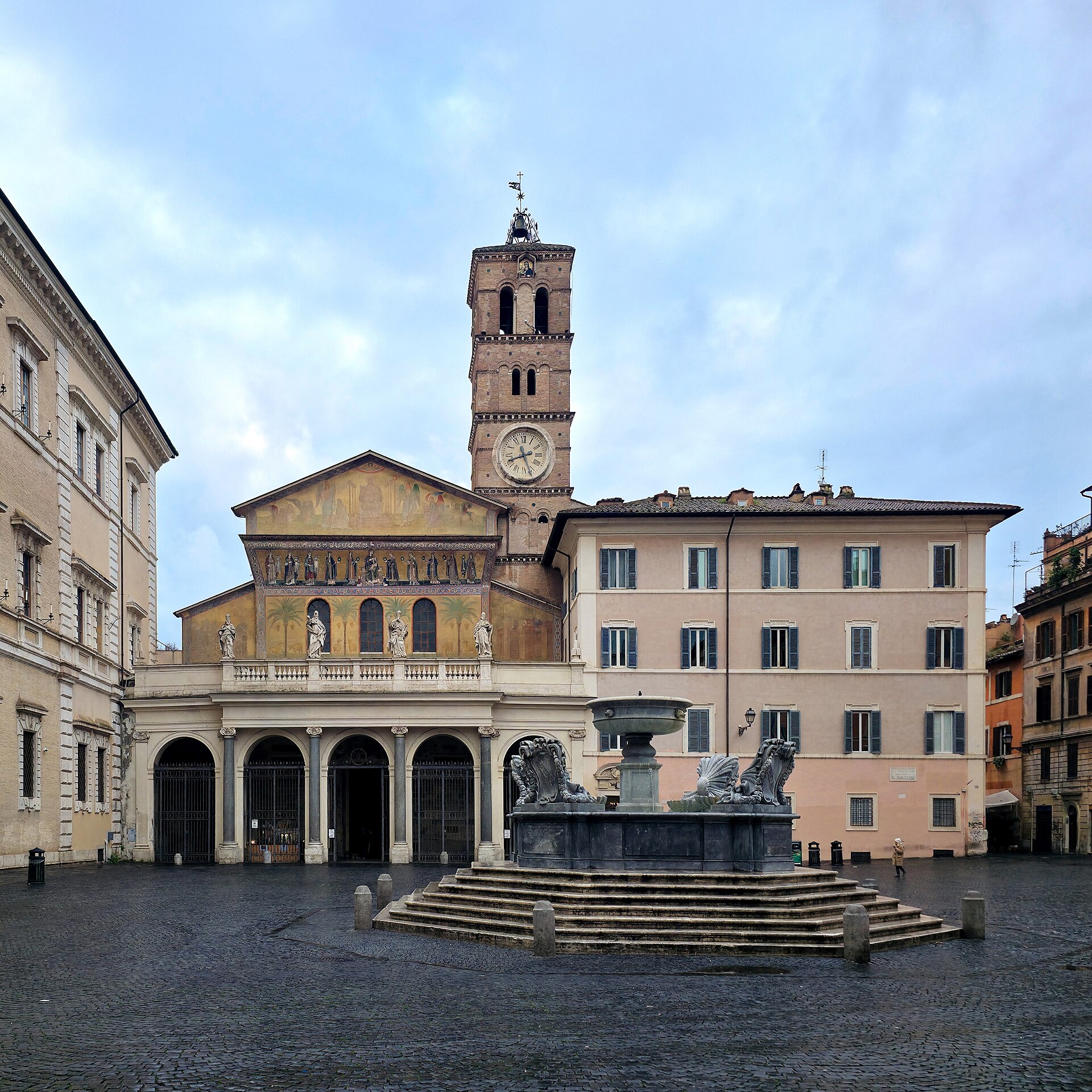
The Basilica di Santa Maria in Trastevere is one of the oldest churches in Rome, traditionally founded in the 3rd century by Pope Callixtus I on the site of the Taberna Meritoria. While the current structure largely dates to the 12th-century reconstruction under Pope Innocent II, it incorporates ancient materials and architectural elements from earlier iterations of the site.
The interior is renowned for its 12th-century mosaics by Pietro Cavallini, which depict the life of the Virgin Mary, and the stunning golden apse mosaic. The basilica serves as a titular church and remains an active place of worship, preserving a significant collection of medieval art and Roman spolia within its nave.
Key Facts
- Materials
- Marble, Brick, Mosaic tesserae, Granite columns
- Civilization
- Roman / Medieval
- Accessibility
- Ground level access, limited interior mobility
- Date(s)
- 3rd century (original), 1140-1143 (current structure)
- Condition
- Active basilica, well-preserved
- Original Function
- Titular Church
- Key Figures
- Pope Callixtus I, Pope Innocent II, Pietro Cavallini
Early Foundations
3rd CenturyTradition holds that the site was established as a house church by Pope Callixtus I. It is considered one of the first places of public Christian worship in Rome, built over the site of a legendary miraculous fountain of oil.
Medieval Reconstruction
12th CenturyPope Innocent II commissioned the complete rebuilding of the basilica between 1140 and 1143. This project defined the current floor plan and utilized granite columns salvaged from the Baths of Caracalla.
Artistic Flourish
13th CenturyThe interior was significantly enhanced by the addition of mosaics by Pietro Cavallini, which represent a pivotal shift toward naturalism in Roman medieval art, moving away from rigid Byzantine stylization.
Baroque Additions
18th CenturyThe facade and portico underwent modifications, including the addition of the current portico roof and various interior decorative elements that reflect the aesthetic preferences of the Baroque era.
Cultural Significance
The basilica is a cornerstone of the Trastevere neighborhood's identity, serving as a focal point for local religious and social life for over a millennium. It represents the continuity of Roman history, where ancient pagan materials were repurposed to serve the evolving needs of the Christian Church.
Its artistic legacy, particularly the transition from Byzantine influence to the proto-Renaissance style of Cavallini, makes it a critical site for the study of Western art history and the development of mosaic techniques in Italy.
Interpretive Notes
Scholarly debates and areas of uncertainty
There is ongoing academic discussion regarding the exact location and nature of the original 3rd-century 'titulus' (house church). While the current site is accepted as the traditional location, archaeological evidence for the earliest structural phases remains fragmented and subject to interpretation.
Visiting Information
Entry Rules
Open daily to the public. Entry is free. Visitors are expected to maintain silence and dress modestly, covering shoulders and knees, as it is an active place of worship.
Best Times to Visit
Early morning or late afternoon to avoid the peak tourist crowds of the Trastevere district. Weekday mornings are generally quieter for viewing the mosaics.
Photography
Personal photography is permitted without flash or tripods. Professional photography requires prior authorization from the parish office.
Preservation Notes
The mosaics are highly sensitive to light and environmental changes. Please refrain from touching any surfaces or using flash, as it contributes to the degradation of the pigments and tesserae.
Nearby POIs
11 shownSources & Further Reading
- [1]The Mosaics of the Basilica of Santa Maria in Trastevere — Dale Kinney. Journal of the Warburg and Courtauld Institutes (1983)View
- [2]Rome: An Oxford Archaeological Guide — Amanda Claridge. Oxford University Press (2010)
Key Facts
- Materials
- Marble, Brick, Mosaic tesserae, Granite columns
- Civilization
- Roman / Medieval
- Accessibility
- Ground level access, limited interior mobility
- Date(s)
- 3rd century (original), 1140-1143 (current structure)
- Condition
- Active basilica, well-preserved
- Original Function
- Titular Church
- Key Figures
- Pope Callixtus I, Pope Innocent II, Pietro Cavallini