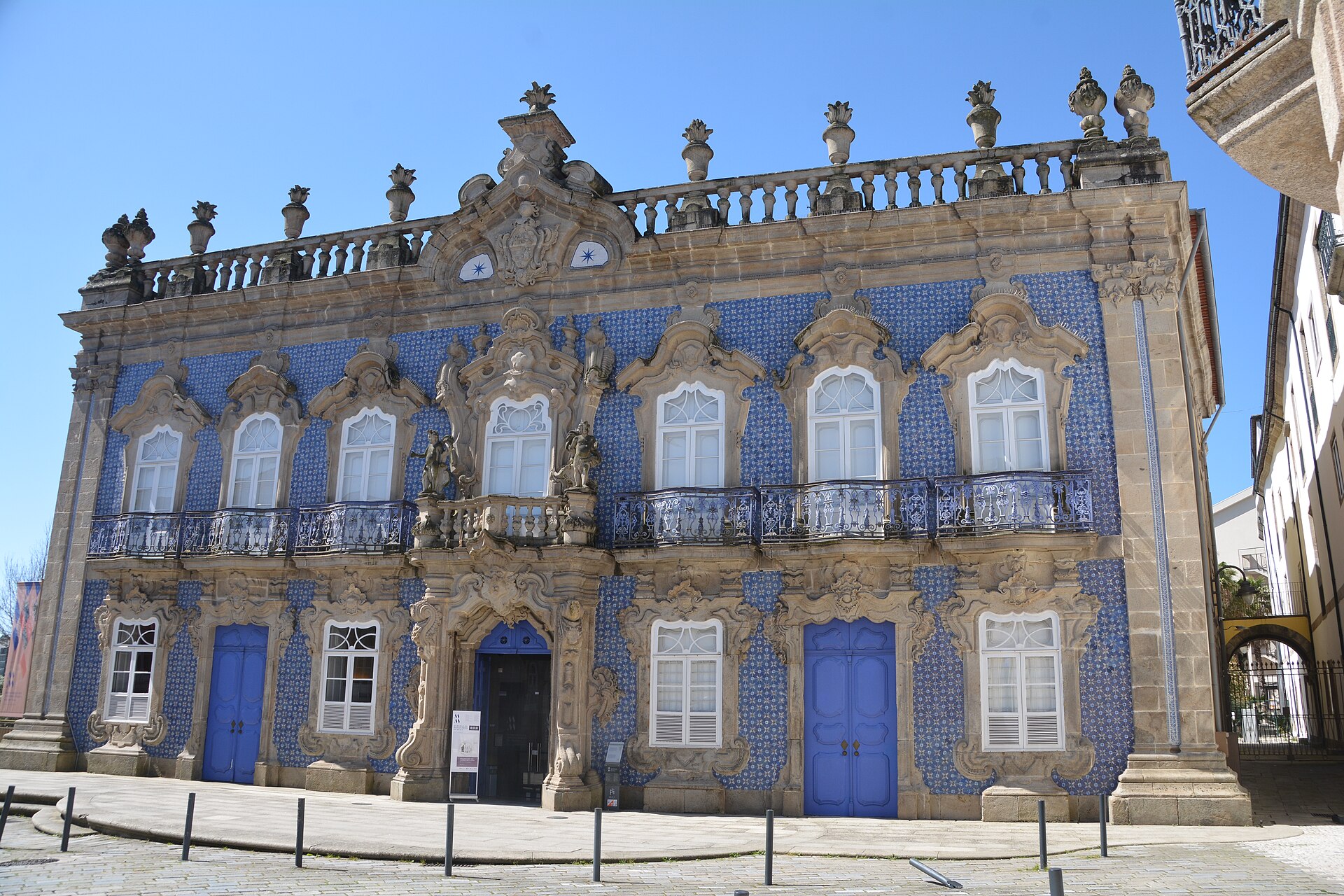
The Palácio do Raio, also known as the Casa do Mexicano, is a prominent example of 18th-century Portuguese Baroque and Rococo civic architecture located in the historic center of Braga. Commissioned by João Duarte de Faria, a wealthy merchant, the palace was completed in 1754 and is attributed to the architect André Soares, a master of the regional Rococo style.
The building is distinguished by its elaborate facade, which features intricate stonework, ornate window frames, and a vibrant blue-and-white tile (azulejo) cladding that covers the exterior. Following its restoration, the palace now serves as a cultural space and museum, housing a collection of religious art and historical artifacts that reflect the social status and cultural ambitions of Braga’s elite during the late monarchical period.
Key Facts
- Materials
- Granite, Azulejo tiles, Wrought iron
- Civilization
- Portuguese
- Accessibility
- Ground floor accessible
- Date(s)
- 1754
- Condition
- Restored and functioning as a museum
- Original Function
- Private residence
- Key Figures
- André Soares, João Duarte de Faria
Commission and Construction
1752-1754The palace was commissioned by João Duarte de Faria, a merchant and Knight of the Order of Christ. The design is widely attributed to André Soares, who was instrumental in defining the Rococo aesthetic in Northern Portugal.
Residential Use
18th-19th centuryFor over a century, the building served as a private residence for the Faria family, symbolizing the economic prosperity of Braga's merchant class during the 18th century.
Institutional Transformation
20th centuryThe building was acquired by the Santa Casa da Misericórdia de Braga. It served various institutional purposes before undergoing a major restoration to preserve its architectural integrity and historical significance.
Modern Museum
21st centuryFollowing extensive renovations, the palace opened to the public as the Interpretive Center of the Palácio do Raio, showcasing both the architecture of the building and the history of the Santa Casa da Misericórdia.
Cultural Significance
The Palácio do Raio is a landmark of the 'Braga Rococo' style, representing the transition from the heavy Baroque to the lighter, more decorative Rococo movement in Portugal. Its facade is considered one of the most significant examples of civil architecture in the city, reflecting the influence of the merchant class in shaping the urban landscape of 18th-century Braga.
Beyond its architectural value, the palace is deeply linked to the history of the Santa Casa da Misericórdia, a charitable institution that has played a central role in the social and religious life of the city for centuries.
Interpretive Notes
Scholarly debates and areas of uncertainty
While the attribution to André Soares is widely accepted by art historians due to the stylistic similarities with his other works in Braga, some scholars note that documentation regarding the specific construction contracts remains incomplete, leaving room for discussion regarding the extent of his direct involvement versus that of his workshop.
Visiting Information
Entry Rules
Open Tuesday to Saturday. Tickets are required for entry to the museum galleries. Modest attire is recommended as the site is managed by a religious charitable institution.
Best Times to Visit
Weekday mornings are generally quieter. The exterior facade is best viewed in the afternoon when the sunlight highlights the intricate details of the granite carvings.
Photography
Personal photography is permitted in most areas without flash. Tripods and professional equipment require prior authorization.
Preservation Notes
The exterior tile work is fragile; do not touch or lean against the facade. Visitors are requested to follow marked paths within the museum to protect the historic interior.
Nearby POIs
11 shownSources & Further Reading
- [1]André Soares e o Barroco em Braga — José Eduardo Horta Correia. Editorial Presença (1998)
- [2]Palácio do Raio: História e Arquitetura — Santa Casa da Misericórdia de Braga. Edições da Misericórdia (2015)View
Key Facts
- Materials
- Granite, Azulejo tiles, Wrought iron
- Civilization
- Portuguese
- Accessibility
- Ground floor accessible
- Date(s)
- 1754
- Condition
- Restored and functioning as a museum
- Original Function
- Private residence
- Key Figures
- André Soares, João Duarte de Faria