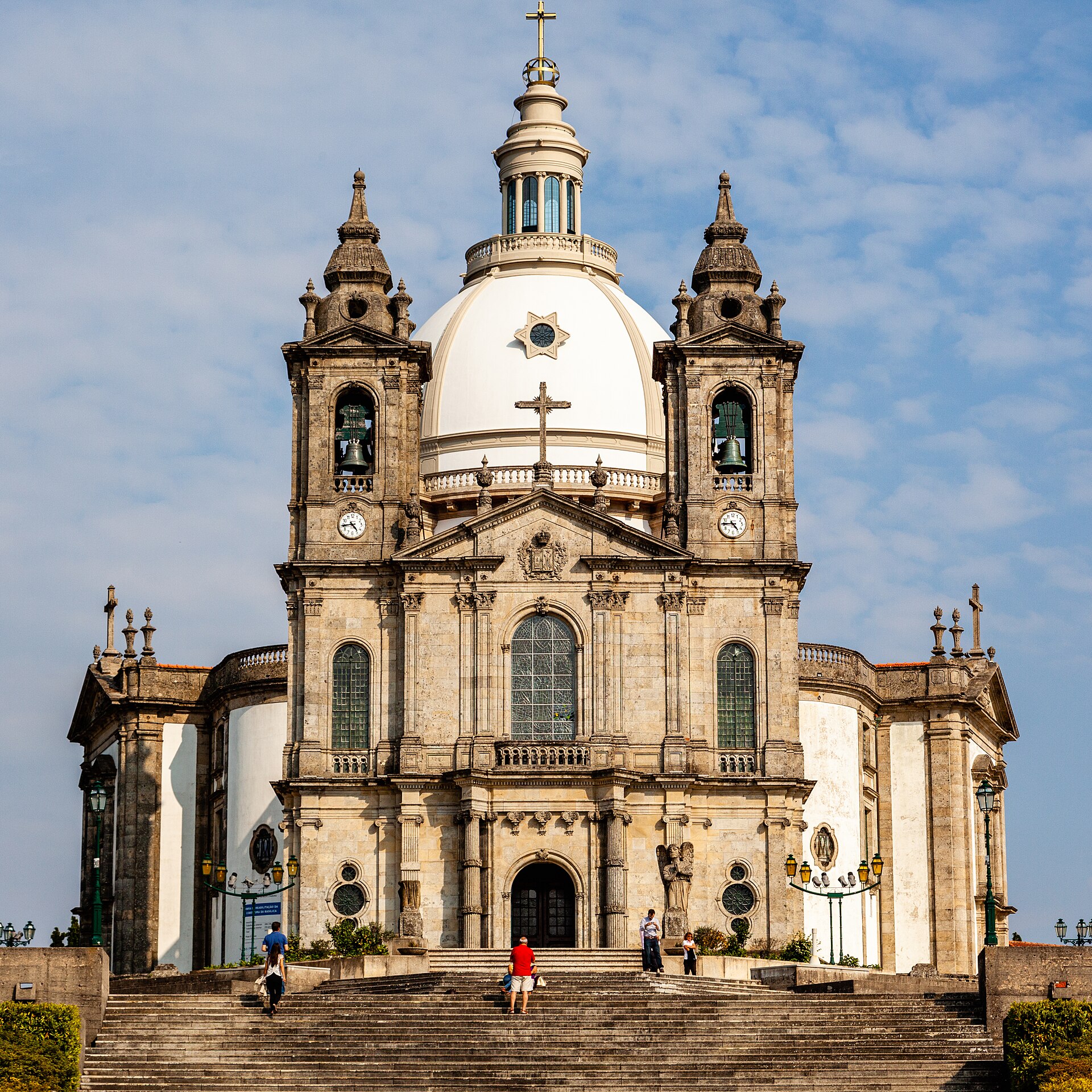
The Sanctuary of Our Lady of Sameiro is a prominent Marian shrine located on the Sameiro hill in Braga, Portugal. Initiated in 1863 by Father Martinho da Silva Jordão, the site was developed to foster devotion to the Immaculate Conception. The complex is characterized by its monumental staircase, expansive esplanade, and a neoclassical basilica that dominates the surrounding landscape, offering panoramic views of the Minho region.
The sanctuary serves as one of the most significant pilgrimage destinations in Portugal, attracting thousands of devotees annually, particularly during the major pilgrimages in June and August. Its architectural evolution reflects the religious fervor of the late 19th and early 20th centuries, blending devotional space with a grand scale intended to accommodate large gatherings of the faithful.
Key Facts
- Materials
- Granite, White marble
- Civilization
- Portuguese
- Accessibility
- Accessible by road; stairs leading to the main entrance
- Date(s)
- 1863 - 1953
- Condition
- Active religious site and pilgrimage destination
- Original Function
- Marian pilgrimage shrine
- Key Figures
- Martinho da Silva Jordão, Pope Pius IX
Founding and Early Development
1863The project began when Father Martinho da Silva Jordão placed a small statue of the Virgin Mary on the hill of Sameiro. The site quickly gained popularity among local residents, leading to the construction of a small chapel to house the image.
Expansion of the Sanctuary
1870s - 1900sDue to the increasing number of pilgrims, plans for a larger structure were initiated. The construction of the monumental staircase and the foundation of the basilica were undertaken to accommodate the growing religious movement, supported by donations from the faithful.
Completion and Consecration
1953The basilica reached its final architectural form in the mid-20th century. It was officially consecrated in 1953, solidifying its status as a major center for Marian devotion in the Catholic Church in Portugal.
Cultural Significance
The Sanctuary of Our Lady of Sameiro is a cornerstone of religious identity in Northern Portugal. It represents the historical importance of Marian devotion in the region and serves as a focal point for communal religious expression. The site is deeply embedded in the local culture of Braga, where it is often visited in conjunction with the nearby Bom Jesus do Monte.
Beyond its religious role, the sanctuary functions as a landmark of regional heritage. Its annual pilgrimages are significant social events that reinforce community bonds and maintain traditional religious practices, reflecting the enduring influence of the Catholic Church on Portuguese social life.
Interpretive Notes
Scholarly debates and areas of uncertainty
There is limited academic debate regarding the site, though architectural historians occasionally discuss the transition from the site's initial modest chapel to the grand neoclassical scale of the current basilica, reflecting the shift in 19th-century ecclesiastical architecture toward monumentalism to assert religious presence in the public sphere.
Visiting Information
Entry Rules
Open daily to the public. Entry to the basilica is free. Visitors are expected to maintain a respectful demeanor and dress modestly, as it is an active place of worship.
Best Times to Visit
Early morning or late afternoon for cooler temperatures and better lighting for photography. The site is particularly vibrant during the major pilgrimages in the first Sunday of June and the last Sunday of August.
Photography
Personal photography is permitted in outdoor areas. Inside the basilica, photography should be discreet and avoid the use of flash during religious services.
Preservation Notes
The site is well-maintained by the local religious authorities. Visitors are requested to stay on designated paths and respect the sanctity of the prayer areas.
Nearby POIs
11 shownKey Facts
- Materials
- Granite, White marble
- Civilization
- Portuguese
- Accessibility
- Accessible by road; stairs leading to the main entrance
- Date(s)
- 1863 - 1953
- Condition
- Active religious site and pilgrimage destination
- Original Function
- Marian pilgrimage shrine
- Key Figures
- Martinho da Silva Jordão, Pope Pius IX