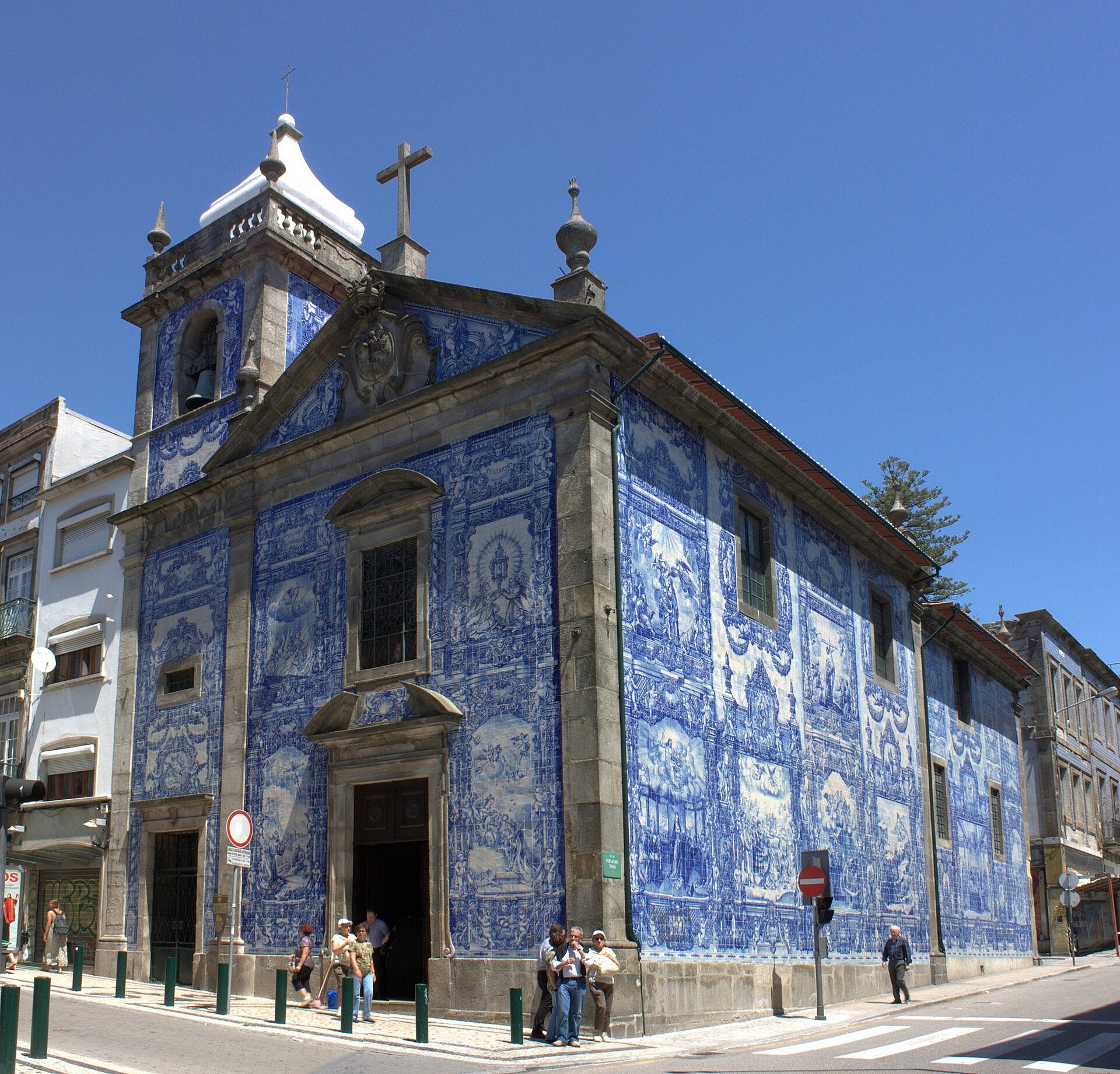
The Chapel of Santa Catarina, also known as the Chapel of Souls (Capela das Almas), is a prominent religious structure located on the busy Rua de Santa Catarina in Porto. While the original chapel dates back to the 18th century, its most distinctive feature is the exterior facade, which was covered in 1929 with approximately 15,947 blue and white azulejo tiles.
The tiles were designed by Eduardo Leite and manufactured by the Viúva Lamego factory in Lisbon. They depict various scenes from the lives of Saint Catherine and Saint Francis of Assisi, serving as a significant example of the Portuguese tradition of using ceramic art to narrate religious history and local cultural identity.
Key Facts
- Materials
- Stone masonry, Ceramic azulejo tiles
- Civilization
- Portuguese
- Accessibility
- Ground level access
- Date(s)
- 18th century (facade 1929)
- Condition
- Well-preserved, active church
- Original Function
- Religious worship
- Key Figures
- Eduardo Leite
Origins
18th centuryThe chapel was originally built in the 18th century as a modest religious site. It was dedicated to Saint Catherine and served the local community in the growing commercial district of Porto.
The Azulejo Transformation
1929In 1929, the exterior walls were completely renovated and covered with the iconic blue and white tiles. This project transformed the building into a landmark of the city, blending traditional religious architecture with the decorative ceramic style characteristic of the era.
Modern Status
PresentThe chapel remains an active place of worship and a major tourist attraction. It is maintained as a protected cultural site, with ongoing efforts to preserve the integrity of the thousands of individual tiles that cover its exterior.
Cultural Significance
The Chapel of Santa Catarina is a primary example of the 'azulejo' aesthetic that defines much of Porto's urban landscape. It serves as a visual narrative for passersby, reflecting the deep integration of religious storytelling into the public architecture of the city. It is widely regarded as one of the most photogenic and culturally representative buildings in Porto.
Interpretive Notes
Scholarly debates and areas of uncertainty
There is limited academic debate regarding the chapel, though some architectural historians discuss the tension between the 18th-century structural form and the 20th-century decorative application, questioning how the later tile work alters the perception of the building's original historical period.
Visiting Information
Entry Rules
Open to the public for visits and services. Visitors are expected to maintain silence and dress modestly as it is an active place of worship.
Best Times to Visit
Early morning or late afternoon to avoid the heavy foot traffic of the Rua de Santa Catarina shopping street.
Photography
Photography is permitted from the exterior. Inside, visitors should respect ongoing services and avoid using flash.
Preservation Notes
The tiles are fragile; do not touch or lean against the exterior walls. The site is subject to environmental monitoring due to the high volume of pedestrian traffic.
Nearby POIs
11 shownSources & Further Reading
- [1]Azulejos in Portugal — Santos, J. M.. Portuguese Heritage Press (2015)
- [2]The Architecture of Porto: A Guide — Oliveira, A.. University of Porto Press (2019)
Key Facts
- Materials
- Stone masonry, Ceramic azulejo tiles
- Civilization
- Portuguese
- Accessibility
- Ground level access
- Date(s)
- 18th century (facade 1929)
- Condition
- Well-preserved, active church
- Original Function
- Religious worship
- Key Figures
- Eduardo Leite