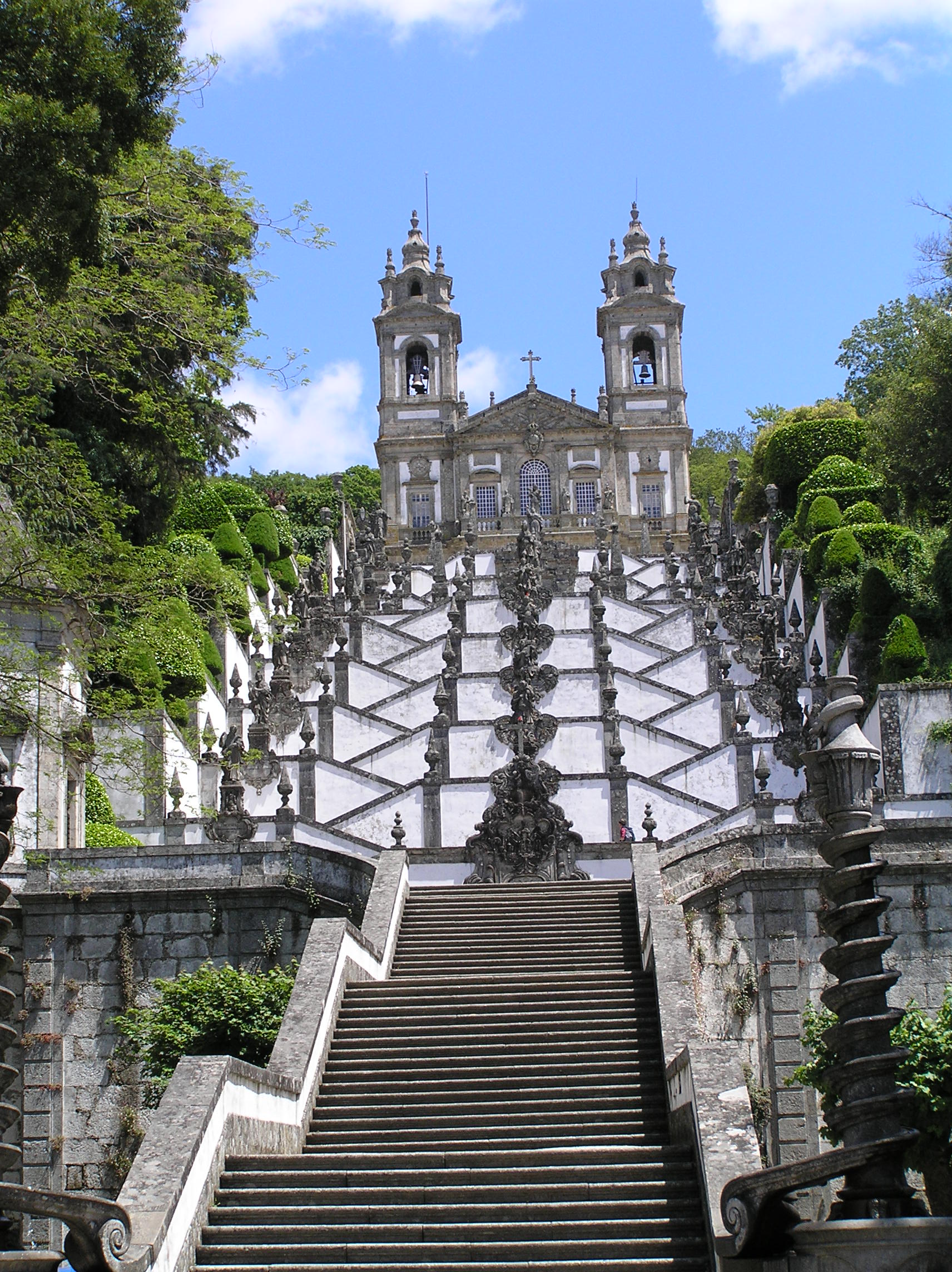
The Sanctuary of Bom Jesus do Monte is a monumental religious complex located on the slopes of Mount Espinho, overlooking the city of Braga in northern Portugal. The site is renowned for its elaborate Baroque stairway, known as the 'Escadório do Bom Jesus,' which rises 116 meters and features a series of chapels dedicated to the Stations of the Cross, interspersed with fountains and allegorical statues.
The architectural ensemble represents a synthesis of European Baroque and Neoclassical styles, designed to facilitate a meditative pilgrimage experience. The sanctuary grounds include a church, a park, and a funicular railway—the oldest of its kind in the world still powered by water counterbalancing—which connects the lower city to the hilltop shrine.
Key Facts
- Materials
- Granite, Plaster, Stucco, Tile
- Civilization
- Portuguese
- Accessibility
- Accessible via funicular or stairs; some areas require steep climbing
- Date(s)
- 1722 - 1811
- Condition
- Well-preserved and active religious site
- Original Function
- Pilgrimage site and devotional sanctuary
- Key Figures
- Archbishop Rodrigo de Moura Teles, Carlos Amarante
Early Devotion
14th - 17th centuryThe site originated as a small chapel dedicated to the Holy Cross, which became a popular destination for local pilgrims. By the 17th century, the area was established as a place of retreat, with several small chapels built along the path to the summit.
Baroque Expansion
1722 - 1784Archbishop Rodrigo de Moura Teles initiated the construction of the current monumental stairway. This phase saw the development of the zigzagging 'Via Sacra' and the installation of fountains representing the five senses, designed to guide pilgrims through a sensory and spiritual journey.
Neoclassical Completion
1784 - 1811Architect Carlos Amarante oversaw the construction of the current church, replacing the older structure. This phase introduced Neoclassical elements to the complex, creating the unified aesthetic that defines the sanctuary today.
Modern Recognition
1882 - presentThe installation of the water-powered funicular in 1882 significantly increased accessibility to the site. In 2019, the sanctuary was inscribed as a UNESCO World Heritage site, recognizing its unique contribution to the European tradition of 'Sacri Monti' or Sacred Mountains.
Cultural Significance
Bom Jesus do Monte serves as a quintessential example of the 'Sacri Monti' tradition, where the landscape is transformed into a sacred space through architecture and iconography. It remains a vital center for Portuguese Catholic identity, particularly during the annual pilgrimage festivals.
The site is also a landmark of civil engineering, as the funicular railway serves as a testament to 19th-century industrial innovation, blending seamlessly into the religious landscape without disrupting the site's spiritual atmosphere.
Interpretive Notes
Scholarly debates and areas of uncertainty
Debate exists regarding the extent to which the sanctuary's design was influenced by Italian models of the 'Sacri Monti' versus purely local Portuguese devotional practices. Scholars also analyze the symbolic program of the fountains, questioning whether the specific order of the 'Five Senses' fountains was intended to represent a linear progression of moral purification or a more complex theological allegory.
Visiting Information
Entry Rules
The sanctuary is open to the public daily. Entry to the church is free, though donations are encouraged. Visitors are expected to maintain a respectful demeanor as it is an active place of worship. Modest dress is requested when entering the church.
Best Times to Visit
Early morning or late afternoon provides the best light for photography and avoids the heat of the day. Weekdays are significantly quieter than weekends, especially during the summer months.
Photography
Photography is permitted in outdoor areas and the sanctuary grounds. Inside the church, photography is generally discouraged during services; flash should be avoided at all times.
Preservation Notes
The granite stairs and statuary are subject to erosion and require ongoing maintenance. Visitors are asked to stay on marked paths and refrain from climbing on the fountains or statues. The site is a protected heritage area; littering and unauthorized commercial activities are strictly prohibited.
Nearby POIs
11 shownSources & Further Reading
- [1]
- [2]The Architecture of the Portuguese Baroque — Robert C. Smith. University of Pennsylvania Press (1968)
Key Facts
- Materials
- Granite, Plaster, Stucco, Tile
- Civilization
- Portuguese
- Accessibility
- Accessible via funicular or stairs; some areas require steep climbing
- Date(s)
- 1722 - 1811
- Condition
- Well-preserved and active religious site
- Original Function
- Pilgrimage site and devotional sanctuary
- Key Figures
- Archbishop Rodrigo de Moura Teles, Carlos Amarante