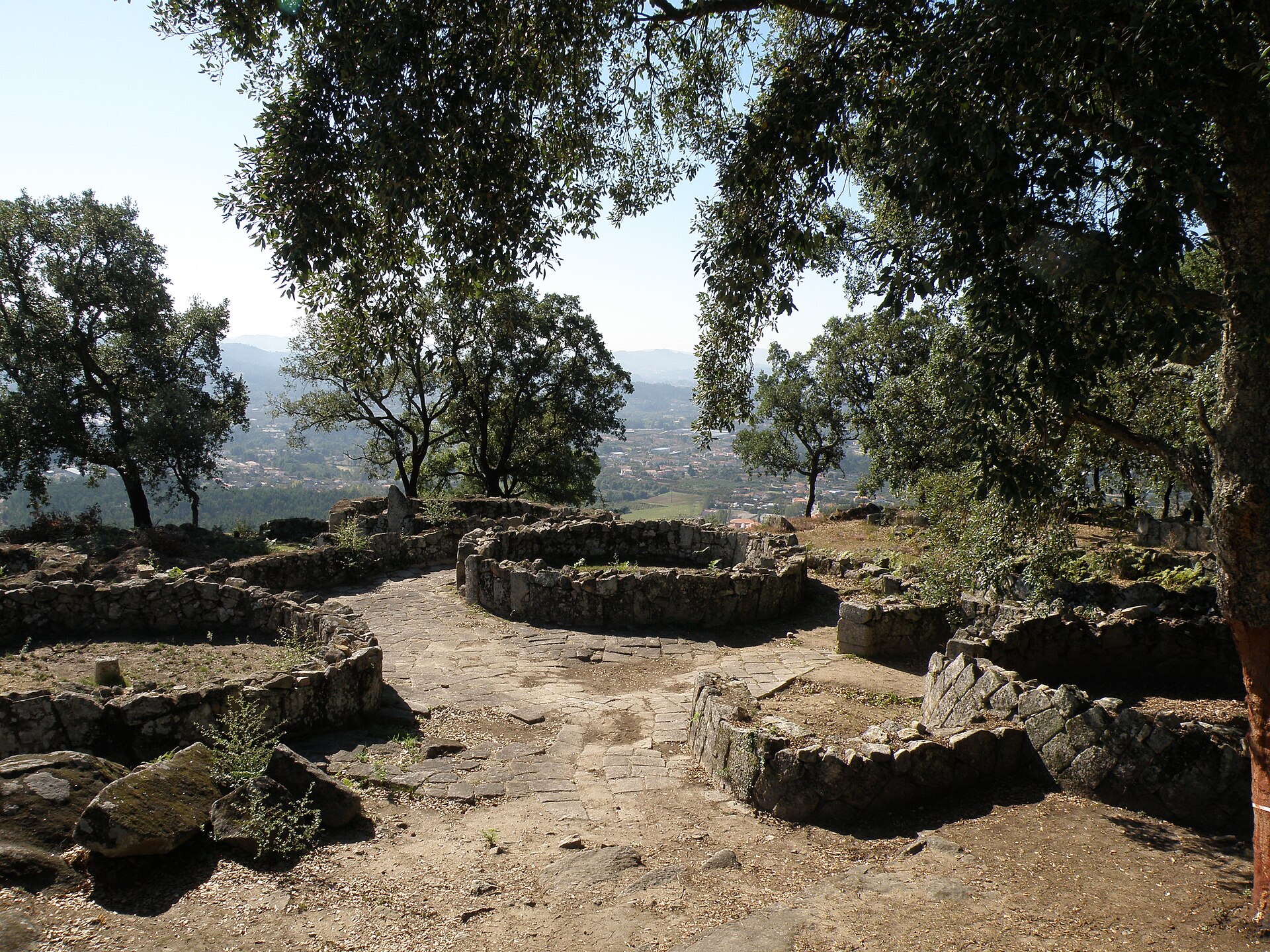
Citânia de Briteiros is one of the most significant archaeological sites of the Castro culture, located on the summit of Monte de São Romão near Guimarães, Portugal. This fortified settlement, or 'citânia', represents a peak of Iron Age urban development in the Iberian Peninsula, characterized by its complex defensive walls and dense clusters of circular stone dwellings.
The site provides extensive evidence of the transition from indigenous Iron Age social structures to Romanized life. Excavations have revealed a sophisticated urban layout with paved streets, drainage systems, and public spaces, alongside a wealth of artifacts including pottery, metalwork, and epigraphic inscriptions that document the cultural synthesis of the region during the first centuries CE.
Key Facts
- Materials
- Granite
- Civilization
- Castro Culture
- Accessibility
- Unpaved paths, moderate incline
- Date(s)
- 2nd century BCE - 3rd century CE
- Condition
- Archaeological site with partially reconstructed dwellings
- Original Function
- Fortified hillfort settlement
- Key Figures
- Francisco Martins Sarmento
Foundation and Peak
2nd century BCEThe settlement was established as a fortified hillfort, serving as a central hub for the Castro culture. Its strategic location allowed for control over the surrounding valleys and trade routes.
Roman Integration
1st century BCE - 1st century CEFollowing the Roman conquest of the Iberian Peninsula, the site underwent significant changes. While the indigenous architectural style persisted, Roman influence is visible in the adoption of new building techniques and the presence of Latin inscriptions.
Abandonment
3rd century CEThe site was gradually abandoned as populations moved toward the plains and Roman-style villas, a common trend in the region during the late Roman period.
Rediscovery and Excavation
1875 - presentThe site was brought to international attention by archaeologist Francisco Martins Sarmento in 1875. His systematic excavations were among the first of their kind in Portugal, establishing the site as a cornerstone of Portuguese archaeology.
Cultural Significance
Citânia de Briteiros is a primary reference for understanding the Castro culture, which defined the social and political landscape of Northwest Iberia before and during the Roman occupation. It serves as a vital link in the study of proto-historic urbanism and the evolution of domestic architecture in the region.
Today, the site is a symbol of regional heritage in Northern Portugal. It continues to be a focal point for research into the cultural identity of the Gallaeci people and the mechanisms of Romanization in rural, mountainous environments.
Interpretive Notes
Scholarly debates and areas of uncertainty
The extent of Roman influence on the daily life of the inhabitants remains a subject of discussion. While some scholars emphasize a rapid cultural shift, others argue for a long-term persistence of indigenous social practices despite the adoption of Roman material culture.
Visiting Information
Entry Rules
Open daily. Tickets are required for entry and can be purchased at the site entrance. Guided tours are available by appointment.
Best Times to Visit
Spring and autumn offer the most comfortable temperatures for exploring the exposed hilltop. Early morning visits are recommended to avoid the intense summer sun.
Photography
Personal photography is permitted. Commercial photography requires prior authorization from the site management.
Preservation Notes
Stay on marked paths to protect the archaeological structures. Do not climb on the stone walls of the dwellings. The site is an open-air museum; please carry out all trash.
Nearby POIs
11 shown- Sanctuary of Our Lady of Sameiro4.7 km
- Sanctuary of Bom Jesus do Monte5.9 km
- Basilica dos Congregados9.1 km
- Castelo de Guimarães9.1 km
- Palacio do Raio9.2 km
- Nogueira da Silva Museum9.2 km
- Igreja de Santa Cruz9.3 km
- Castelo de Braga9.3 km
- Pius XII Museum9.4 km
- Archiepiscopal Palace of Braga9.5 km
- Se de Braga9.6 km
Sources & Further Reading
- [1]A Citânia de Briteiros — Francisco Martins Sarmento. Sociedade Martins Sarmento (1879)
- [2]The Castro Culture of Northwest Iberia — Armando Coelho Ferreira da Silva. Journal of Iberian Archaeology (1999)
Key Facts
- Materials
- Granite
- Civilization
- Castro Culture
- Accessibility
- Unpaved paths, moderate incline
- Date(s)
- 2nd century BCE - 3rd century CE
- Condition
- Archaeological site with partially reconstructed dwellings
- Original Function
- Fortified hillfort settlement
- Key Figures
- Francisco Martins Sarmento
Nearby POIs
11 shown- Sanctuary of Our Lady of Sameiro4.7 km
- Sanctuary of Bom Jesus do Monte5.9 km
- Basilica dos Congregados9.1 km
- Castelo de Guimarães9.1 km
- Palacio do Raio9.2 km
- Nogueira da Silva Museum9.2 km
- Igreja de Santa Cruz9.3 km
- Castelo de Braga9.3 km
- Pius XII Museum9.4 km
- Archiepiscopal Palace of Braga9.5 km
- Se de Braga9.6 km