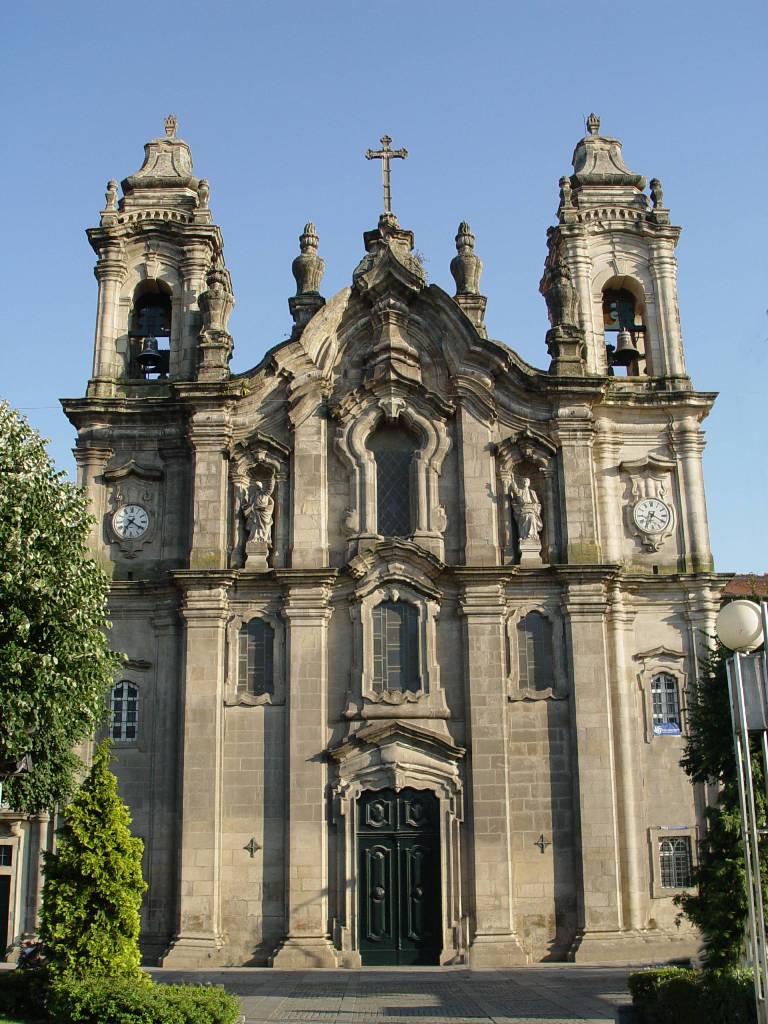
The Basilica dos Congregados is a prominent religious structure located in the historic center of Braga, Portugal. Designed by the architect André Soares, the church is a significant example of the transition between the late Baroque and Neoclassical styles in the Minho region. Its construction began in the early 18th century to serve the Congregation of the Oratory of Saint Philip Neri, reflecting the city's deep-rooted religious traditions and the influence of local confraternities.
The facade is characterized by its rhythmic composition and decorative stonework, typical of Soares's architectural language. Inside, the basilica features a single-nave layout adorned with intricate gilded woodcarvings and a notable collection of religious art, including ceiling paintings that depict scenes from the life of Saint Philip Neri. The building remains an active place of worship and a focal point for religious processions in Braga.
Key Facts
- Materials
- Granite, Gilded wood, Stucco
- Civilization
- Portuguese
- Accessibility
- Ground level access
- Date(s)
- 1703 - 18th century
- Condition
- Well-preserved, active basilica
- Original Function
- Church for the Congregation of the Oratory
- Key Figures
- André Soares, Saint Philip Neri
Foundation and Early Construction
1703The church was founded by the Congregation of the Oratory of Saint Philip Neri, who settled in Braga at the invitation of the Archbishop. The initial structure was intended to serve the spiritual needs of the congregation and the local community.
Architectural Redesign
18th centuryUnder the direction of the renowned architect André Soares, the basilica underwent significant modifications. Soares implemented his signature Baroque style, which defined the current facade and the sophisticated interior decorative program.
Elevation to Basilica
1997In recognition of its historical, architectural, and religious importance to the city of Braga, the church was elevated to the status of a minor basilica by the Catholic Church.
Cultural Significance
The Basilica dos Congregados serves as a testament to the influence of the Oratorian order in northern Portugal. It is deeply embedded in the religious life of Braga, a city historically known as the 'Rome of Portugal' due to its high density of churches and religious institutions. The basilica acts as a site of memory for the city's confraternities, which played a vital role in social and religious cohesion throughout the 18th and 19th centuries.
Interpretive Notes
Scholarly debates and areas of uncertainty
While the attribution of the facade to André Soares is widely accepted, scholars continue to debate the extent of his involvement in the interior layout versus the contributions of other contemporary master masons active in the Braga region during the mid-18th century.
Visiting Information
Entry Rules
Open daily for visitors and worshipers. Entry is free. Modest dress is expected as it is an active place of worship. Please remain quiet during services.
Best Times to Visit
Weekday mornings are generally quiet. The basilica is particularly significant during Holy Week, when it serves as a major station for Braga's famous religious processions.
Photography
Photography is permitted without flash. Tripods and professional equipment require prior authorization from the parish office.
Preservation Notes
The interior gilded woodcarvings are sensitive to humidity and touch. Please refrain from touching any surfaces or artifacts. Restoration work is conducted periodically to maintain the granite facade.
Nearby POIs
11 shownSources & Further Reading
- [1]Arquitetura Barroca em Braga — José Eduardo Horta Correia. Editorial Presença (1997)
- [2]André Soares: O Arquiteto do Barroco Bracarense — Eduardo Pires de Oliveira. Câmara Municipal de Braga (2005)
Key Facts
- Materials
- Granite, Gilded wood, Stucco
- Civilization
- Portuguese
- Accessibility
- Ground level access
- Date(s)
- 1703 - 18th century
- Condition
- Well-preserved, active basilica
- Original Function
- Church for the Congregation of the Oratory
- Key Figures
- André Soares, Saint Philip Neri