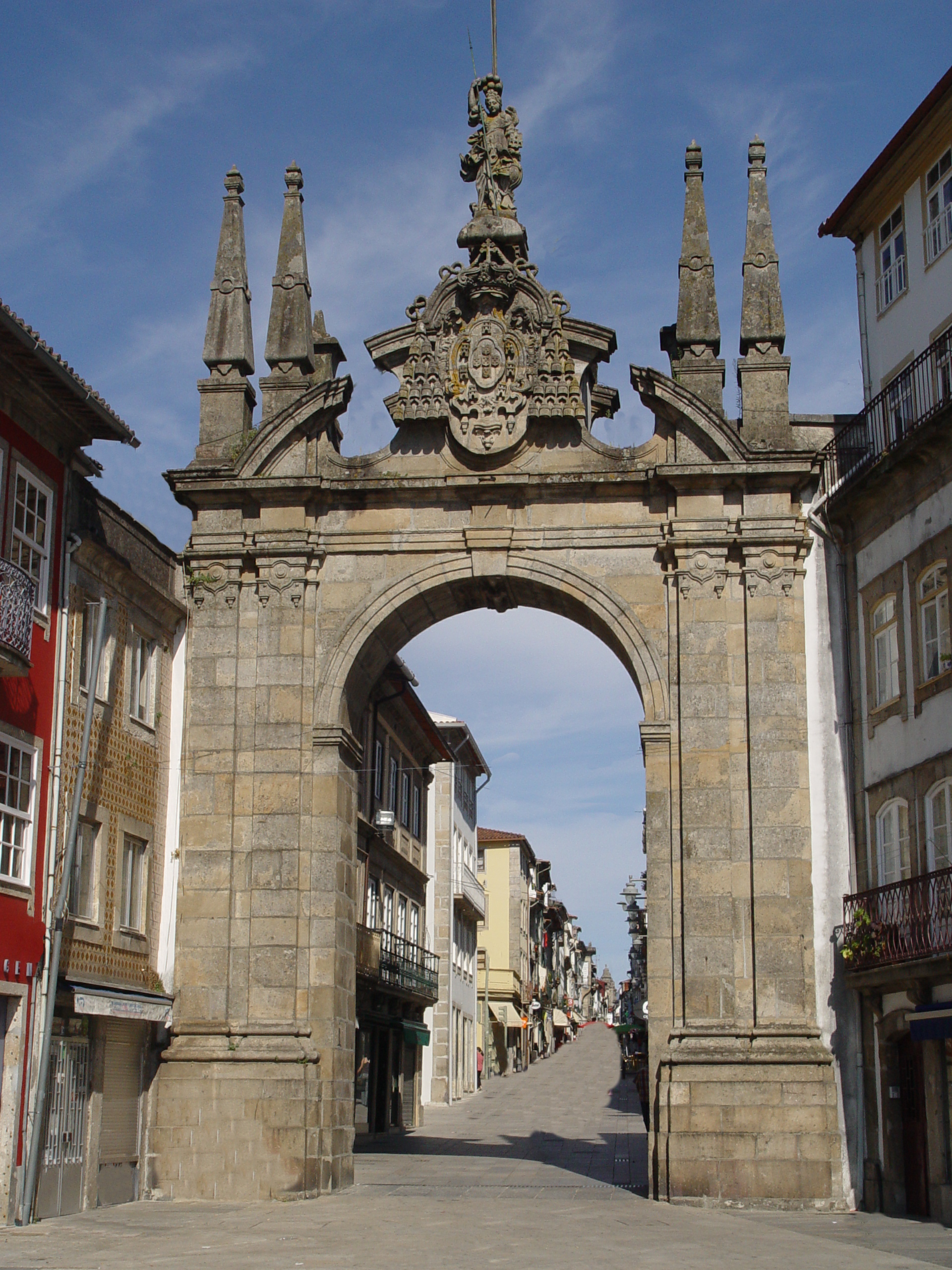
The Arco da Porta Nova is a prominent triumphal arch located in the historic center of Braga, Portugal. Originally constructed in 1512 as part of the city's medieval defensive walls, the current structure was rebuilt in 1772 under the direction of Archbishop Gaspar de Bragança. It serves as a symbolic gateway to the city and is a notable example of the transition between Baroque and Neoclassical architectural styles.
The arch features two distinct facades: the western side, facing the exterior of the city, is designed in a refined Baroque style, while the eastern side, facing the city center, exhibits Neoclassical characteristics. It has historically served as the ceremonial entrance for dignitaries and high-ranking officials, where the keys to the city were traditionally presented.
Key Facts
- Materials
- Granite
- Civilization
- Portuguese
- Accessibility
- Accessible via public pedestrian street
- Date(s)
- 1772 (current structure)
- Condition
- Well-preserved, public monument
- Original Function
- City gate and ceremonial entrance
- Key Figures
- Archbishop Gaspar de Bragança, André Soares
Medieval Origins
1512The original Porta Nova was built as part of the defensive wall system surrounding Braga, serving as one of the primary access points to the city during the medieval period.
Baroque Reconstruction
1772Archbishop Gaspar de Bragança commissioned the architect André Soares to redesign the gate. The project transformed the functional defensive structure into a decorative triumphal arch, reflecting the city's prestige.
Modern Preservation
20th century - presentThe arch remains a central landmark in Braga. It has undergone periodic maintenance to preserve its granite masonry and continues to function as a symbolic threshold for civic ceremonies.
Cultural Significance
The Arco da Porta Nova is deeply embedded in the local identity of Braga, encapsulated by the popular Portuguese expression 'és de Braga?' (are you from Braga?), which is often followed by the question 'deixas a porta aberta?' (did you leave the door open?). This refers to the historical fact that the Porta Nova was the only gate in the city walls that did not have a door, as it was intended for ceremonial use rather than defense.
Beyond its linguistic legacy, the arch remains the primary site for the symbolic delivery of the city keys to visiting dignitaries, maintaining its role as the ceremonial heart of the municipality.
Interpretive Notes
Scholarly debates and areas of uncertainty
There is minor academic discussion regarding the extent of André Soares' direct involvement in the final execution of the Neoclassical facade, as some stylistic elements suggest the influence of his contemporaries in the late 18th-century Portuguese architectural scene.
Visiting Information
Entry Rules
Public monument located on a pedestrian street; no entry fees or restrictions.
Best Times to Visit
Early morning or late afternoon for optimal lighting on the granite facades. The area is highly pedestrianized and busy during local festivals.
Photography
None; public space.
Preservation Notes
The structure is maintained by the Municipality of Braga. Visitors are requested to respect the integrity of the stone masonry.
Nearby POIs
11 shownSources & Further Reading
- [1]Património Cultural: Arco da Porta Nova — Direção-Geral do Património Cultural. DGPC Portugal (2020)View
- [2]Braga: Cidade dos Arcebispos — José Marques. Universidade do Minho (2015)
Key Facts
- Materials
- Granite
- Civilization
- Portuguese
- Accessibility
- Accessible via public pedestrian street
- Date(s)
- 1772 (current structure)
- Condition
- Well-preserved, public monument
- Original Function
- City gate and ceremonial entrance
- Key Figures
- Archbishop Gaspar de Bragança, André Soares