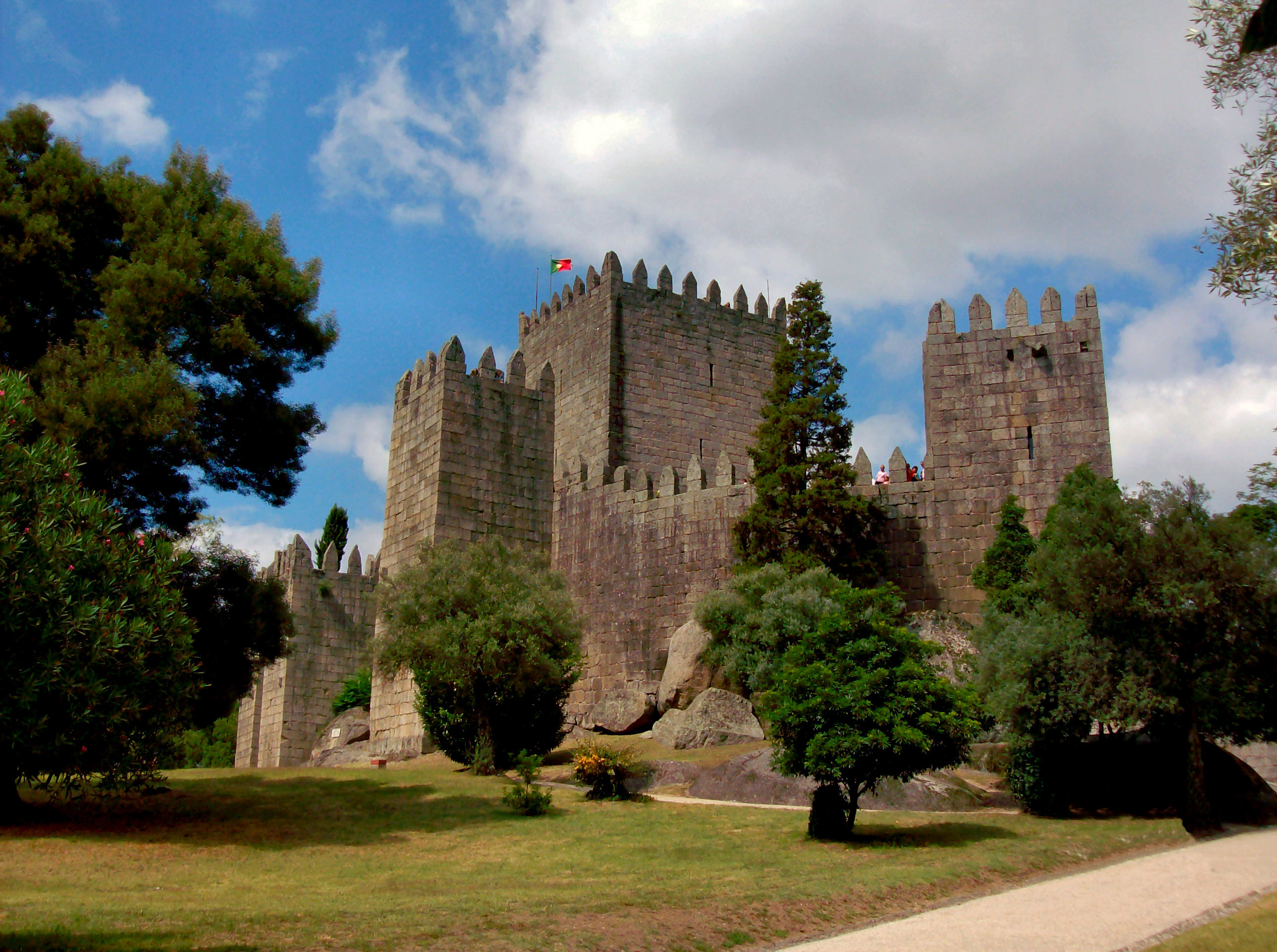
The Castle of Guimarães is a medieval fortification located in the city of Guimarães, Portugal. It was originally constructed in the 10th century under the orders of Countess Mumadona Dias to protect the monastery of São Mamede from Viking and Moorish raids. The structure was later expanded and reinforced, becoming a pivotal site in the history of the Portuguese nation.
Regarded as the birthplace of Portugal, the castle is traditionally associated with the birth of Afonso Henriques, the first King of Portugal, who was born within its walls. The fortress features a central keep and seven square towers, representing a significant example of military architecture from the Reconquista period.
Key Facts
- Materials
- Granite
- Civilization
- Kingdom of Portugal
- Accessibility
- Partial; steep terrain and uneven stone surfaces
- Date(s)
- 10th century
- Condition
- Restored and well-preserved
- Original Function
- Defensive fortification
- Key Figures
- Mumadona Dias, Afonso Henriques
Origins and Early Defense
10th centuryCountess Mumadona Dias ordered the construction of a monastery and a defensive structure to protect the local population from frequent raids by Norsemen and Saracens.
Birth of a Nation
12th centuryThe castle became the residence of Count Henry of Portugal and his wife Theresa. It served as the strategic base for Afonso Henriques during his struggle for independence from the Kingdom of León.
Expansion and Decline
13th-17th centuryFollowing the consolidation of the Portuguese kingdom, the castle underwent various structural expansions. However, as military technology evolved and the borders shifted, the fortress gradually lost its strategic importance and fell into disrepair.
Modern Restoration
20th centuryIn 1910, the castle was declared a National Monument. Extensive restoration works were carried out in the 1940s to stabilize the walls and towers, preserving the site as a symbol of Portuguese national identity.
Cultural Significance
The Castle of Guimarães is deeply embedded in the Portuguese national consciousness, often referred to as the 'cradle of the nation.' It serves as a physical manifestation of the formative years of the Portuguese state and the Reconquista.
Today, the site is a major cultural landmark, hosting historical reenactments and educational programs that emphasize the role of the castle in the development of Portuguese sovereignty and the legacy of the first dynasty.
Interpretive Notes
Scholarly debates and areas of uncertainty
There is ongoing academic discussion regarding the exact extent of the original 10th-century structure versus the later Romanesque and Gothic additions. Some historians argue that the current appearance is heavily influenced by the 20th-century restoration, which may have idealized the medieval aesthetic.
Visiting Information
Entry Rules
Open daily. Tickets are required for entry to the interior of the keep. Visitors are advised to wear comfortable footwear due to the uneven stone paths.
Best Times to Visit
Spring and early autumn offer the most pleasant weather for exploring the exterior walls and surrounding park areas. Weekdays are recommended to avoid weekend tourist crowds.
Photography
Personal photography is permitted throughout the site. Commercial photography requires prior authorization from the local municipal authorities.
Preservation Notes
The site is a protected monument; visitors must remain on designated paths and refrain from climbing on the historic masonry. Restoration work is ongoing to maintain the structural integrity of the granite walls.
Nearby POIs
11 shown- Citania de Briteiros9.1 km
- Sanctuary of Our Lady of Sameiro12.3 km
- Sanctuary of Bom Jesus do Monte13.9 km
- Palacio do Raio15.7 km
- Basilica dos Congregados15.8 km
- Igreja de Santa Cruz15.9 km
- Pius XII Museum15.9 km
- Roman Thermae of Maximinus16 km
- Nogueira da Silva Museum16 km
- Castelo de Braga16 km
- Se de Braga16.1 km
Sources & Further Reading
- [1]Castelo de Guimarães: História e Arquitetura — Direção-Geral do Património Cultural. Património Cultural Portugal (2020)View
- [2]The Birth of Portugal: A History of the First Dynasty — José Mattoso. Editorial Estampa (2014)
Key Facts
- Materials
- Granite
- Civilization
- Kingdom of Portugal
- Accessibility
- Partial; steep terrain and uneven stone surfaces
- Date(s)
- 10th century
- Condition
- Restored and well-preserved
- Original Function
- Defensive fortification
- Key Figures
- Mumadona Dias, Afonso Henriques
Nearby POIs
11 shown- Citania de Briteiros9.1 km
- Sanctuary of Our Lady of Sameiro12.3 km
- Sanctuary of Bom Jesus do Monte13.9 km
- Palacio do Raio15.7 km
- Basilica dos Congregados15.8 km
- Igreja de Santa Cruz15.9 km
- Pius XII Museum15.9 km
- Roman Thermae of Maximinus16 km
- Nogueira da Silva Museum16 km
- Castelo de Braga16 km
- Se de Braga16.1 km