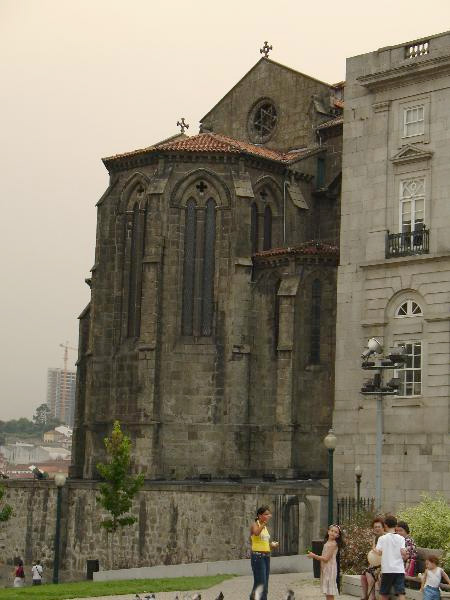
The Church of São Francisco is the most prominent Gothic monument in Porto, Portugal. Construction began in 1383 under the patronage of King Ferdinand I, following the Franciscan order's arrival in the city. The structure is characterized by its austere granite exterior, which retains its original 14th-century Gothic design, including a notable rose window on the main facade.
While the exterior remains strictly Gothic, the interior underwent a radical transformation during the 17th and 18th centuries. The nave and side chapels were lavishly decorated with intricate gilded wood carvings, known as talha dourada, which are considered among the finest examples of Baroque and Rococo art in Portugal. The church is also home to the catacombs, which served as the final resting place for many of Porto's noble families and members of the Franciscan order.
Key Facts
- Materials
- Granite, Gilded wood, Marble
- Civilization
- Portuguese
- Accessibility
- Ground floor accessible, catacombs have limited access
- Date(s)
- 1383 - 1425
- Condition
- Well-preserved, museum and active religious site
- Original Function
- Franciscan convent church
- Key Figures
- King Ferdinand I, João de Castilho
Foundation and Gothic Origins
1383 - 1425The church was built on the site of a smaller 13th-century Franciscan convent. Construction of the current Gothic structure was authorized by King Ferdinand I and completed in the early 15th century, featuring a three-aisled nave and a polygonal apse.
Baroque Transformation
17th - 18th centuryDuring the 17th and 18th centuries, the interior was completely overhauled. The plain Gothic walls were covered in elaborate gilded wood carvings, transforming the space into a masterpiece of the Baroque and Rococo styles.
Fire and Restoration
1832During the Siege of Porto in 1832, the adjacent convent was destroyed by fire. The church itself was spared, but the site of the former cloister was later replaced by the Neoclassical Palácio da Bolsa.
Modern Preservation
20th century - presentThe church was classified as a National Monument in 1910. It is now managed as a museum, with ongoing conservation efforts focused on the delicate gilded wood carvings and the structural integrity of the granite masonry.
Cultural Significance
The Church of São Francisco serves as a vital symbol of Porto's historical wealth and religious devotion. The contrast between its austere Gothic exterior and the opulent gilded interior reflects the transition of Portuguese artistic tastes from the medieval period to the height of the Baroque era. It remains a central landmark within the UNESCO-listed Historic Centre of Porto.
Interpretive Notes
Scholarly debates and areas of uncertainty
Scholars often debate the exact amount of gold used in the interior decoration, with estimates varying significantly due to the complexity of the wood-carving techniques. There is also ongoing discussion regarding the extent to which the original Gothic interior layout was modified to accommodate the heavy Baroque altarpieces.
Visiting Information
Entry Rules
Open daily. Tickets are required for entry, which includes access to the church, the catacombs, and the museum. Modest dress is requested as it is a site of religious significance.
Best Times to Visit
Early morning or late afternoon to avoid peak tourist crowds. Weekdays are generally quieter than weekends.
Photography
Photography is permitted in the church, but the use of flash and tripods is strictly prohibited to protect the gilded surfaces.
Preservation Notes
Do not touch the gilded wood carvings, as oils from human skin can cause irreversible damage. Stay within the designated visitor paths.
Nearby POIs
11 shownSources & Further Reading
- [1]The Church of São Francisco in Porto — Robert C. Smith. Journal of the Society of Architectural Historians (1966)View
- [2]Porto: A History of the City — Joel Serrão. Editorial Verbo (1990)
Key Facts
- Materials
- Granite, Gilded wood, Marble
- Civilization
- Portuguese
- Accessibility
- Ground floor accessible, catacombs have limited access
- Date(s)
- 1383 - 1425
- Condition
- Well-preserved, museum and active religious site
- Original Function
- Franciscan convent church
- Key Figures
- King Ferdinand I, João de Castilho