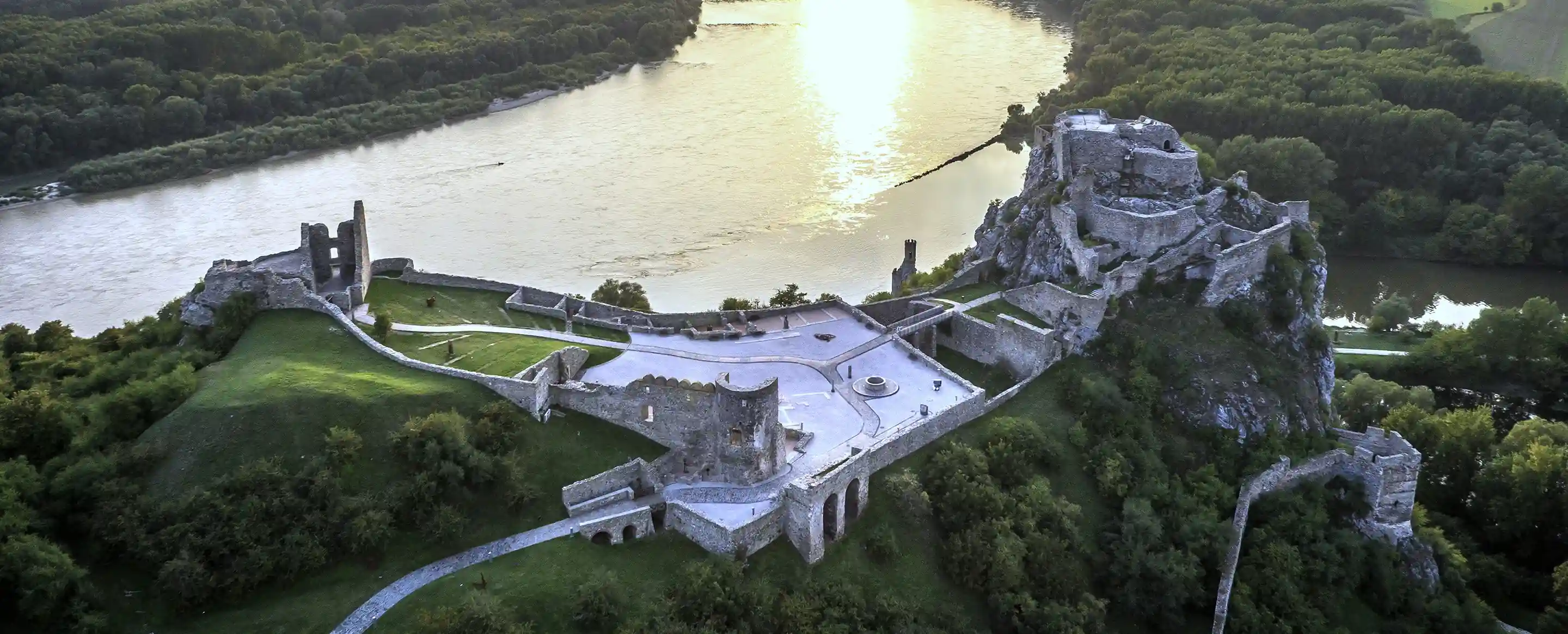
Devin Castle is a medieval fortress located at the confluence of the Danube and Morava rivers, near the present-day border of Slovakia and Austria. The site has been strategically significant since antiquity, with evidence of earlier Roman fortifications forming part of the Limes Romanus frontier system. Its elevated position provided control over key trade and military routes through Central Europe. The castle reached its prominence during the Middle Ages as a defensive stronghold within the Kingdom of Hungary. It later declined in military importance and was partially destroyed in 1809 during the Napoleonic Wars. Today, it remains a well-preserved ruin and an important archaeological and cultural site, offering insight into regional history from the Roman period through the medieval era.
Key Facts
- Materials
- Stone
- Civilization
- Great Moravian, later Kingdom of Hungary
- Accessibility
- Accessible via marked paths; steep sections may limit mobility
- Date(s)
- 9th century CE (with earlier Roman occupation)
- Condition
- Ruined but preserved
- Original Function
- Military fortress and border defense
- Key Figures
- Prince Rastislav, Napoleon Bonaparte
Early Occupation and Roman Presence
1st-4th century CEThe site was originally part of the Roman frontier defense system along the Danube. A military outpost was established to monitor and control movement along the river and nearby trade routes, forming part of the broader Limes Romanus.
Great Moravian Period
9th centuryDuring the Great Moravian Empire, Devin Castle became a significant fortified settlement. It played a role in regional defense and administration, and is associated with early Slavic state formation in Central Europe.
Medieval Development
10th-15th centuryUnder the Kingdom of Hungary, the fortress was expanded and reinforced. Its strategic location made it a key defensive site against external threats and a control point for trade along the Danube corridor.
Destruction in the Napoleonic Wars
1809The castle was partially destroyed by French troops under Napoleon Bonaparte to prevent its further military use. Explosions damaged key sections of the structure, contributing to its current ruined state.
Modern Preservation
20th century - presentArchaeological research and preservation efforts have stabilized the ruins and made the site accessible to the public. It is now a protected cultural monument and part of Slovakia’s national heritage.
Cultural Significance
Devin Castle has long served as a symbol of Slovak national identity, particularly during periods of political change and national revival in the 19th century. Its location at the meeting point of major rivers and cultures reinforced its role as a boundary marker and a place of historical memory tied to early Slavic statehood. In modern Slovakia, the site is associated with cultural heritage and educational initiatives. It is frequently used for historical exhibitions and public events, reinforcing its role as both a monument and a space for engaging with the region’s past.
Visiting Information
Entry Rules
Open to the public year-round. Ticketed entry required for access to the castle grounds and exhibitions. Closed on certain public holidays.
Best Times to Visit
Morning hours for fewer visitors. Spring and early autumn offer more comfortable conditions for exploring the elevated terrain.
Photography
Personal photography permitted. Tripods and drones require prior authorization.
Preservation Notes
Visitors must remain on designated paths. Climbing on unstable structures is prohibited due to safety and preservation concerns.
Nearby POIs
11 shownSources & Further Reading
- [1]Devin Castle and Its Role in Great Moravian History — Ján Steinhübel. Slovak Academy of Sciences (2012)
- [2]The Archaeology of Slovakia: Historical Fortifications — Karol Pieta. Slovak National Museum (2008)
- [3]Napoleonic Wars and Central European Fortifications — David Chandler. Macmillan (1999)
Key Facts
- Materials
- Stone
- Civilization
- Great Moravian, later Kingdom of Hungary
- Accessibility
- Accessible via marked paths; steep sections may limit mobility
- Date(s)
- 9th century CE (with earlier Roman occupation)
- Condition
- Ruined but preserved
- Original Function
- Military fortress and border defense
- Key Figures
- Prince Rastislav, Napoleon Bonaparte