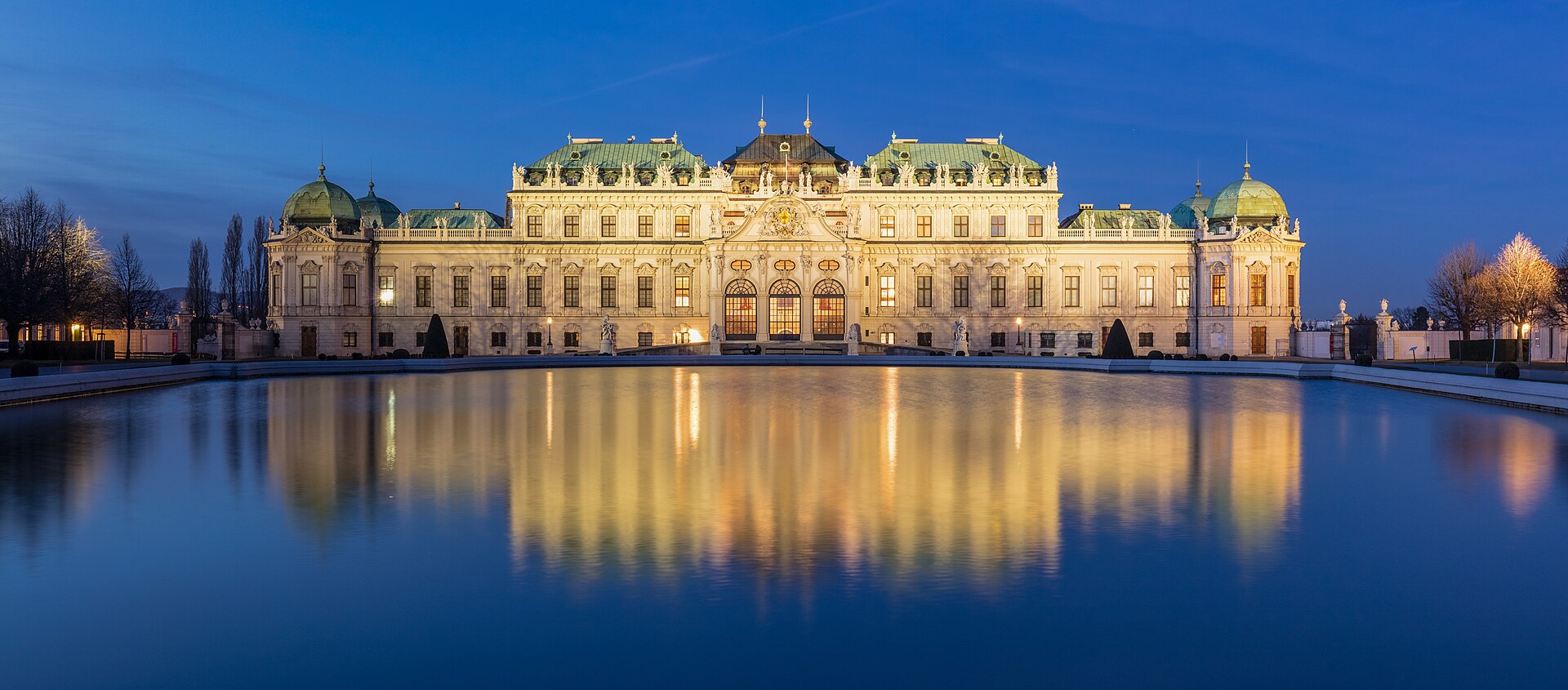
The Belvedere is a historic building complex in Vienna, Austria, consisting of two Baroque palaces, the Orangery, and the Palace Stables. Built as a summer residence for Prince Eugene of Savoy, the site is renowned for its architectural harmony and its extensive gardens, which feature fountains, cascades, and mythological sculptures.
The Upper Belvedere houses an extensive collection of Austrian art, including the world's largest collection of Gustav Klimt paintings. The complex serves as both a significant example of Baroque architecture and a major cultural institution, reflecting the grandeur of the Habsburg era and the artistic evolution of the region.
Key Facts
- Materials
- Stone, Stucco, Marble
- Civilization
- Austrian
- Accessibility
- Wheelchair accessible with elevator access to upper floors
- Date(s)
- 1712-1723
- Condition
- Well-preserved, active museum
- Original Function
- Summer residence
- Key Figures
- Prince Eugene of Savoy, Johann Lukas von Hildebrandt, Gustav Klimt
Commission and Construction
1712-1723Prince Eugene of Savoy commissioned the architect Johann Lukas von Hildebrandt to design the Lower Belvedere, completed in 1716. The larger Upper Belvedere was constructed later, serving as a prestigious venue for state functions and entertainment.
Imperial Acquisition
1752Following the death of Prince Eugene, Empress Maria Theresa purchased the entire complex. It became part of the imperial estates and was later used to house the imperial art collections.
Modern Era and Museum
20th century - presentAfter the fall of the monarchy in 1918, the Belvedere was transformed into a public museum. It survived significant damage during World War II and underwent extensive restoration to preserve its Baroque interiors and art collections.
Cultural Significance
The Belvedere is a cornerstone of Viennese cultural identity, symbolizing the city's transition from an imperial capital to a modern center of art. Its gardens are considered a masterpiece of Baroque landscape design, bridging the gap between the architecture of the palaces and the surrounding urban environment.
Beyond its architectural value, the site is globally recognized for its role in the preservation and display of Austrian Modernism. The presence of iconic works like Klimt's 'The Kiss' makes the palace a focal point for international art tourism and scholarly research.
Interpretive Notes
Scholarly debates and areas of uncertainty
There is ongoing academic discussion regarding the original intended use of the Upper Belvedere's Sala Terrena and the extent to which the garden's iconographic program reflects Prince Eugene's personal political ambitions versus standard Baroque allegorical tropes.
Visiting Information
Entry Rules
Open daily. Tickets are required for museum entry and can be purchased online or at the box office. Security checks are mandatory at all entrances. Large bags and backpacks must be stored in lockers.
Best Times to Visit
Weekday mornings are recommended to avoid weekend crowds. The gardens are best experienced in late spring and summer when the fountains are fully operational.
Photography
Non-commercial photography is permitted in the galleries without flash or tripods. Photography is strictly prohibited in specific temporary exhibition rooms.
Preservation Notes
Do not touch the artworks or wall coverings. Maintain a respectful distance from all historical fixtures. The palace is a non-smoking facility.
Nearby POIs
11 shownSources & Further Reading
- [1]The Belvedere: A History of the Palace and its Collections — Agnes Husslein-Arco. Belvedere Publication (2010)View
- [2]Baroque Architecture in Central Europe — John Stathatos. Academic Press (2015)
Key Facts
- Materials
- Stone, Stucco, Marble
- Civilization
- Austrian
- Accessibility
- Wheelchair accessible with elevator access to upper floors
- Date(s)
- 1712-1723
- Condition
- Well-preserved, active museum
- Original Function
- Summer residence
- Key Figures
- Prince Eugene of Savoy, Johann Lukas von Hildebrandt, Gustav Klimt