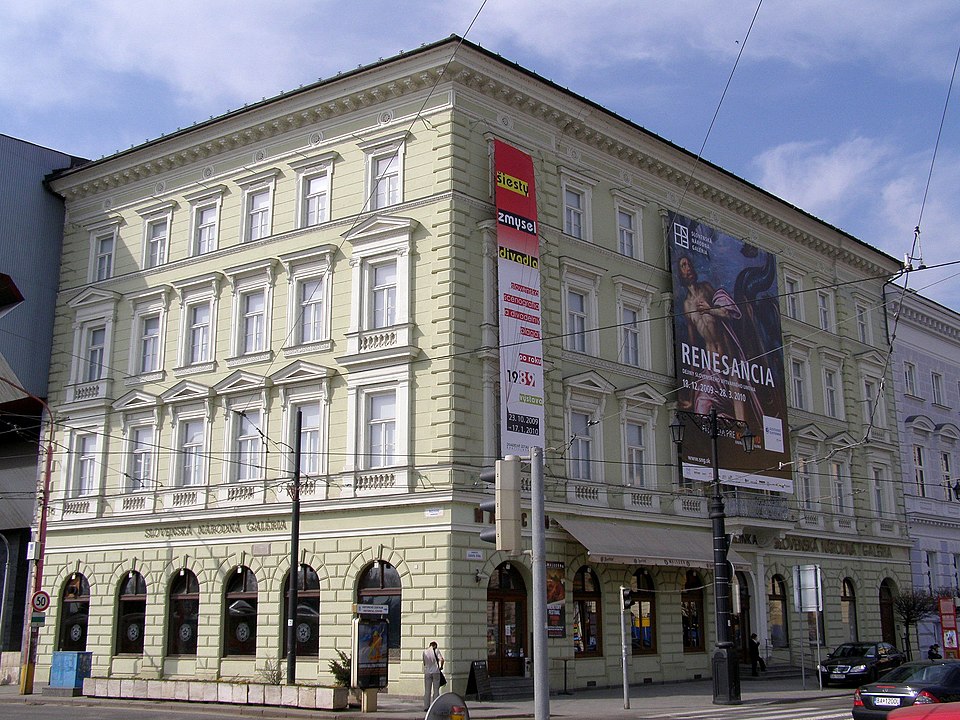
The Slovak National Gallery (SNG) is the primary institution for visual arts in Slovakia, housed within a complex that blends historical architecture with bold 20th-century design. The site centers on the 17th-century Esterházy Palace, which was expanded in the 1970s by architect Vladimír Dedeček with a controversial and iconic functionalist bridge extension that spans the courtyard.
The gallery holds the nation's most significant collection of fine arts, ranging from medieval Gothic panel paintings and Baroque sculpture to 20th-century modernism and contemporary works. Following an extensive multi-year reconstruction completed in 2022, the facility now integrates its disparate historical and modern wings into a unified public space along the Danube riverfront.
Key Facts
- Materials
- Brick, Concrete, Glass, Steel
- Civilization
- Slovak
- Accessibility
- Fully wheelchair accessible with elevators and ramps
- Date(s)
- 1948 (founding), 1970s (bridge extension), 2022 (renovation)
- Condition
- Fully restored and operational
- Original Function
- Art Museum
- Key Figures
- Vladimír Dedeček, Ľudovít Fulla
Establishment
1948The Slovak National Gallery was established by an act of the Slovak National Council in 1948, initially tasked with collecting and preserving works of art within the newly formed state structures.
The Dedeček Expansion
1970sArchitect Vladimír Dedeček designed the iconic bridge-like extension that connected the Esterházy Palace to the Water Barracks. This structure became a landmark of Slovak functionalist architecture but remained a subject of intense debate regarding its aesthetic impact on the historic city center.
Modern Reconstruction
2016-2022After years of closure due to structural decay, the gallery underwent a comprehensive renovation led by the architectural studio Architekti BKPŠ. The project successfully modernized the climate control systems and unified the complex while preserving the integrity of the Dedeček bridge.
Cultural Significance
The SNG serves as the custodian of Slovak national identity through visual culture. It acts as a bridge between the country's historical heritage and its contemporary artistic output, playing a vital role in public education and the preservation of Central European art history.
The site itself is a significant cultural artifact, representing the tension between historical preservation and socialist-era architectural ambition. Its recent renovation has turned the gallery into a central social hub for Bratislava, emphasizing transparency and public accessibility.
Interpretive Notes
Scholarly debates and areas of uncertainty
The primary scholarly and public debate surrounding the gallery concerns the legacy of the 1970s bridge extension. While some architectural historians view it as a masterpiece of late-modernist design, others have historically criticized it for its perceived lack of harmony with the surrounding baroque urban fabric.
Visiting Information
Entry Rules
Open Tuesday through Sunday. Admission is required for permanent and temporary exhibitions, though the public atrium and certain common areas are accessible free of charge. Visitors are expected to store large bags in provided lockers.
Best Times to Visit
Weekday mornings are generally quieter. The gallery is particularly active during the summer months when the courtyard hosts public events and film screenings.
Photography
Personal photography is permitted for non-commercial use without flash or tripods. Specific temporary exhibitions may prohibit photography due to copyright agreements.
Preservation Notes
Maintain distance from artworks and do not touch surfaces. The climate-controlled environment is strictly monitored; please follow staff instructions regarding the use of umbrellas and large items.
Nearby POIs
11 shownSources & Further Reading
- [1]
- [2]Vladimír Dedeček: A Monograph — Moravčíková, Henrieta. Slovak University of Technology Press (2018)
Key Facts
- Materials
- Brick, Concrete, Glass, Steel
- Civilization
- Slovak
- Accessibility
- Fully wheelchair accessible with elevators and ramps
- Date(s)
- 1948 (founding), 1970s (bridge extension), 2022 (renovation)
- Condition
- Fully restored and operational
- Original Function
- Art Museum
- Key Figures
- Vladimír Dedeček, Ľudovít Fulla