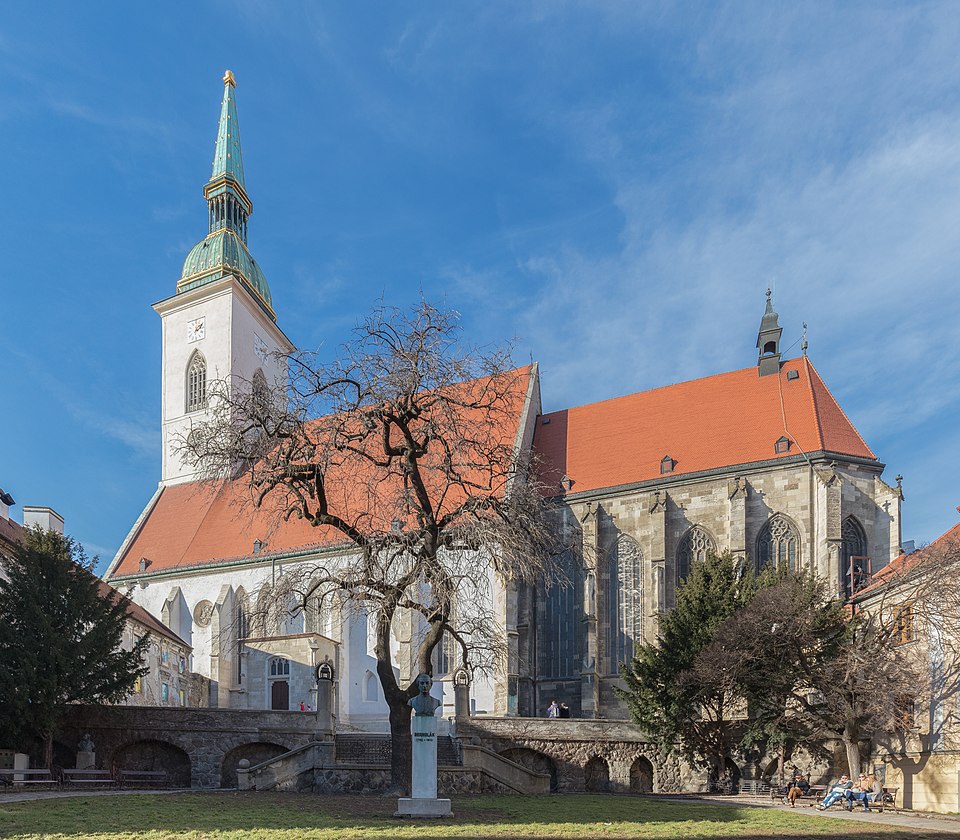
St Martin’s Cathedral is a Gothic church located in the historic center of Bratislava, constructed between the 13th and 15th centuries on the site of an earlier Romanesque structure. It served as the coronation church of the Kingdom of Hungary from 1563 to 1830, during which time eleven kings and eight queens were crowned within its walls. Its location just below Bratislava Castle underscored its political and ceremonial importance within the Habsburg realm. The cathedral is characterized by its three-nave layout, ribbed vaulting, and a prominent tower topped with a gilded replica of the Hungarian royal crown. Despite later modifications, including Baroque additions, the structure retains its core Gothic form. Today, it functions as an active Roman Catholic cathedral and remains one of the most historically significant religious buildings in Slovakia.
Key Facts
- Materials
- Stone
- Civilization
- Kingdom of Hungary
- Date(s)
- 13th–15th centuries
- Condition
- Well-preserved, active religious site
- Original Function
- Roman Catholic cathedral and coronation church
- Key Figures
- Maria Theresa, Maximilian II
- Architectural Style
- Gothic
Early Foundations
13th centuryThe cathedral was built on the site of an earlier Romanesque church following the expansion of Bratislava as a regional center. Construction began in the 13th century, incorporating Gothic architectural elements that reflected broader trends in Central Europe.
Gothic Expansion
14th–15th centuriesThe structure was expanded and refined over several centuries, resulting in a three-aisled basilica with ribbed vaulting and a tall tower. Its position near the city fortifications emphasized its importance within the urban landscape.
Coronation Church of Hungary
1563–1830After the Ottoman occupation of Buda, Bratislava became the capital of the Kingdom of Hungary, and the cathedral was designated as the coronation site for Hungarian monarchs. Ceremonies held here reinforced the city's political significance within the Habsburg monarchy.
Baroque Modifications
17th–18th centuriesInterior elements were modified during the Baroque period, including altars and decorative features. These additions introduced new artistic styles while preserving the overall Gothic structure.
Modern Preservation
19th century – presentRestoration efforts in the modern era have aimed to preserve both the Gothic and Baroque elements of the cathedral. It continues to function as an active place of worship and a major historical monument.
Cultural Significance
St Martin’s Cathedral played a central role in the political and religious life of the Kingdom of Hungary, particularly during the period when Bratislava served as the capital after the Ottoman conquest of central Hungary. Its function as a coronation site made it a symbol of royal authority and continuity during a time of geopolitical instability. In modern Slovakia, the cathedral remains a key historical landmark and an active religious institution. Its layered architectural styles reflect the broader historical transitions of the region, from medieval kingdom to Habsburg rule and into the present national context.
Interpretive Notes
Scholarly debates and areas of uncertainty
The extent to which the original Romanesque structure influenced the current Gothic design remains debated, as archaeological evidence is limited. Some scholars argue for substantial continuity in the site’s layout, while others suggest a more complete reconstruction during the Gothic period. There is also discussion regarding the precise ceremonial practices of the Hungarian coronations conducted here, as surviving records vary in detail and interpretation, particularly concerning liturgical arrangements and spatial usage within the cathedral.
Visiting Information
Entry Rules
Open daily. Entry is free; donations are encouraged. As an active cathedral, access may be limited during services and special events.
Best Times to Visit
Early morning or late afternoon for fewer visitors. Visiting outside of scheduled services allows more complete access to the interior.
Photography
Photography permitted without flash. Tripods and commercial photography require prior permission.
Preservation Notes
Maintain quiet and respectful behavior inside. Do not enter restricted areas or disturb ongoing services. Follow posted guidelines for visitors.
Nearby POIs
11 shownSources & Further Reading
- [1]St. Martin's Cathedral in Bratislava. Slovak Catholic Church Resources
- [2]Bratislava: The Coronation City — Mária Kohútová. Slovak Academic Press (2015)
- [3]The Kingdom of Hungary and the Habsburg Monarchy — Pál Engel. I.B. Tauris (2001)
Key Facts
- Materials
- Stone
- Civilization
- Kingdom of Hungary
- Date(s)
- 13th–15th centuries
- Condition
- Well-preserved, active religious site
- Original Function
- Roman Catholic cathedral and coronation church
- Key Figures
- Maria Theresa, Maximilian II
- Architectural Style
- Gothic