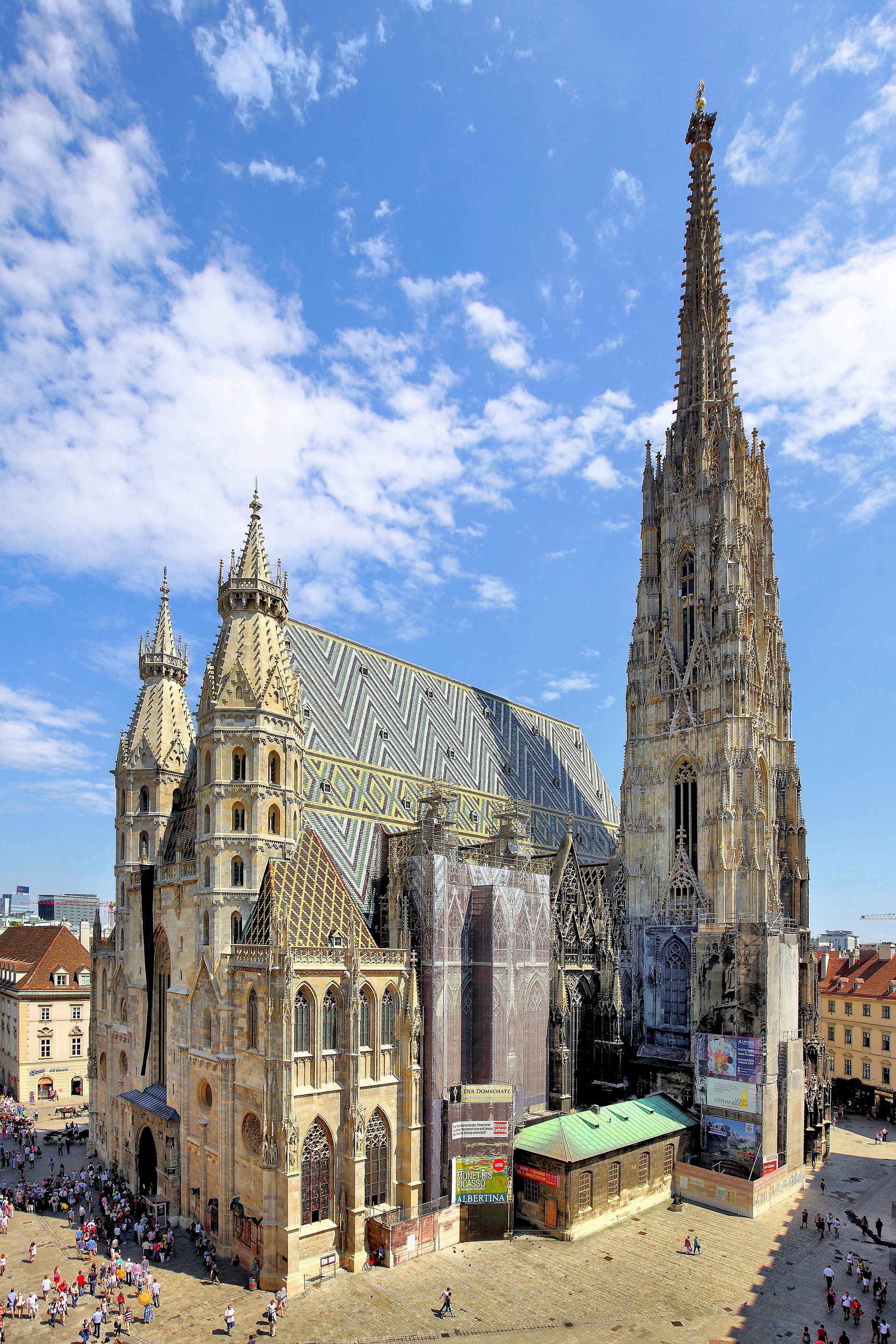
St. Stephen's Cathedral, located in the heart of Vienna, serves as the mother church of the Roman Catholic Archdiocese of Vienna and is a defining landmark of the city. The structure is renowned for its multi-colored tile roof, which features the imperial double-headed eagle and the coats of arms of the City of Vienna and Austria, and its massive south tower, known locally as 'Steffl'.
The cathedral stands on the ruins of two earlier churches, the first being a parish church consecrated in 1147. The current edifice reflects a transition from Romanesque foundations to a dominant Gothic style, characterized by its intricate stone carvings, soaring nave, and extensive catacombs. It has survived numerous conflicts, including the Ottoman sieges and the bombings of World War II, remaining a central symbol of Austrian national identity.
Key Facts
- Materials
- Limestone, Glazed roof tiles
- Civilization
- Austrian
- Accessibility
- Ground floor accessible; tower and catacombs have limited access
- Date(s)
- 1137–1160 (Romanesque), 1304–1511 (Gothic)
- Condition
- Active cathedral, fully restored
- Original Function
- Parish church
- Key Figures
- Duke Rudolf IV, Prince Eugene of Savoy, Wolfgang Amadeus Mozart
Foundations
12th centuryThe original Romanesque church was commissioned by Margrave Leopold IV and consecrated in 1147. It served as a parish church located outside the city walls of the time.
Gothic Expansion
14th–15th centuryUnder the patronage of the Habsburgs, particularly Duke Rudolf IV, the church underwent significant expansion. The Albertine Choir and the iconic south tower were constructed during this period, establishing the cathedral's Gothic profile.
Imperial Significance
16th–19th centuryThe cathedral became the seat of the Bishop of Vienna in 1722. It served as the site for major imperial events, including the funeral of Holy Roman Emperor Frederick III and the wedding of Wolfgang Amadeus Mozart.
War and Restoration
20th centuryDuring the final days of World War II, the cathedral suffered severe damage from fire caused by looting and subsequent shelling. A massive national effort led to its reconstruction, with the cathedral reopening in 1952.
Cultural Significance
St. Stephen's Cathedral is the spiritual and architectural heart of Vienna. Its silhouette is synonymous with the city's skyline, and it has historically functioned as a repository for the Habsburg dynasty, housing the tombs of numerous emperors and high-ranking officials.
Beyond its religious role, the cathedral is a site of deep cultural memory. It is the location where Mozart was married and later had his funeral service, and it remains a focal point for national celebrations and mourning in Austria.
Interpretive Notes
Scholarly debates and areas of uncertainty
There is ongoing academic discussion regarding the extent of the original Romanesque layout and the exact sequence of the Gothic expansions, as the site was heavily modified during the 19th-century restoration efforts which sought to 'purify' the Gothic aesthetic.
Visiting Information
Entry Rules
Open daily. Entry to the main nave is free, though some areas like the catacombs, tower, and treasury require a paid ticket. Modest dress is requested as it is an active place of worship.
Best Times to Visit
Early morning on weekdays to avoid large tourist groups. The cathedral is particularly significant during major liturgical holidays like Easter and Christmas.
Photography
Photography is permitted for personal use without flash. Tripods and professional equipment require prior authorization from the cathedral administration.
Preservation Notes
The limestone exterior is subject to constant weathering and pollution damage, requiring ongoing maintenance by the Dombauhütte (Cathedral Building Workshop). Visitors should respect cordoned-off areas.
Nearby POIs
11 shownSources & Further Reading
- [1]St. Stephen's Cathedral in Vienna — Renate Wagner-Rieger. Böhlau Verlag (1994)
- [2]The Cathedral of St. Stephen in Vienna — Anton Macku. Verlag für Jugend und Volk (1960)
Key Facts
- Materials
- Limestone, Glazed roof tiles
- Civilization
- Austrian
- Accessibility
- Ground floor accessible; tower and catacombs have limited access
- Date(s)
- 1137–1160 (Romanesque), 1304–1511 (Gothic)
- Condition
- Active cathedral, fully restored
- Original Function
- Parish church
- Key Figures
- Duke Rudolf IV, Prince Eugene of Savoy, Wolfgang Amadeus Mozart