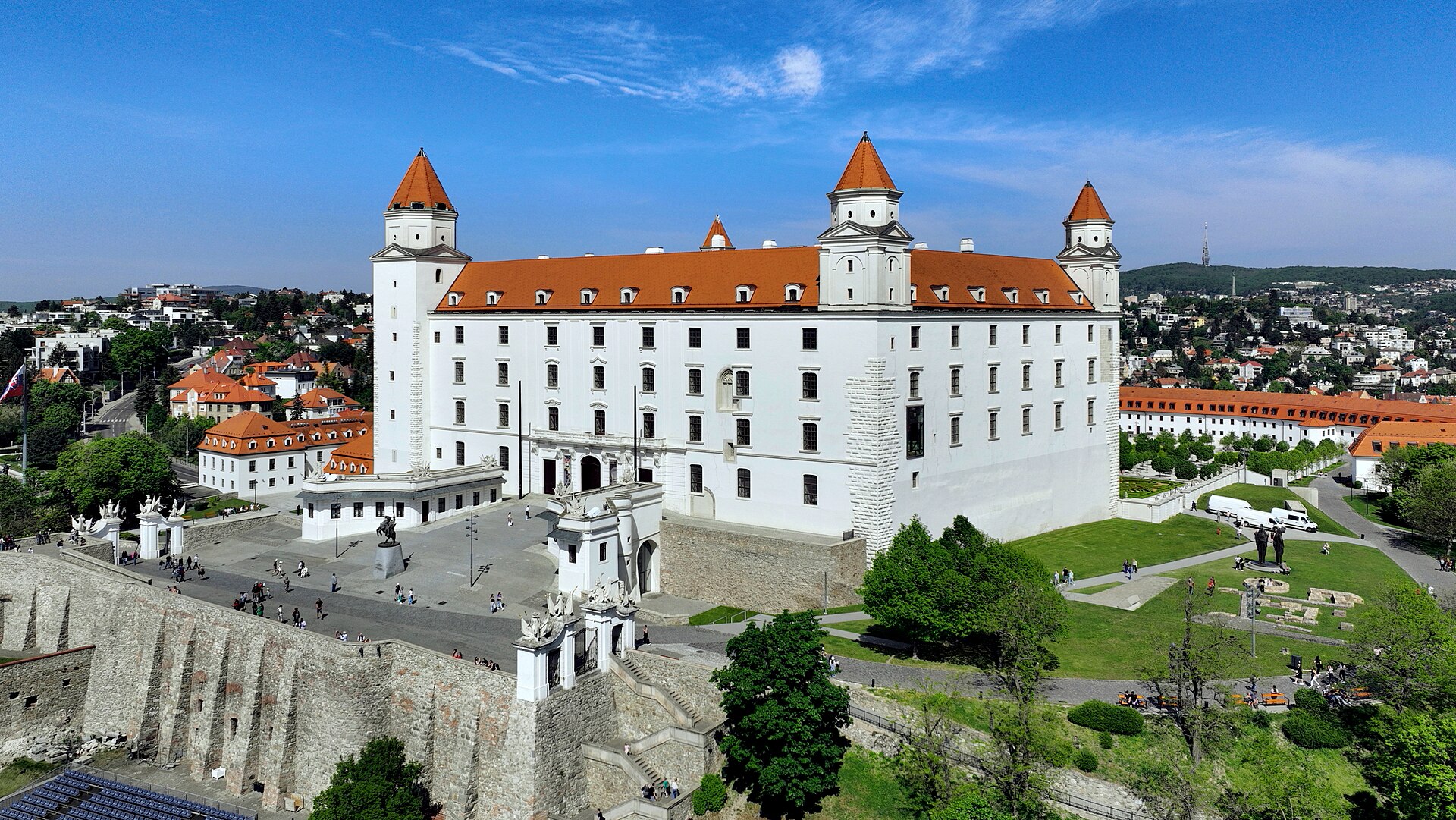
Bratislava Castle is a historic fortified complex situated on a hill overlooking the Danube River in Bratislava. Its strategic position has been occupied since prehistoric times, with major construction phases occurring during the medieval period and later transformations under the Habsburg Monarchy. The current structure largely reflects 18th-century Baroque reconstruction commissioned during the reign of Maria Theresa, when the castle served as a royal residence and administrative center. The castle is characterized by its rectangular layout with four corner towers and a prominent hilltop silhouette visible across the city. After suffering a destructive fire in 1811, the structure remained in ruins for over a century before being reconstructed in the mid-20th century. Today, it houses exhibitions of the Slovak National Museum and serves as a key symbol of Slovak history and statehood.
Key Facts
- Materials
- Stone
- Civilization
- Great Moravian, Kingdom of Hungary, Habsburg Monarchy
- Date(s)
- 9th century origins; major reconstruction 18th century
- Condition
- Reconstructed and preserved complex with museum
- Original Function
- Fortified stronghold and royal residence
- Key Figures
- Maria Theresa
- Architectural Style
- Baroque with medieval foundations
Early Settlement and Great Moravian Period
Prehistory – 9th centuryThe castle hill was inhabited from prehistoric times due to its strategic position above the Danube. During the Great Moravian period, it became a fortified center, serving both defensive and administrative functions.
Medieval Fortress
10th–15th centuriesFollowing the incorporation of the region into the Kingdom of Hungary, the site was developed into a stone fortress. It played a key role in defending the western frontier and controlling trade routes along the river.
Habsburg Reconstruction
18th centuryUnder Maria Theresa, the castle was transformed into a Baroque residence. Extensive renovations reshaped the medieval fortress into a more comfortable and representative seat of power, reflecting its administrative importance.
Destruction and Decline
19th centuryIn 1811, a fire severely damaged the castle, leaving it in ruins for more than a century. During this period, the structure lost its political and residential functions.
Modern Reconstruction
20th century – presentReconstruction efforts began in the mid-20th century, restoring the castle to its Baroque appearance. Today, it houses museum collections and serves as a cultural and historical landmark.
Cultural Significance
Bratislava Castle has long functioned as a symbol of political authority due to its commanding position and historical role as a seat of regional power. Its transformation from a medieval fortress to a Baroque residence reflects broader shifts in governance and the consolidation of Habsburg influence in Central Europe. In modern Slovakia, the castle serves as a prominent national symbol and a focal point for cultural identity. Its visibility across the city and its use as a museum space connect historical narratives with contemporary public life, reinforcing its role in representing Slovak heritage.
Visiting Information
Entry Rules
Open daily. Entry to the castle grounds is free. Museum exhibitions in the castle are ticketed with standard hours.
Best Times to Visit
Morning hours for fewer visitors and clearer views. Late afternoon provides better conditions for exploring the grounds without peak crowds.
Photography
Photography permitted in the courtyard. Interior photography may be restricted in certain exhibitions; check posted guidelines.
Preservation Notes
Stay on marked paths and respect barriers in museum areas. Some sections may be under ongoing maintenance or restoration.
Nearby POIs
11 shownSources & Further Reading
- [1]
- [2]The Kingdom of Hungary in the Middle Ages — Pál Engel. I.B. Tauris (2001)
- [3]Maria Theresa: The Habsburg Empress in Her Time — Barbara Stollberg-Rilinger. Princeton University Press (2019)
Key Facts
- Materials
- Stone
- Civilization
- Great Moravian, Kingdom of Hungary, Habsburg Monarchy
- Date(s)
- 9th century origins; major reconstruction 18th century
- Condition
- Reconstructed and preserved complex with museum
- Original Function
- Fortified stronghold and royal residence
- Key Figures
- Maria Theresa
- Architectural Style
- Baroque with medieval foundations