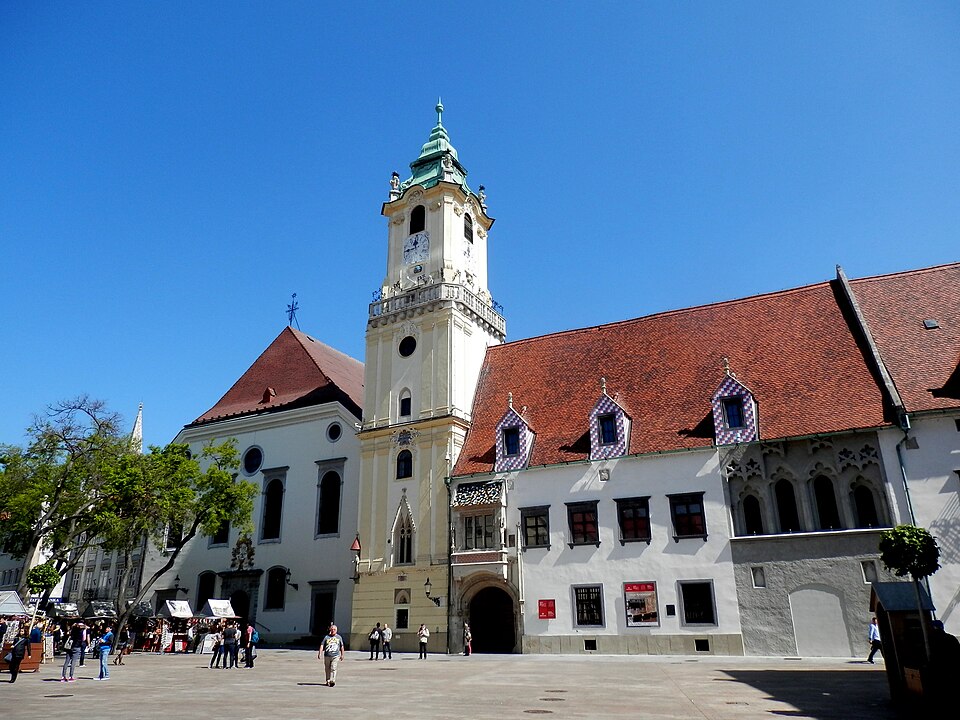
The Old Town Hall in Bratislava is a complex of buildings that served as the administrative center of the city from the 15th century until the late 19th century. It was formed through the gradual integration of several medieval houses, including the house of Jakob, the house of Pawer, and the house of Unger, centered around a prominent Gothic tower constructed in the 13th century.
The structure displays a diverse architectural evolution, featuring a Gothic tower, a Renaissance courtyard with arcades, and various Baroque modifications. Today, the complex houses the Bratislava City Museum, which documents the history of the city through extensive collections of artifacts, historical documents, and period interiors.
Key Facts
- Materials
- Stone, Brick, Plaster
- Civilization
- Kingdom of Hungary
- Accessibility
- Partial accessibility due to historical layout
- Date(s)
- 13th - 16th century
- Condition
- Well-preserved, functioning as a municipal museum
- Original Function
- City administration and seat of government
- Key Figures
- Jakob the Judge, Sigismund of Luxembourg
Medieval Origins
13th centuryThe core of the complex, the tower, was built in the 13th century as a defensive structure. By the 14th century, the city council began acquiring adjacent burgher houses to consolidate administrative functions.
Expansion and Integration
15th centuryThe individual houses were structurally unified into a single administrative complex. This period saw the addition of the Gothic chapel and the expansion of the council chambers, establishing the site as the heart of Bratislava's civic life.
Renaissance and Baroque Alterations
16th - 18th centuryThe courtyard was redesigned in the Renaissance style with arcades, and the building underwent several Baroque-era renovations following earthquake damage and changing aesthetic preferences of the city council.
Transition to Museum
1868 - presentFollowing the relocation of the city administration to the Primate's Palace, the building was repurposed. In 1868, it became the home of the Bratislava City Museum, preserving the site's historical integrity while opening its chambers to the public.
Cultural Significance
The Old Town Hall is a symbol of Bratislava's historical autonomy and its development as a free royal city within the Kingdom of Hungary. It represents the transition from medieval defensive architecture to the administrative requirements of a burgeoning urban center.
As the oldest museum in Bratislava, it serves as the primary repository for the city's collective memory, housing artifacts that trace the evolution of the capital from its Roman roots to the modern era.
Interpretive Notes
Scholarly debates and areas of uncertainty
There is ongoing academic discussion regarding the exact sequence of the integration of the individual houses, as the complex structural history makes it difficult to distinguish between original medieval walls and later 15th-century reinforcements.
Visiting Information
Entry Rules
Open Tuesday to Sunday. Tickets can be purchased at the entrance. Visitors are expected to respect the museum environment and follow signage regarding restricted areas.
Best Times to Visit
Weekday mornings are recommended to avoid weekend tourist crowds. The courtyard is particularly notable during the summer months.
Photography
Personal photography is permitted without flash. Professional photography requires prior authorization from the museum administration.
Preservation Notes
The building is a protected national cultural monument. Visitors should avoid touching historical wall surfaces and remain within designated visitor paths to protect the fragile interior plaster and stone elements.
Nearby POIs
11 shownSources & Further Reading
- [1]Bratislava City Museum: History of the Old Town Hall — Bratislava City Museum. Muzeum.bratislava.sk (2023)View
- [2]The Architecture of Bratislava — Ján Lacika. Dajama Publishing (2011)
Key Facts
- Materials
- Stone, Brick, Plaster
- Civilization
- Kingdom of Hungary
- Accessibility
- Partial accessibility due to historical layout
- Date(s)
- 13th - 16th century
- Condition
- Well-preserved, functioning as a municipal museum
- Original Function
- City administration and seat of government
- Key Figures
- Jakob the Judge, Sigismund of Luxembourg