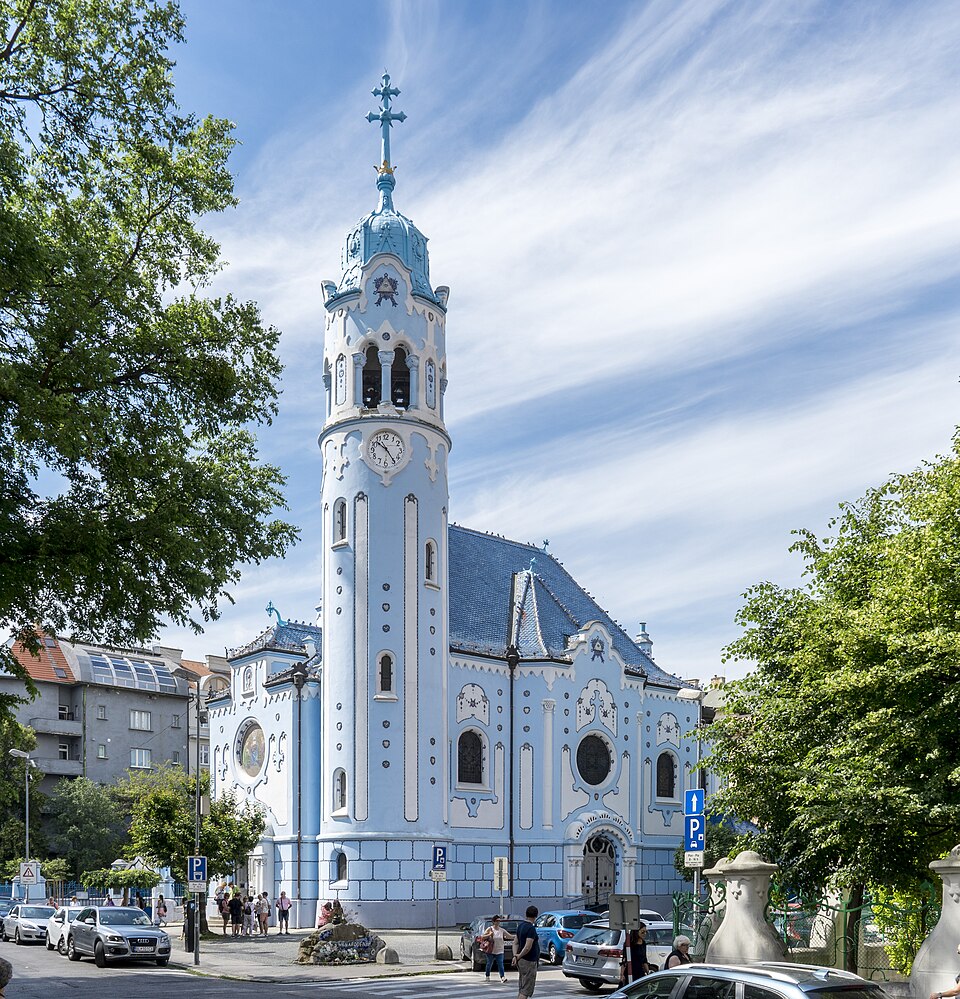
The Church of St. Elizabeth, commonly known as the Blue Church, is a prominent example of Hungarian Secessionist architecture located in the Old Town of Bratislava. Designed by the architect Ödön Lechner and completed in 1913, the structure is renowned for its distinctive blue-glazed roof tiles, majolica decorations, and soft, rounded forms that deviate from traditional ecclesiastical geometry.
Originally built as a chapel for the adjacent grammar school, the church is dedicated to Saint Elizabeth of Hungary, who was born in the nearby Bratislava Castle. Its facade features a unique color palette of pastel blue and white, accented by intricate mosaics and ceramic ornaments, making it one of the most recognizable landmarks in the city.
Key Facts
- Materials
- Majolica, Glazed ceramic tiles, Concrete, Brick
- Civilization
- Austro-Hungarian
- Accessibility
- Ground level access
- Date(s)
- 1909-1913
- Condition
- Well-preserved and active
- Original Function
- School chapel
- Key Figures
- Ödön Lechner
Design and Commission
1907-1909The church was commissioned as a chapel for the Catholic grammar school located on Bezručova Street. Ödön Lechner, often referred to as the 'Hungarian Gaudí,' was selected to design the building, applying his signature Secessionist style characterized by organic shapes and folk-inspired ornamentation.
Construction
1909-1913Construction proceeded over four years, during which the unique blue-glazed tiles and majolica details were meticulously applied. The building was consecrated in 1913, serving both the student population and the local community.
Modern Status
20th century - presentThe church has remained a functioning place of worship throughout the 20th and 21st centuries. It has undergone periodic maintenance to preserve its delicate ceramic facade and is currently protected as a national cultural monument of Slovakia.
Cultural Significance
The Blue Church serves as a primary example of the Hungarian Secessionist movement, representing a departure from the rigid historical styles of the 19th century. Its aesthetic influence extends beyond architecture, as it has become a symbol of Bratislava's unique cultural heritage and a popular subject for architectural study.
Locally, the church is deeply integrated into the daily life of the Old Town. It is frequently visited by tourists and locals alike, serving as a focal point for the neighborhood and a testament to the artistic innovation of the early 20th-century Austro-Hungarian Empire.
Interpretive Notes
Scholarly debates and areas of uncertainty
There is ongoing discussion among architectural historians regarding the extent of Lechner's influence on the specific decorative motifs used in the church, with some scholars comparing his work to contemporary movements in Vienna and Munich, while others emphasize the distinctively Hungarian folk-art origins of the ceramic patterns.
Visiting Information
Entry Rules
Open for public worship. Visitors are requested to remain quiet and respectful during services. Entry is free, but donations for maintenance are encouraged.
Best Times to Visit
Early morning or late afternoon provides the best natural light for viewing the blue facade. Weekdays are generally less crowded than weekends.
Photography
Photography is permitted for personal use. Tripods and professional equipment require prior permission from the parish office.
Preservation Notes
The exterior ceramic tiles are fragile; do not lean against or touch the facade. The site is actively maintained, and scaffolding may occasionally be present for cleaning and restoration.
Nearby POIs
11 shownSources & Further Reading
- [1]Ödön Lechner: The Hungarian Gaudí — Ákos Moravánszky. MIT Press (1998)
- [2]Secessionist Architecture in Central Europe — Jindřich Vybíral. Academia (2015)
Key Facts
- Materials
- Majolica, Glazed ceramic tiles, Concrete, Brick
- Civilization
- Austro-Hungarian
- Accessibility
- Ground level access
- Date(s)
- 1909-1913
- Condition
- Well-preserved and active
- Original Function
- School chapel
- Key Figures
- Ödön Lechner