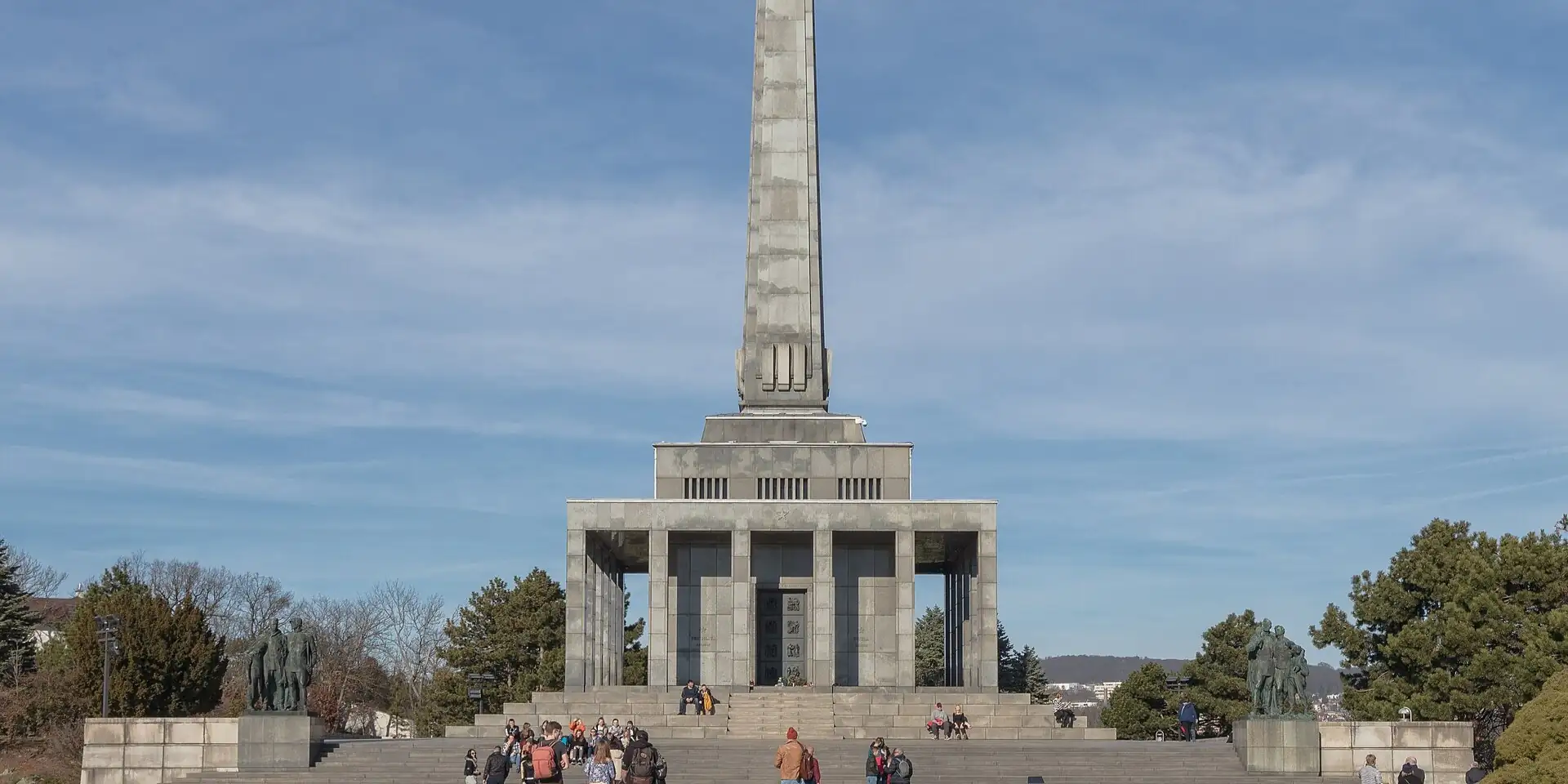
Slavín is a monumental war memorial and military cemetery in Bratislava, Slovakia, commemorating the Soviet Army soldiers who died during the liberation of the city from occupying German forces in April 1945 during World War II. The complex stands on a hill overlooking much of the city and serves as both a place of remembrance and a public landmark with panoramic views. Constructed between 1957 and 1960 and inaugurated on April 3, 1960, it incorporates a ceremonial hall, cemetery with mass and individual graves, and a tall obelisk crowned by a statue of a Soviet soldier holding a flag. The site was designated a National Cultural Monument in 1961 and remains a focal point for annual commemorations of the city’s liberation.
Key Facts
- Materials
- Concrete, Stone, Bronze
- Civilization
- Czechoslovak / Soviet-era
- Accessibility
- Open public site with panoramic city views
- Date(s)
- 1957 - 1960
- Condition
- Well-preserved, public memorial
- Original Function
- World War II memorial and military cemetery
- Key Figures
- Ján Svetlík, Alexander Trizuljak
Origins & Purpose
World War IIThe site on Slavín hill originally served as a field cemetery for Soviet soldiers who fell in the liberation battles around Bratislava in April 1945.
Construction & Unveiling
1957 - 1960The monument was designed by architect Ján Svetlík and constructed between 1957 and 1960. It was inaugurated on April 3, 1960, marking the 15th anniversary of Bratislava’s liberation.
Postwar Legacy
1961 - PresentIn 1961 Slavín was officially declared a National Cultural Monument. Ceremonies to honor the fallen soldiers continue on key anniversaries, and the site also provides panoramic views of Bratislava.
Cultural Significance
Slavín embodies the complex legacy of World War II in Central Europe — it is both a solemn burial ground for 6,845 Soviet soldiers and a symbolic landmark in Bratislava’s urban landscape. The memorial reflects the city’s historical liberation from Nazi occupation and the subsequent Soviet influence during the Cold War era. It remains a focal point for public ceremonies.
Visiting Information
Entry Rules
Open daily with free admission. The memorial and cemetery are publicly accessible at all hours. No formal ticketing or guided access is required.
Best Times to Visit
Late morning to early afternoon for clearer views across Bratislava and the surrounding landscape. Liberation anniversary dates (4 April) and Victory in Europe Day (8 May) have ceremonial significance.
Photography
Personal photography permitted throughout the site. Respect commemorative ceremonies and avoid obstructing memorial plaques or visitors paying respects.
Preservation Notes
Remain on marked paths and respect gravesites and memorial elements. Do not disturb memorial surfaces or inscriptions.
Nearby POIs
11 shownKey Facts
- Materials
- Concrete, Stone, Bronze
- Civilization
- Czechoslovak / Soviet-era
- Accessibility
- Open public site with panoramic city views
- Date(s)
- 1957 - 1960
- Condition
- Well-preserved, public memorial
- Original Function
- World War II memorial and military cemetery
- Key Figures
- Ján Svetlík, Alexander Trizuljak