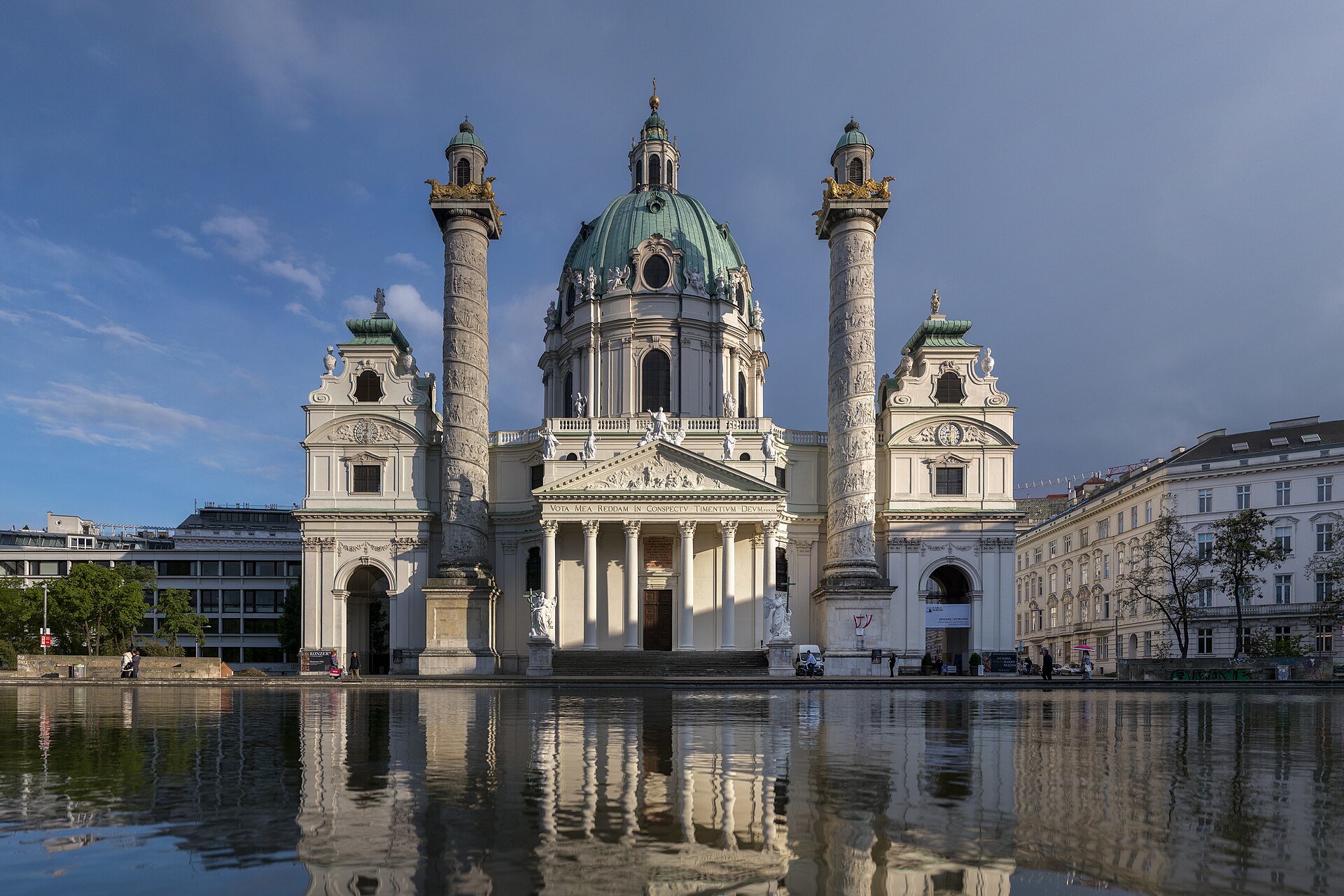
Karlskirche is a Baroque church located on the south side of Karlsplatz in Vienna, Austria. It was commissioned by Emperor Charles VI in 1713 following a plague epidemic and dedicated to Saint Charles Borromeo. The church is recognized for its impressive dome and twin columns flanking the entrance, which are inspired by Trajan's Column in Rome. Designed by Johann Bernhard Fischer von Erlach and completed by his son Joseph Emanuel Fischer von Erlach in 1737, Karlskirche combines elements of Greek, Roman, and Baroque architecture. Its interior features frescoes, ornate stuccowork, and a high altar emphasizing the devotion to Saint Charles Borromeo.
Key Facts
- Materials
- Stone, Stucco, Marble
- Civilization
- Habsburg Monarchy
- Accessibility
- Wheelchair accessible via main entrance, elevator to dome platform
- Date(s)
- 1716-1737 CE
- Condition
- Active church and popular tourist site
- Original Function
- Roman Catholic Church dedicated to Saint Charles Borromeo
- Key Figures
- Emperor Charles VI, Johann Bernhard Fischer von Erlach, Joseph Emanuel Fischer von Erlach
Commission and Planning
1713-1715 CEFollowing the plague of 1713, Emperor Charles VI vowed to build a church dedicated to Saint Charles Borromeo. Johann Bernhard Fischer von Erlach was commissioned to design the church, creating a plan combining classical temple fronts with a monumental dome.
Construction and Completion
1716-1737 CEConstruction began in 1716 under Fischer von Erlach and continued after his death in 1723 under his son Joseph Emanuel Fischer von Erlach. The church was consecrated in 1737. Its twin columns feature reliefs depicting scenes from the life of Saint Charles Borromeo.
Later Modifications
19th-20th centuryMinor restorations were undertaken in the 19th and 20th centuries to preserve frescoes and structural integrity. The dome platform was later equipped with an elevator to allow visitors panoramic views of Vienna.
Modern Role
20th century - presentKarlskirche remains an active Roman Catholic church and a cultural landmark in Vienna. It hosts regular services, concerts, and attracts tourists worldwide for its architectural significance.
Cultural Significance
Karlskirche serves as both a religious center and a civic symbol of Vienna's Baroque era. Its construction commemorates the city's survival of the 1713 plague, reflecting both spiritual devotion and imperial authority. The church is integral to Vienna’s cultural identity and contributes to the historical ensemble of Karlsplatz. It hosts concerts and events, reinforcing its role in local and tourist engagement.
Interpretive Notes
Scholarly debates and areas of uncertainty
Some scholarly debates concern the stylistic synthesis employed by Fischer von Erlach, combining Greek, Roman, and Baroque motifs. Experts discuss whether Karlskirche represents an innovative Baroque hybrid or a conservative homage to classical precedent.
Visiting Information
Entry Rules
Open daily from 09:00 to 18:00. Entry is ticketed for the dome platform; church nave is free to enter. Visitors should respect ongoing services.
Best Times to Visit
Morning hours (09:00-11:00) are recommended for smaller crowds and optimal lighting for interior frescoes.
Photography
Photography is allowed in the nave without flash; flash and tripods are prohibited. Dome platform photography requires purchased ticket.
Preservation Notes
Do not touch frescoes or stucco decorations. Use marked walkways inside the church. Dome platform has railings, but caution is advised.
Nearby POIs
11 shownSources & Further Reading
- [1]
- [2]Vienna: Art and Architecture of the Baroque — Rolf Toman. Prestel Publishing (2013)
- [3]Fischer von Erlach: Architectural Principles in Baroque Vienna — Markus Kristan. Austrian Academy of Sciences (2008)
Key Facts
- Materials
- Stone, Stucco, Marble
- Civilization
- Habsburg Monarchy
- Accessibility
- Wheelchair accessible via main entrance, elevator to dome platform
- Date(s)
- 1716-1737 CE
- Condition
- Active church and popular tourist site
- Original Function
- Roman Catholic Church dedicated to Saint Charles Borromeo
- Key Figures
- Emperor Charles VI, Johann Bernhard Fischer von Erlach, Joseph Emanuel Fischer von Erlach