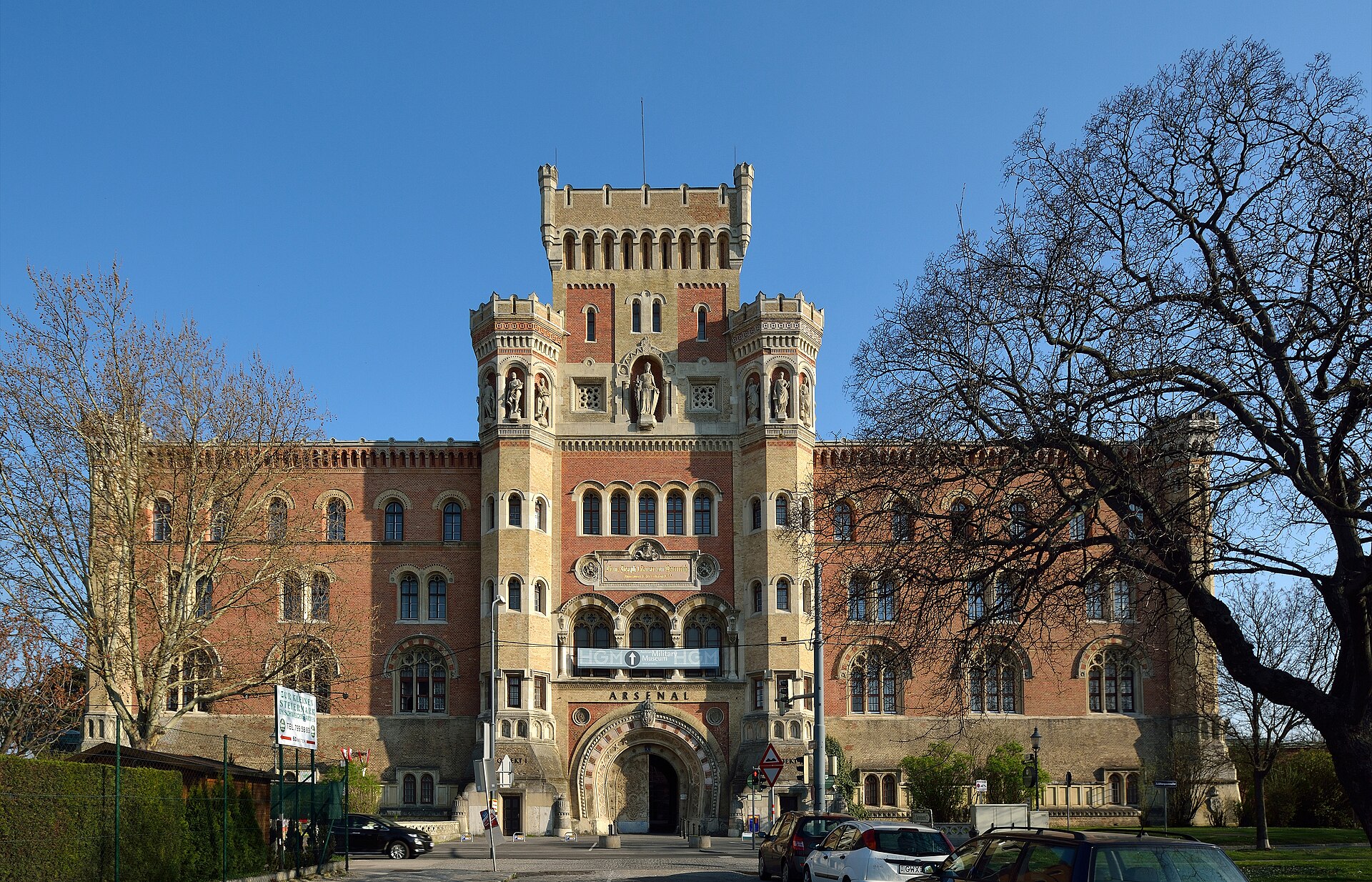
The Heeresgeschichtliches Museum (Museum of Military History) is the leading institution documenting the military history of Austria. Located within the Arsenal complex in Vienna, the museum serves as the primary repository for the history of the Austrian Armed Forces, covering events from the Thirty Years' War through the end of the 20th century.
The museum's extensive collections include historical weaponry, armor, uniforms, flags, and medals, alongside significant technological artifacts such as tanks, aircraft, and naval models. The building itself is a notable example of historicist architecture, designed by Theophil Hansen and Ludwig Förster, and serves as a central monument within the former imperial military complex.
Key Facts
- Materials
- Brick, Sandstone, Terracotta
- Civilization
- Austrian Empire / Republic of Austria
- Accessibility
- Wheelchair accessible
- Date(s)
- 1850-1856
- Condition
- Well-preserved, active museum
- Original Function
- Military museum and memorial
- Key Figures
- Theophil Hansen, Ludwig Förster, Franz Joseph I
Establishment of the Arsenal
1848-1856Following the revolutions of 1848, the Austrian Empire initiated the construction of the Arsenal in Vienna to secure the city. The museum was conceived as a central component of this complex to commemorate the military achievements of the Habsburg monarchy.
Imperial Era
1856-1918During the late 19th century, the museum expanded its collections significantly, focusing on the history of the imperial army and the glorification of military leadership. It became a key site for state-sponsored historical narratives.
World Wars and Transition
1918-1945Following the collapse of the Austro-Hungarian Empire, the museum underwent significant shifts in its curatorial focus. During World War II, the building sustained damage from Allied bombing, necessitating extensive post-war restoration.
Modern Era
1945-PresentIn the post-war period, the museum was reorganized to provide a more objective historical perspective on Austrian military affairs. It continues to serve as a research institution and a public venue for military history education.
Cultural Significance
The museum is central to the understanding of Austrian national identity and its complex military past. It provides a critical space for examining the transition from the imperial Habsburg military tradition to the modern neutral stance of the Austrian Armed Forces.
Beyond its historical collections, the museum is culturally significant for its architecture, which represents the 'Rundbogenstil' (round-arch style) popular in 19th-century Central Europe. It remains a focal point for academic research into military technology and the socio-political history of the region.
Interpretive Notes
Scholarly debates and areas of uncertainty
The museum has faced academic scrutiny regarding its historical narratives, particularly concerning the interpretation of the Habsburg military legacy and the presentation of the World Wars. Debates often center on the balance between preserving historical artifacts and providing a critical, modern context for the events depicted.
Visiting Information
Entry Rules
Open daily. Ticketed entry required. Visitors are subject to standard museum security protocols. No specific dress code is enforced.
Best Times to Visit
Weekday mornings are generally quieter. The museum is a popular destination for school groups, so visiting outside of peak academic terms can provide a more contemplative experience.
Photography
Personal photography is permitted for non-commercial use. Flash and tripods are generally prohibited to protect sensitive artifacts.
Preservation Notes
Do not touch exhibits. Maintain distance from open displays. Some areas may be closed periodically for conservation work or exhibit rotation.
Nearby POIs
11 shownSources & Further Reading
- [1]The Heeresgeschichtliches Museum: A Guide to the Collections — Manfried Rauchensteiner. HGM Press (2000)
- [2]The Arsenal of Vienna: Architecture and History — Peter Broucek. Austrian Military History Journal (2012)
Key Facts
- Materials
- Brick, Sandstone, Terracotta
- Civilization
- Austrian Empire / Republic of Austria
- Accessibility
- Wheelchair accessible
- Date(s)
- 1850-1856
- Condition
- Well-preserved, active museum
- Original Function
- Military museum and memorial
- Key Figures
- Theophil Hansen, Ludwig Förster, Franz Joseph I