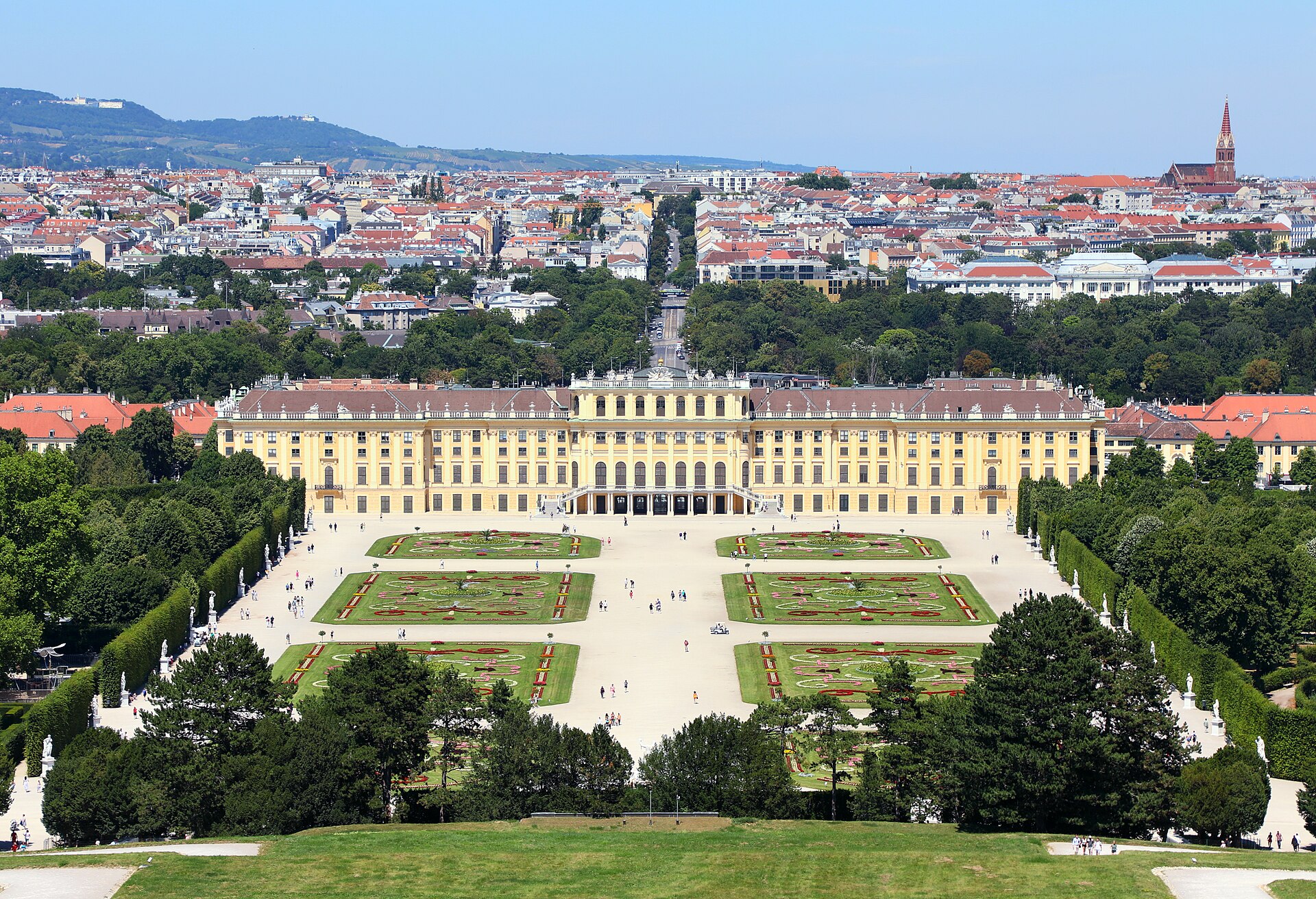
Schönbrunn Palace, located in Vienna, Austria, served as the principal summer residence of the Habsburg emperors from the 18th century to 1918. Its extensive grounds and opulent architecture reflect the grandeur and political power of the Habsburg monarchy. The palace complex, including its vast gardens, Gloriette, and zoo, is a prime example of Baroque art and landscape design.
Originally conceived as a hunting lodge for Emperor Leopold I, the palace underwent significant expansion and transformation under Empress Maria Theresa in the mid-18th century. Her reign saw the palace evolve into a magnificent Rococo ensemble, becoming a center of imperial court life and political decision-making. Today, it stands as a UNESCO World Heritage Site, attracting millions of visitors annually.
Key Facts
- Materials
- Stone, Stucco, Wood, Marble, Gilding
- Civilization
- Habsburg Monarchy
- Accessibility
- Partially wheelchair accessible; main tours are accessible, but some garden areas or upper floors may have limitations.
- Date(s)
- Late 17th century - Mid-18th century (major renovations)
- Condition
- Well-preserved, active museum, park, and zoo
- Original Function
- Imperial summer residence
- Key Figures
- Emperor Leopold I, Empress Maria Theresa, Nikolaus Pacassi, Johann Bernhard Fischer von Erlach, Emperor Franz Joseph I
Origins & Early Plans
Late 16th - Late 17th centuryThe site's history dates back to the Katterburg estate, acquired by Emperor Maximilian II in 1569. In 1683, following the Ottoman siege, Emperor Leopold I commissioned Johann Bernhard Fischer von Erlach to design a grand imperial hunting lodge, laying the foundation for the current palace.
Baroque Grandeur
Late 17th - Early 18th centuryConstruction of the first Baroque palace began in 1696 under Fischer von Erlach. Though not fully completed to his original ambitious plans, the initial structure established the core layout and architectural style, intended to rival Versailles.
Maria Theresa's Transformation
Mid-18th centuryThe palace achieved its present form under Empress Maria Theresa, who, from 1740 onwards, commissioned Nikolaus Pacassi to undertake extensive renovations and expansions. This period saw the palace transformed into a lavish Rococo residence, adding numerous state rooms, private apartments, and the Gloriette.
19th Century & Imperial Life
19th centurySchönbrunn remained the primary summer residence of the Habsburgs throughout the 19th century. Emperor Franz Joseph I, born and died at Schönbrunn, spent much of his life there. The palace witnessed significant historical events, including the Congress of Vienna in 1815.
End of Monarchy & Public Access
20th century - presentFollowing the collapse of the Habsburg monarchy in 1918, Schönbrunn Palace became the property of the newly established Republic of Austria. It was subsequently opened to the public as a museum, preserving its imperial legacy and making its historical rooms accessible to visitors.
Cultural Significance
Schönbrunn Palace is an enduring symbol of Austrian imperial history and European Baroque art. As the former residence of the Habsburgs, one of Europe's most influential dynasties, it embodies centuries of political power, cultural patronage, and dynastic ambition. The palace and its gardens reflect the sophisticated court culture that shaped Central Europe.
Beyond its historical role, Schönbrunn holds deep significance for Austrian national identity, representing a golden age of imperial splendor. Its architectural and artistic achievements continue to inspire, while its extensive park and the world's oldest continuously operating zoo serve as vital recreational and educational spaces for both locals and international visitors.
Visiting Information
Entry Rules
Entry to the palace requires a ticket, available online or at the ticket office. Various tour options are offered, including the Imperial Tour and Grand Tour. Large bags, backpacks, and umbrellas are not permitted inside the palace and must be stored in lockers. Strollers are allowed in some areas but may be restricted in others.
Best Times to Visit
The best times to visit are early morning (9:00-10:00) or late afternoon (after 15:00) to avoid peak crowds, especially during summer. Weekdays are generally less busy than weekends. Spring (April-May) and autumn (September-October) offer pleasant weather for exploring the gardens and fewer visitors than the high summer season.
Photography
Photography and videography are strictly prohibited inside the palace's imperial apartments and museum areas. Photography is permitted in the exterior gardens and park, but commercial photography and drone use require prior authorization. Flash photography is not allowed anywhere on the premises.
Preservation Notes
Visitors are requested to stay on marked paths within the palace and gardens to protect historical surfaces and plantings. Do not touch walls, furniture, or artworks. Food and drinks are not allowed inside the palace. Please dispose of waste in designated bins to help maintain the pristine condition of this UNESCO World Heritage site.
Nearby POIs
11 shownSources & Further Reading
- [1]Schoenbrunn Palace: The Imperial Summer Residence — Elfriede Iby, Alexander Koller. Brandstuetter Verlag (2014)
- [2]The Habsburgs: The Private Lives of a Dynasty — Martina Winkelhofer. Piper Verlag (2008)
- [3]Schoenbrunn Palace: A Cultural History — Herbert Fuhrmann. Verlag Anton Schroll & Co. (1984)
- [4]Schoenbrunn Palace Official WebsiteView
Key Facts
- Materials
- Stone, Stucco, Wood, Marble, Gilding
- Civilization
- Habsburg Monarchy
- Accessibility
- Partially wheelchair accessible; main tours are accessible, but some garden areas or upper floors may have limitations.
- Date(s)
- Late 17th century - Mid-18th century (major renovations)
- Condition
- Well-preserved, active museum, park, and zoo
- Original Function
- Imperial summer residence
- Key Figures
- Emperor Leopold I, Empress Maria Theresa, Nikolaus Pacassi, Johann Bernhard Fischer von Erlach, Emperor Franz Joseph I