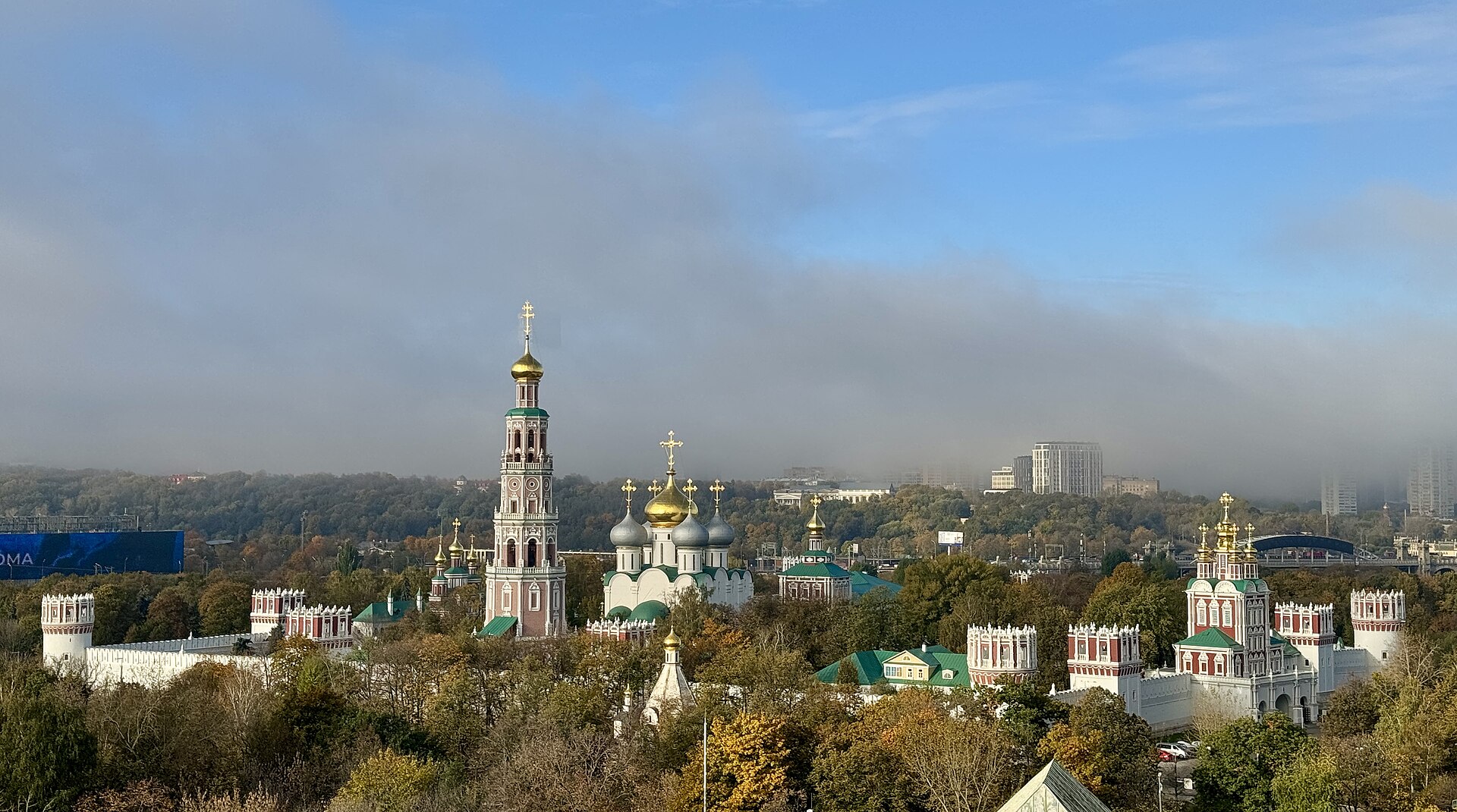
Novodevichy Convent is a fortified Russian Orthodox monastery founded in 1524 by Grand Prince Vasili III to commemorate the capture of Smolensk. Located on the Moscow River, it became one of the most prestigious convents in Russia, closely associated with the ruling elite and noble families. The ensemble includes the Smolensky Cathedral (1524–1525), defensive walls and towers built in the late 16th and 17th centuries, and later Baroque additions. The adjacent Novodevichy Cemetery became the burial place of prominent cultural and political figures. The convent was inscribed as a UNESCO World Heritage Site in 2004.
Key Facts
- Materials
- Brick, White stone, Wood
- Civilization
- Grand Duchy of Moscow; Tsardom of Russia
- Date(s)
- Founded 1524; major expansions 16th-17th centuries
- Condition
- Active convent and museum complex
- Original Function
- Orthodox convent and fortified religious complex
- Key Figures
- Vasili III, Tsarina Irina Godunova, Peter the Great, Sophia Alekseyevna
- Architectural Style
- Muscovite architecture; Moscow Baroque
Foundation and Political Role
1524-16th centuryFounded by Vasili III, the convent was dedicated to the Smolensk Icon of the Mother of God. It served both religious and political purposes, often housing noblewomen and members of the ruling family who entered monastic life.
Fortification and Expansion
Late 16th-17th centuriesStone defensive walls and twelve towers were constructed as part of Moscow’s southern defensive line. Architectural additions in the Moscow Baroque style further defined the complex’s appearance.
Imperial and Revolutionary Periods
18th-20th centuriesThe convent continued functioning during the imperial era but experienced secularization and partial closure after the 1917 Revolution. Many buildings were repurposed as museums under Soviet administration.
Restoration and UNESCO Recognition
Late 20th century-presentReligious life gradually resumed after the collapse of the Soviet Union. In 2004, the architectural ensemble was designated a UNESCO World Heritage Site in recognition of its historical and artistic significance.
Cultural Significance
Novodevichy Convent reflects the integration of religious institutions with political authority in Muscovite Russia. It functioned as both a spiritual center and a place of confinement or retirement for elite women, linking monastic life with dynastic history. The adjacent cemetery contains graves of prominent writers, artists, scientists, and political leaders, reinforcing the site’s importance within Russian cultural memory.
Interpretive Notes
Scholarly debates and areas of uncertainty
Scholars examine the dual role of the convent as both a religious institution and a political instrument, particularly in cases where noblewomen were compelled to take monastic vows. Debates also address conservation challenges associated with preserving fortified monastic complexes within expanding urban environments.
Visiting Information
Entry Rules
Free of charge and open to visitors daily. Paid admission required for museum areas. Modest dress expected inside active religious spaces. Access may be limited during services.
Best Times to Visit
Weekday mornings for lower visitor volume. Spring and early autumn offer comfortable conditions for exploring both the convent grounds and cemetery.
Photography
Exterior photography permitted. Interior photography may be restricted in certain churches or museum spaces; flash and tripods typically prohibited.
Preservation Notes
Visitors must remain on designated paths and avoid touching historic structures. Some areas may undergo restoration. Respectful behavior is required within active religious buildings.
Nearby POIs
11 shown- The Garage Museum2.9 km
- Poklonnaya Hill3.2 km
- Multimedia Art Museum3.2 km
- Museum of the Great Patriotic War3.2 km
- Peter the Great Statue3.6 km
- Cathedral of Christ the Saviour3.7 km
- Pushkin State Museum of Fine Arts3.9 km
- State Darwin Museum4 km
- Tretyakov Gallery4.4 km
- Stalin's Dacha4.4 km
- Cathedral of the Dormition4.7 km
Key Facts
- Materials
- Brick, White stone, Wood
- Civilization
- Grand Duchy of Moscow; Tsardom of Russia
- Date(s)
- Founded 1524; major expansions 16th-17th centuries
- Condition
- Active convent and museum complex
- Original Function
- Orthodox convent and fortified religious complex
- Key Figures
- Vasili III, Tsarina Irina Godunova, Peter the Great, Sophia Alekseyevna
- Architectural Style
- Muscovite architecture; Moscow Baroque
Nearby POIs
11 shown- The Garage Museum2.9 km
- Poklonnaya Hill3.2 km
- Multimedia Art Museum3.2 km
- Museum of the Great Patriotic War3.2 km
- Peter the Great Statue3.6 km
- Cathedral of Christ the Saviour3.7 km
- Pushkin State Museum of Fine Arts3.9 km
- State Darwin Museum4 km
- Tretyakov Gallery4.4 km
- Stalin's Dacha4.4 km
- Cathedral of the Dormition4.7 km