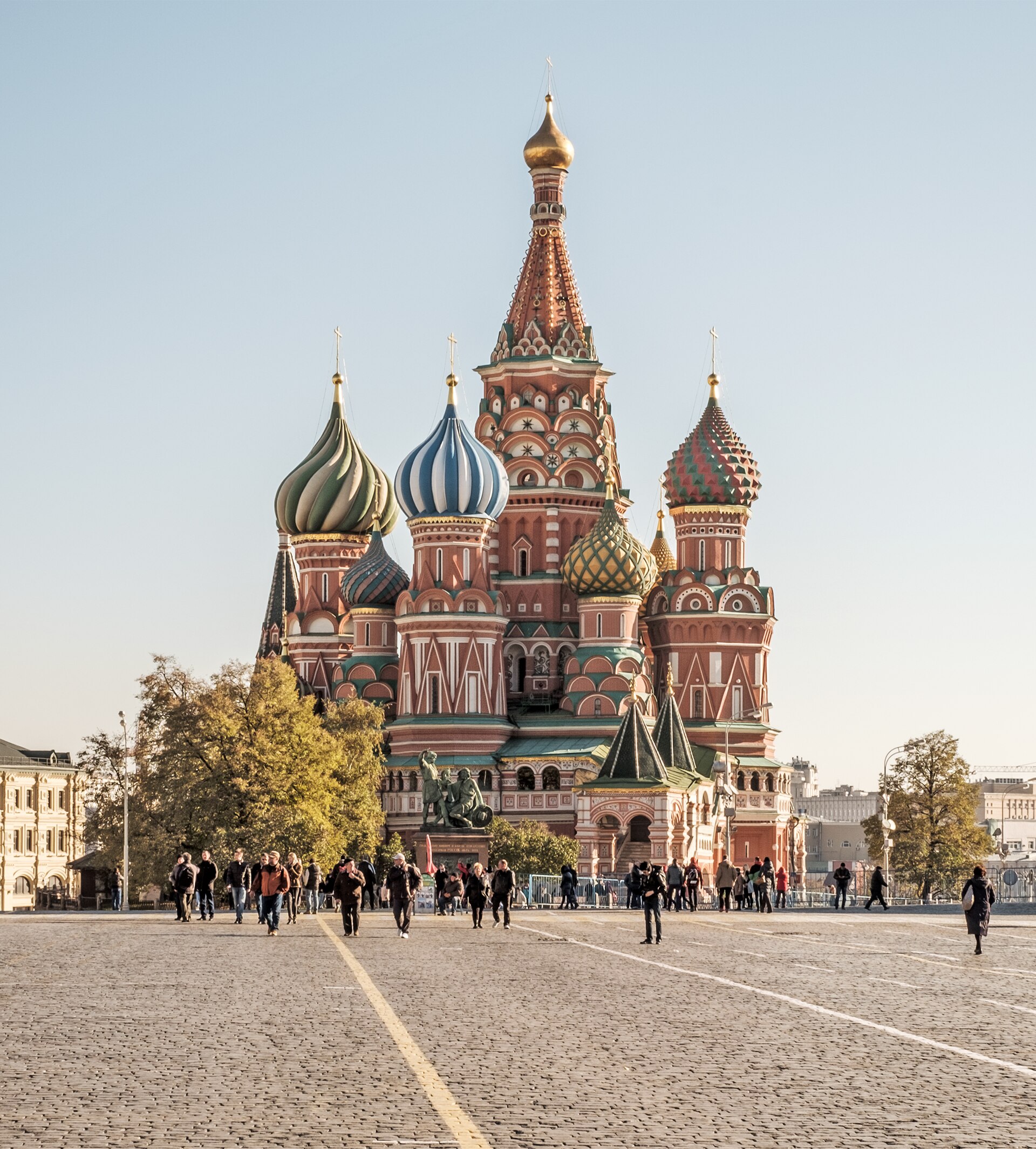
The Cathedral of Vasily the Blessed, commonly known as Saint Basil’s Cathedral, is a Russian Orthodox church in Moscow commissioned by Ivan Grozny (Ivan the Terrible) in 1555 to commemorate the capture of Kazan and Astrakhan. Its colorful onion domes and complex structure make it one of Russia’s most iconic architectural landmarks. The cathedral now functions primarily as a museum and a cultural symbol of Russia, while occasional religious services are still held on special occasions.
Key Facts
- Materials
- Brick, Stone, Wood (interior)
- Civilization
- Tsardom of Russia
- Date(s)
- 1555-1561
- Condition
- Well-preserved, functioning as museum with occasional services
- Original Function
- Commemorative Orthodox church
- Key Figures
- Ivan Grozny (Ivan the Terrible), Postnik Yakovlev
Construction and Commemoration
1555-1561Commissioned by Ivan IV to celebrate the conquest of Kazan, the cathedral was designed by architects Barma and Postnik Yakovlev. The structure consisted of nine chapels arranged around a central nave, each topped with uniquely patterned onion domes.
Medieval and Early Modern Alterations
17th-18th centuriesSeveral renovations and decorative enhancements occurred, including the addition of frescoes, gilding, and the expansion of interior spaces to accommodate growing religious functions.
Preservation and Museum Status
20th century - presentAfter the Russian Revolution, the cathedral was secularized and converted into a museum. It survived attempts at demolition during Stalin’s regime and remains a central symbol of Moscow and Russian national identity.
Cultural Significance
Saint Basil’s Cathedral symbolizes Russian religious and political power during the reign of Ivan IV and the consolidation of the Russian state. Its distinctive architecture has influenced Russian cultural identity and is a global symbol of Moscow. The cathedral is central to celebrations and imagery in Russian history, art, and tourism, representing both faith and national pride.
Interpretive Notes
Scholarly debates and areas of uncertainty
Scholars debate the extent of Postnik Yakovlev’s role versus other architects in the cathedral’s design. There is also ongoing discussion about whether the asymmetrical layout was intentional or evolved from later modifications.
Visiting Information
Entry Rules
Paid admission required for museum areas. General access is open daily, though certain chapels may have temporary closures for preservation or special events.
Best Times to Visit
Weekday mornings to avoid large tourist crowds. Summer afternoons are particularly busy due to high tourism.
Photography
Personal photography allowed without flash. Tripods and commercial photography require a permit. Flash is prohibited in frescoed areas.
Preservation Notes
Visitors must stay on marked paths and avoid touching walls or artifacts. Ongoing restoration work may limit access to some chapels. Follow all signage and staff instructions.
Nearby POIs
11 shown- Lenin's Mausoleum0.2 km
- Kremlin0.3 km
- Cathedral of the Dormition0.4 km
- Cathedral of Our Lady of Kazan0.4 km
- State Historical Museum0.4 km
- Bolshoi Theatre0.9 km
- Pushkin State Museum of Fine Arts1.2 km
- Tretyakov Gallery1.2 km
- Cathedral of Christ the Saviour1.4 km
- Moscow Museum of Modern Art1.7 km
- Peter the Great Statue1.8 km
Sources & Further Reading
- [1]St. Basil’s Cathedral: History and Architecture — William Craft Brumfield. Cambridge University Press (1993)
- [2]The Russian Orthodox Church and Architecture — Alexei Lidov. Routledge (2002)
Key Facts
- Materials
- Brick, Stone, Wood (interior)
- Civilization
- Tsardom of Russia
- Date(s)
- 1555-1561
- Condition
- Well-preserved, functioning as museum with occasional services
- Original Function
- Commemorative Orthodox church
- Key Figures
- Ivan Grozny (Ivan the Terrible), Postnik Yakovlev
Nearby POIs
11 shown- Lenin's Mausoleum0.2 km
- Kremlin0.3 km
- Cathedral of the Dormition0.4 km
- Cathedral of Our Lady of Kazan0.4 km
- State Historical Museum0.4 km
- Bolshoi Theatre0.9 km
- Pushkin State Museum of Fine Arts1.2 km
- Tretyakov Gallery1.2 km
- Cathedral of Christ the Saviour1.4 km
- Moscow Museum of Modern Art1.7 km
- Peter the Great Statue1.8 km