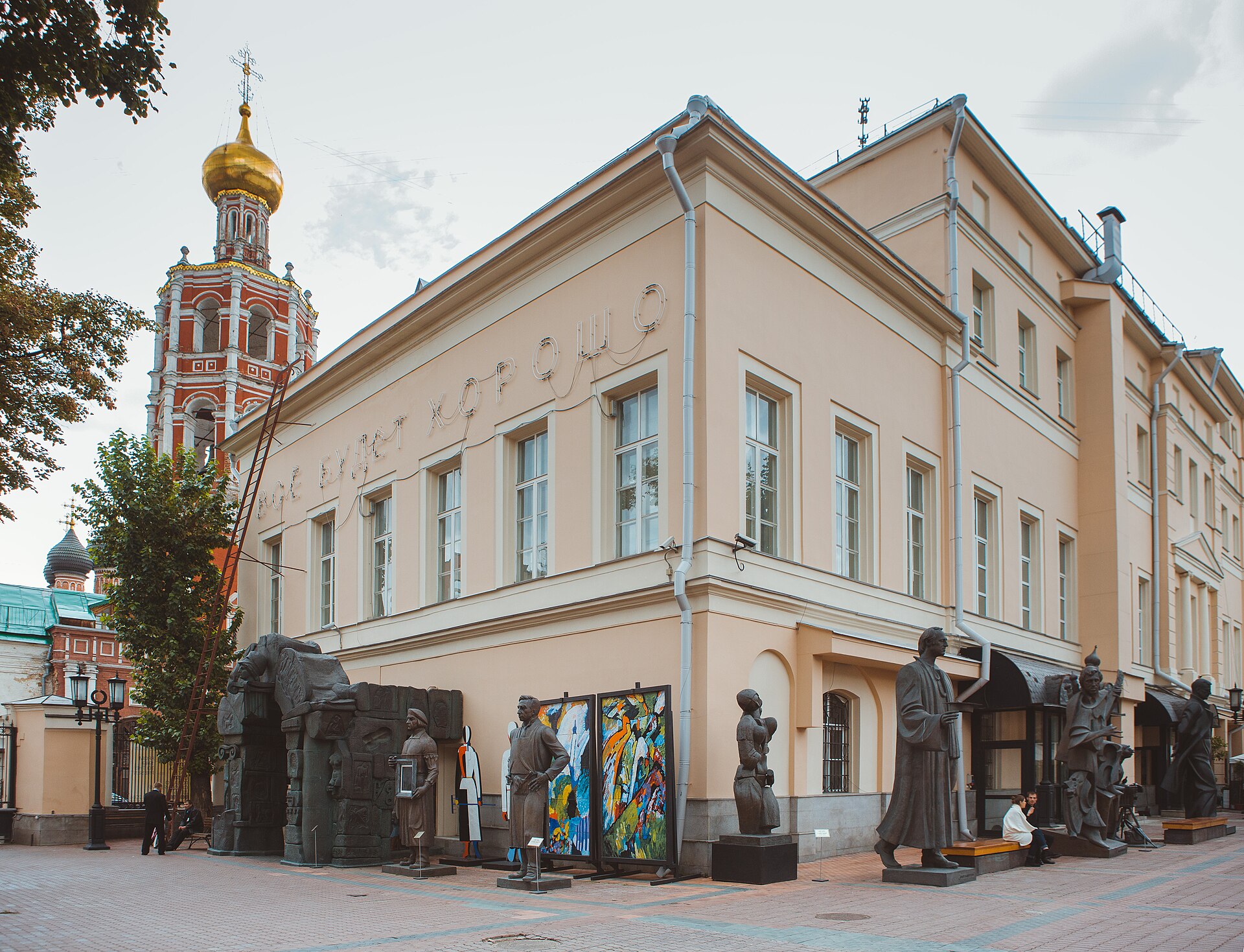
The Moscow Museum of Modern Art (MMOMA) is the first state museum in Russia dedicated exclusively to the art of the 20th and 21st centuries. Founded in 1999 by Zurab Tsereteli, the museum houses a significant collection that traces the evolution of Russian art from the early avant-garde period through the Soviet nonconformist movement to contemporary installations.
The museum operates across several historic buildings in central Moscow, with its main site located in a 18th-century mansion on Petrovka Street. Its extensive holdings include works by prominent figures such as Kazimir Malevich, Marc Chagall, and Natalia Goncharova, alongside a rotating schedule of international exhibitions and educational programs.
Key Facts
- Materials
- Brick, Stucco, Glass
- Civilization
- Russian
- Accessibility
- Wheelchair accessible at main locations
- Date(s)
- 1999
- Condition
- Active
- Original Function
- Art Museum
- Key Figures
- Zurab Tsereteli
Founding and Vision
1999The museum was established in 1999 by the Russian Academy of Arts and its president, Zurab Tsereteli. It was the first state-funded institution in Russia to focus specifically on modern and contemporary art, filling a significant gap in the national museum landscape.
Expansion and Development
2000-2010Following its opening, the museum rapidly expanded its collection through acquisitions and donations, particularly of Soviet nonconformist art. It grew from a single location to a multi-site institution, incorporating several historic buildings across Moscow to house its growing archives and exhibition spaces.
Contemporary Status
2011-PresentToday, MMOMA serves as a major hub for contemporary art research and education. It maintains an active publishing program and hosts international collaborations, continuing to document the trajectory of Russian art in a global context.
Cultural Significance
MMOMA plays a critical role in preserving the legacy of the Russian avant-garde and the underground nonconformist movements that were suppressed during the Soviet era. By providing a state-sanctioned platform for these works, the museum has been instrumental in reintegrating 20th-century Russian art into the broader international art historical canon.
Beyond its collection, the museum serves as a vital educational center, fostering dialogue between historical Russian modernism and contemporary global practices. It remains a central institution for the study of the social and political shifts reflected in Russian visual culture over the last century.
Interpretive Notes
Scholarly debates and areas of uncertainty
There is ongoing academic discussion regarding the museum's role in defining the 'canon' of Russian nonconformist art, given its origins within the Russian Academy of Arts. Scholars often debate the balance between the museum's state-funded status and its ability to provide objective historical analysis of works that were once considered subversive or anti-establishment.
Visiting Information
Entry Rules
Open Tuesday through Sunday. Tickets can be purchased online or at the box office. Visitors are required to check large bags in the cloakroom.
Best Times to Visit
Weekday mornings are generally quieter. The museum frequently hosts evening lectures and vernissages which are popular with the local art community.
Photography
Non-commercial photography is permitted without flash. Tripods and professional lighting equipment require prior authorization.
Preservation Notes
Maintain a respectful distance from all artworks. Flash photography is strictly prohibited to prevent light damage to sensitive archival materials and paintings.
Nearby POIs
11 shown- Bolshoi Theatre0.8 km
- Cathedral of Our Lady of Kazan1.3 km
- State Historical Museum1.3 km
- Lenin's Mausoleum1.5 km
- Cathedral of Vasily the Blessed1.7 km
- Kremlin1.7 km
- Cathedral of the Dormition1.8 km
- Central Armed Forces Museum2 km
- Pushkin State Museum of Fine Arts2.3 km
- Cathedral of Christ the Saviour2.6 km
- Tretyakov Gallery2.9 km
Sources & Further Reading
- [1]
- [2]Russian Art of the 20th Century — Ekaterina Degot. Artguide Editions (2018)
Key Facts
- Materials
- Brick, Stucco, Glass
- Civilization
- Russian
- Accessibility
- Wheelchair accessible at main locations
- Date(s)
- 1999
- Condition
- Active
- Original Function
- Art Museum
- Key Figures
- Zurab Tsereteli
Nearby POIs
11 shown- Bolshoi Theatre0.8 km
- Cathedral of Our Lady of Kazan1.3 km
- State Historical Museum1.3 km
- Lenin's Mausoleum1.5 km
- Cathedral of Vasily the Blessed1.7 km
- Kremlin1.7 km
- Cathedral of the Dormition1.8 km
- Central Armed Forces Museum2 km
- Pushkin State Museum of Fine Arts2.3 km
- Cathedral of Christ the Saviour2.6 km
- Tretyakov Gallery2.9 km