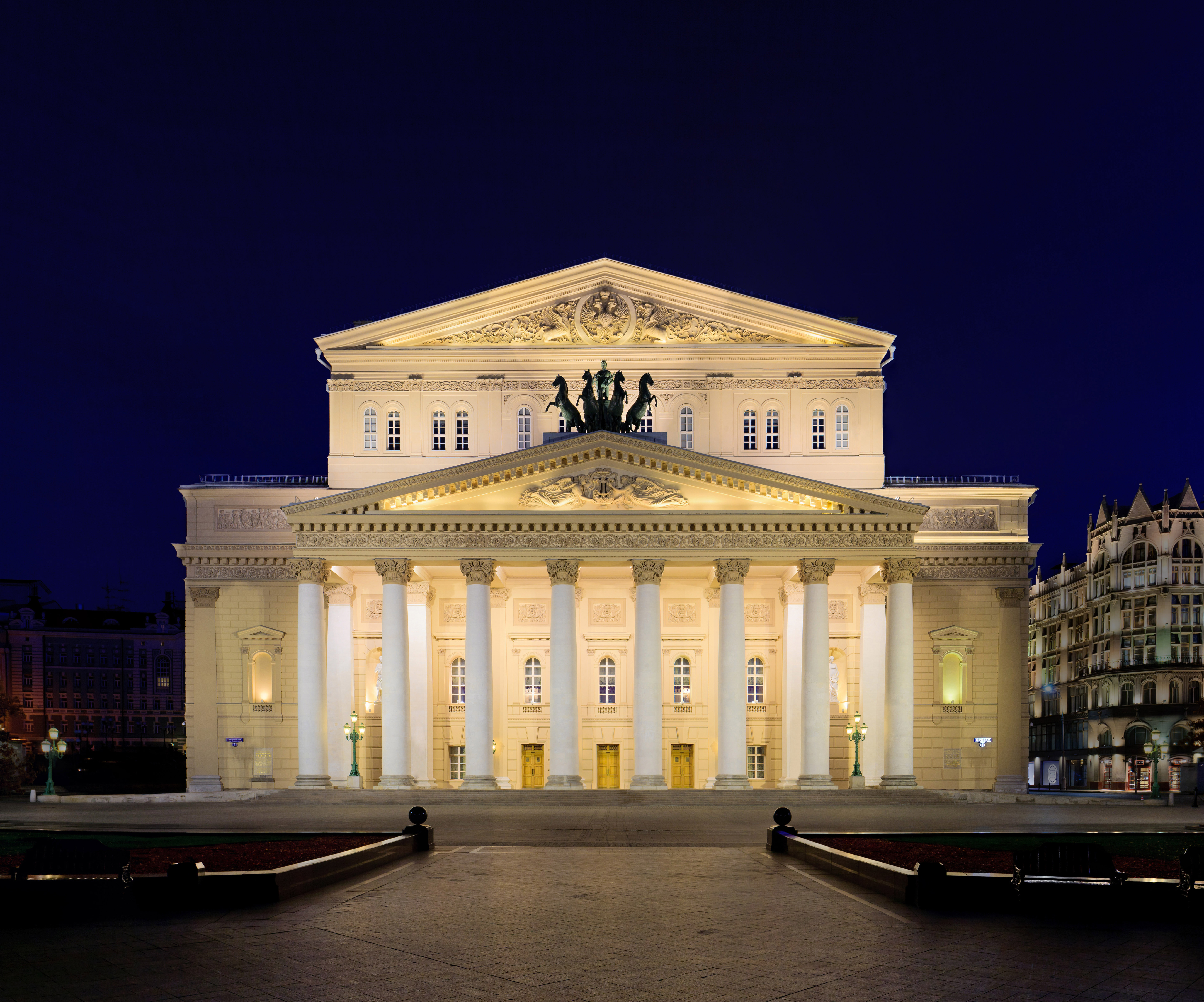
The Bolshoi Theatre is a historic performance venue in Moscow, Russia, designed by architect Joseph Bové and opened in 1825. It serves as the primary home for the Bolshoi Ballet and Bolshoi Opera, two of the oldest and most prestigious performing arts companies in the world. The building is a landmark of Russian Neoclassical architecture, characterized by its iconic eight-column portico topped by a quadriga of Apollo.
Throughout its history, the theatre has undergone multiple reconstructions following fires and structural damage, most notably the extensive restoration completed in 2011. This project aimed to restore the 19th-century imperial aesthetic while integrating modern acoustic and stage technology, ensuring the venue remains a central pillar of global performing arts.
Key Facts
- Materials
- Brick, Stucco, White stone, Gold leaf, Velvet
- Civilization
- Russian Empire
- Accessibility
- Wheelchair accessible with designated seating areas
- Date(s)
- 1820-1825
- Condition
- Fully restored and active
- Original Function
- Public theatre for opera and ballet
- Key Figures
- Joseph Bové, Alberto Cavos, Pyotr Ilyich Tchaikovsky
Founding and Early Years
1825The theatre was inaugurated on January 18, 1825, following the destruction of the earlier Petrovsky Theatre. Designed by Joseph Bové, it was intended to showcase the cultural prestige of the Russian Empire.
Reconstruction and Expansion
1853-1856After a devastating fire in 1853, the theatre was rebuilt by architect Alberto Cavos. This iteration introduced the famous interior design and the current facade, which remains the basis for the modern structure.
Soviet Era
1917-1991During the Soviet period, the Bolshoi became a symbol of state cultural achievement. It survived the Russian Civil War and World War II, continuing to host world-renowned ballet and opera productions despite political shifts.
Modern Restoration
2005-2011The theatre underwent a massive six-year restoration project to repair structural decay and modernize stage equipment. The project successfully reclaimed the original imperial-era interior decor while upgrading the facility to contemporary standards.
Cultural Significance
The Bolshoi Theatre is synonymous with Russian national identity and the pinnacle of classical ballet and opera. It has historically served as a venue for major state events and remains a global reference point for the performing arts, influencing generations of dancers, composers, and choreographers.
Interpretive Notes
Scholarly debates and areas of uncertainty
Debates often center on the 2011 restoration, with some critics arguing that the modernization sacrificed historical authenticity for technical capacity, while others praise the successful preservation of the 19th-century acoustic environment.
Visiting Information
Entry Rules
Entry is by ticket only. Performances are scheduled throughout the year. Visitors are expected to adhere to a formal dress code. Security screening is mandatory for all guests.
Best Times to Visit
The main season runs from September to July. Evening performances are the standard, though matinees are available on weekends.
Photography
Photography is strictly prohibited during performances. Non-flash photography is permitted in the foyer and public areas before the show and during intermissions.
Preservation Notes
The building is a protected cultural heritage site. Visitors are requested to refrain from touching the historic gilding and velvet upholstery. Food and drink are restricted to designated lobby areas.
Nearby POIs
11 shown- Cathedral of Our Lady of Kazan0.5 km
- State Historical Museum0.6 km
- Lenin's Mausoleum0.7 km
- Moscow Museum of Modern Art0.8 km
- Cathedral of Vasily the Blessed0.9 km
- Kremlin1 km
- Cathedral of the Dormition1 km
- Pushkin State Museum of Fine Arts1.7 km
- Cathedral of Christ the Saviour1.9 km
- Tretyakov Gallery2.1 km
- Multimedia Art Museum2.4 km
Sources & Further Reading
- [1]The Bolshoi Theatre: A History — Simon Morrison. Oxford University Press (2016)
- [2]Restoring the Bolshoi: Architecture and Memory — Elena V. Zhuravleva. Journal of Cultural Heritage (2012)
Key Facts
- Materials
- Brick, Stucco, White stone, Gold leaf, Velvet
- Civilization
- Russian Empire
- Accessibility
- Wheelchair accessible with designated seating areas
- Date(s)
- 1820-1825
- Condition
- Fully restored and active
- Original Function
- Public theatre for opera and ballet
- Key Figures
- Joseph Bové, Alberto Cavos, Pyotr Ilyich Tchaikovsky
Nearby POIs
11 shown- Cathedral of Our Lady of Kazan0.5 km
- State Historical Museum0.6 km
- Lenin's Mausoleum0.7 km
- Moscow Museum of Modern Art0.8 km
- Cathedral of Vasily the Blessed0.9 km
- Kremlin1 km
- Cathedral of the Dormition1 km
- Pushkin State Museum of Fine Arts1.7 km
- Cathedral of Christ the Saviour1.9 km
- Tretyakov Gallery2.1 km
- Multimedia Art Museum2.4 km