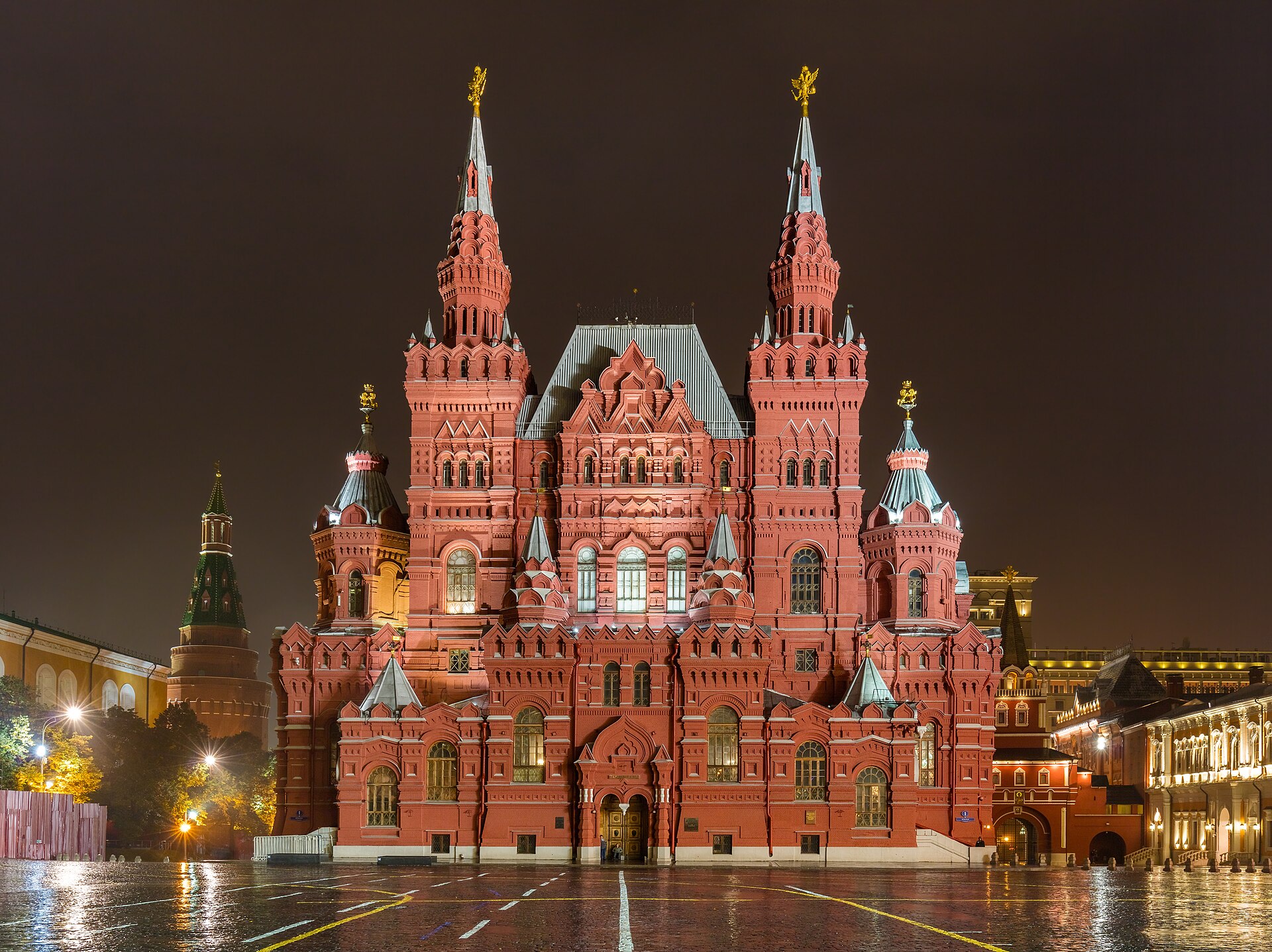
The State Historical Museum, located between Red Square and Manege Square in Moscow, presents the history of Russia from ancient times to the present. Constructed between 1875 and 1883, the building itself is a landmark example of Russian Revival architecture. Its extensive collections include archaeological artifacts, manuscripts, numismatics, ethnography, and artworks, offering a comprehensive overview of Russian civilization and culture.
Key Facts
- Materials
- Brick, Stone, Metal, Plaster
- Civilization
- Russian Empire; Russian Federation
- Date(s)
- 1875-1883
- Condition
- Fully operational museum
- Original Function
- National museum of Russian history
- Key Figures
- Ivan Zabelin (historian), Vladimir Sherwood (architect), Alexander III
Founding and Construction
1875-1883The museum was commissioned by Alexander III and designed by Vladimir Sherwood in the Russian Revival style. It was intended to preserve and showcase Russia’s historical artifacts and promote national identity.
Early 20th Century
1883-1917The museum’s collections expanded rapidly through acquisitions and donations, including private collections of aristocrats and scholars. It became a major educational resource and cultural institution in Moscow.
Soviet Era
1917-1991During the Soviet period, the museum was reorganized to align with ideological narratives, highlighting revolutionary history and state achievements. Some exhibits were relocated or reinterpreted according to political priorities.
Modern Developments
1991-presentAfter the Soviet Union’s dissolution, the museum restored many exhibits and updated galleries to reflect broader historical perspectives. It now hosts permanent and temporary exhibitions, educational programs, and public events.
Cultural Significance
The State Historical Museum embodies Russia’s commitment to preserving and interpreting its national history. It plays a central role in public education, cultural identity, and historical scholarship, particularly regarding Russia’s imperial, Soviet, and post-Soviet eras.
Interpretive Notes
Scholarly debates and areas of uncertainty
Debates focus on the interpretation of Russian history in the museum’s exhibitions, the balance between national pride and critical historiography, and the presentation of politically sensitive events.
Visiting Information
Entry Rules
Paid admission required. Security screening in place. Bags may be restricted inside exhibition halls.
Best Times to Visit
Weekday mornings are ideal to avoid crowds. Public holidays and weekends can be very busy.
Photography
Personal photography allowed without flash in most areas. Flash, tripods, and commercial photography require prior permission.
Preservation Notes
Visitors must follow designated paths, avoid touching artifacts, and comply with staff instructions. Some sections may be temporarily closed for restoration or new exhibitions.
Nearby POIs
11 shown- Cathedral of Our Lady of Kazan0.1 km
- Lenin's Mausoleum0.2 km
- Kremlin0.4 km
- Cathedral of Vasily the Blessed0.4 km
- Cathedral of the Dormition0.5 km
- Bolshoi Theatre0.6 km
- Pushkin State Museum of Fine Arts1.2 km
- Moscow Museum of Modern Art1.3 km
- Cathedral of Christ the Saviour1.4 km
- Tretyakov Gallery1.6 km
- Multimedia Art Museum1.9 km
Sources & Further Reading
- [1]The State Historical Museum of Russia: History and Collections — Alexei Ivanov. Moscow Heritage Press (2014)
- [2]Russian Museums and National Identity — Olga Petrova. Russian Cultural Studies (2010)
Key Facts
- Materials
- Brick, Stone, Metal, Plaster
- Civilization
- Russian Empire; Russian Federation
- Date(s)
- 1875-1883
- Condition
- Fully operational museum
- Original Function
- National museum of Russian history
- Key Figures
- Ivan Zabelin (historian), Vladimir Sherwood (architect), Alexander III
Nearby POIs
11 shown- Cathedral of Our Lady of Kazan0.1 km
- Lenin's Mausoleum0.2 km
- Kremlin0.4 km
- Cathedral of Vasily the Blessed0.4 km
- Cathedral of the Dormition0.5 km
- Bolshoi Theatre0.6 km
- Pushkin State Museum of Fine Arts1.2 km
- Moscow Museum of Modern Art1.3 km
- Cathedral of Christ the Saviour1.4 km
- Tretyakov Gallery1.6 km
- Multimedia Art Museum1.9 km