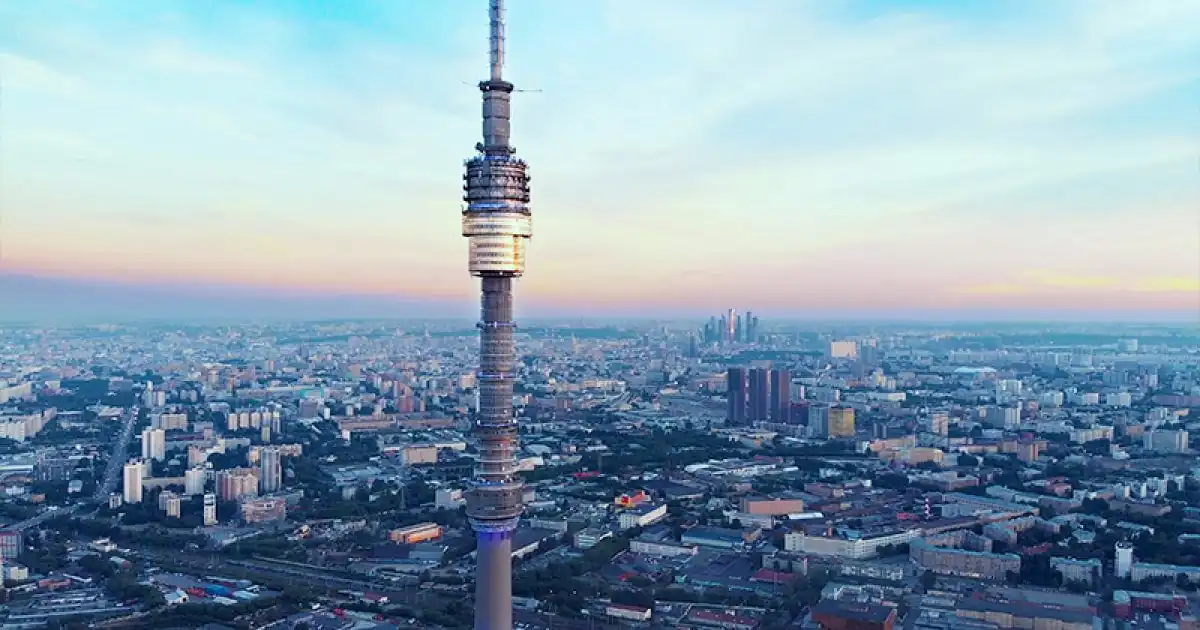
Ostankino Tower is a television and radio broadcasting tower completed in 1967. At 540.1 meters, it was the tallest free-standing structure in the world at the time of its completion and remains the tallest structure in Europe. Designed by engineer Nikolai Nikitin, the tower serves as a central broadcasting hub for Russian television and radio networks. It also includes observation decks and a revolving restaurant, making it both an infrastructure facility and a public landmark.
Key Facts
- Height
- 540.1 meters
- Materials
- Reinforced concrete, Steel
- Civilization
- Soviet Union
- Date(s)
- 1963-1967
- Condition
- Active broadcasting tower with public observation areas
- Original Function
- Television and radio broadcasting tower
- Key Figures
- Nikolai Nikitin
- Architectural Style
- Soviet modernist engineering
Design and Construction
1963-1967The tower was constructed to improve television and radio broadcasting capacity across the Soviet Union. Engineer Nikolai Nikitin developed an innovative reinforced concrete design inspired by the form of a lily, providing structural stability at unprecedented height.
Cold War Era Role
1967-1991Ostankino Tower became a symbol of Soviet technological achievement. It functioned as the primary broadcasting center for national television, including major state events.
2000 Fire and Restoration
2000-2008A major fire in August 2000 damaged interior sections and disrupted broadcasting. Restoration and safety upgrades followed, and public access to observation decks was gradually reinstated.
Present Function
2008-presentThe tower continues to operate as a broadcasting facility while offering controlled public access to observation platforms. Security and safety procedures remain strict due to its infrastructure role.
Cultural Significance
Ostankino Tower represents Soviet-era engineering ambition and remains a prominent feature of Moscow’s skyline. It functions both as a technological infrastructure asset and as a symbol of broadcasting and media development in Russia.
Interpretive Notes
Scholarly debates and areas of uncertainty
Engineering discussions focus on the tower’s structural innovations and fire safety systems, particularly in light of the 2000 fire. Architectural historians also examine it as an example of late Soviet monumental infrastructure design.
Visiting Information
Entry Rules
Public access limited to designated observation decks via timed tickets. Security screening required. Access may be suspended during adverse weather or technical operations.
Best Times to Visit
Clear-weather days for maximum visibility from observation decks. Advance booking recommended on weekends and holidays.
Photography
Photography permitted on observation decks for personal use. Tripods, drones, and professional equipment typically prohibited without authorization.
Preservation Notes
Visitors must follow strict safety regulations and remain within designated areas. The tower is an active broadcasting facility and subject to operational restrictions.
Nearby POIs
11 shown- Exhibition of Achievements of National Economy1.7 km
- Memorial Museum of Cosmonautics1.8 km
- Central Armed Forces Museum3.9 km
- Moscow Museum of Modern Art5.9 km
- Bolshoi Theatre6.6 km
- Cathedral of Our Lady of Kazan7.2 km
- State Historical Museum7.2 km
- Lenin's Mausoleum7.4 km
- Cathedral of Vasily the Blessed7.5 km
- Kremlin7.6 km
- Cathedral of the Dormition7.7 km
Sources & Further Reading
- [1]
Key Facts
- Height
- 540.1 meters
- Materials
- Reinforced concrete, Steel
- Civilization
- Soviet Union
- Date(s)
- 1963-1967
- Condition
- Active broadcasting tower with public observation areas
- Original Function
- Television and radio broadcasting tower
- Key Figures
- Nikolai Nikitin
- Architectural Style
- Soviet modernist engineering
Nearby POIs
11 shown- Exhibition of Achievements of National Economy1.7 km
- Memorial Museum of Cosmonautics1.8 km
- Central Armed Forces Museum3.9 km
- Moscow Museum of Modern Art5.9 km
- Bolshoi Theatre6.6 km
- Cathedral of Our Lady of Kazan7.2 km
- State Historical Museum7.2 km
- Lenin's Mausoleum7.4 km
- Cathedral of Vasily the Blessed7.5 km
- Kremlin7.6 km
- Cathedral of the Dormition7.7 km