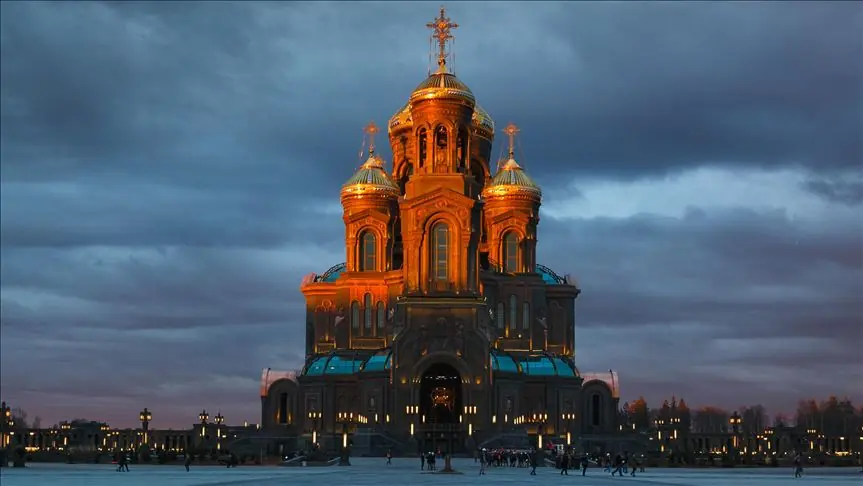
The Cathedral of the Russian Armed Forces is a Russian Orthodox cathedral located in Patriot Park near Moscow, completed in 2020. It was commissioned by the Russian Ministry of Defense to commemorate the 75th anniversary of the Soviet victory in World War II and to honor the history of the Russian military. The cathedral is designed in a monumental Russian Revival style with modern symbolic elements integrated into its architecture. Its structure incorporates numerological references tied to military history, and the interior features mosaics depicting historical battles and figures. The building functions both as a place of worship and as a commemorative monument within a broader military-themed complex.
Key Facts
- Materials
- Metal, Glass, Concrete
- Civilization
- Russian
- Current Function
- Active Orthodox cathedral and memorial site
- Date(s)
- 2018–2020 CE
- Condition
- New and fully preserved
- Original Function
- Military commemorative cathedral
- Key Figures
- Sergei Shoigu, Vladimir Putin
- Architectural Style
- Modern Russian Revival
Planning and Commissioning
2018The cathedral was commissioned by the Russian Ministry of Defense under the leadership of Sergei Shoigu. It was conceived as a central monument commemorating the 75th anniversary of the Soviet victory in World War II and as a symbolic representation of the Russian Armed Forces.
Construction
2018–2020Construction progressed rapidly, with the project completed in approximately two years. The design incorporates symbolic dimensions, such as the height and diameter of structural elements, referencing key dates and figures associated with World War II and Russian military history.
Dedication and Opening
2020The cathedral was officially consecrated and opened in 2020. It forms part of Patriot Park, a large military-themed park that includes museums, exhibitions, and memorials dedicated to Russian military history.
Modern Role
2020–presentThe cathedral functions as both a religious institution and a national memorial. It hosts religious services, state ceremonies, and commemorative events, and is integrated into broader narratives of military heritage and identity in contemporary Russia.
Cultural Significance
The cathedral represents a convergence of religion, state, and military identity in contemporary Russia. Its construction reflects an effort to integrate Orthodox Christianity into national narratives surrounding military history, particularly the legacy of World War II. As part of Patriot Park, the site functions within a broader commemorative landscape that emphasizes historical continuity and national identity. It has become a focal point for official ceremonies and public engagement with military heritage.
Interpretive Notes
Scholarly debates and areas of uncertainty
The cathedral has been the subject of debate regarding the relationship between religion and state in modern Russia, particularly the use of religious architecture to promote national and military narratives. There has also been discussion about specific artistic elements within the cathedral, including the inclusion and subsequent removal or modification of certain mosaics depicting contemporary political figures.
Visiting Information
Entry Rules
Open daily. Entry is generally free, though access may vary during official events and ceremonies.
Best Times to Visit
Weekdays for fewer crowds. National holidays and commemorative dates attract large numbers of visitors.
Photography
Photography is typically permitted, but restrictions may apply inside certain areas. Professional equipment may require permission.
Preservation Notes
Visitors should follow posted guidelines and respect the site’s dual role as a place of worship and memorial. Security screening may be in place.
Nearby POIs
7 shownSources & Further Reading
- [1]Main Cathedral of the Russian Armed Forces — Russian Ministry of Defense (2020)
- [2]Religion and Politics in Contemporary Russia — Marlene Laruelle. Routledge (2021)
- [3]Patriot Park and Military Memory — Ksenia Kizilova. Journal of Eurasian Studies (2022)
Key Facts
- Materials
- Metal, Glass, Concrete
- Civilization
- Russian
- Current Function
- Active Orthodox cathedral and memorial site
- Date(s)
- 2018–2020 CE
- Condition
- New and fully preserved
- Original Function
- Military commemorative cathedral
- Key Figures
- Sergei Shoigu, Vladimir Putin
- Architectural Style
- Modern Russian Revival