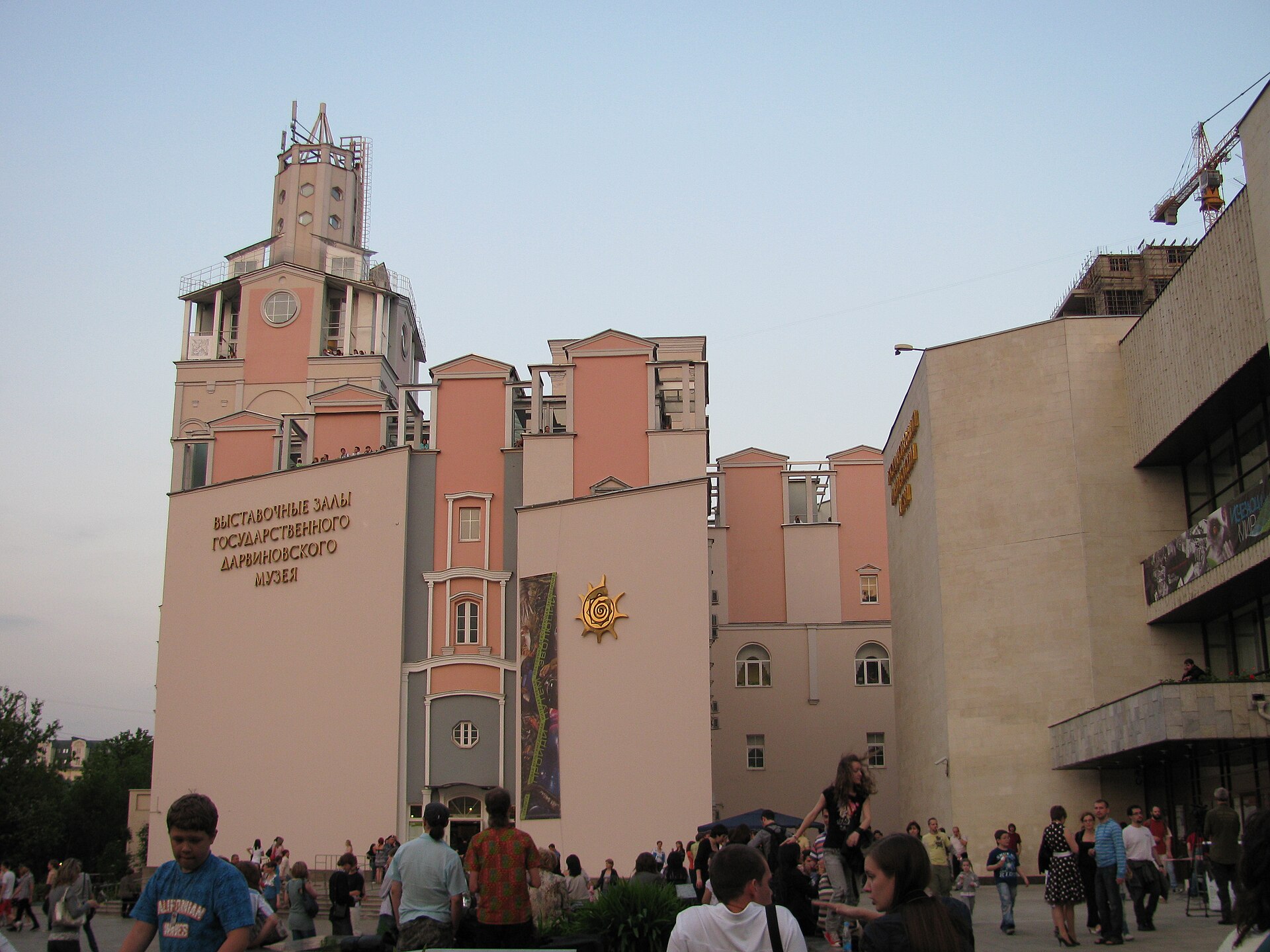
The State Darwin Museum is a natural history museum dedicated to evolutionary theory and biodiversity. Founded in 1907 by zoologist Alexander Kots, it is one of the largest natural science museums in Europe. Its exhibitions trace the development of life on Earth, the principles of natural selection, and the diversity of animal species. The museum combines historical scientific collections with interactive displays and educational programming.
Key Facts
- Civilization
- Russian Empire; Soviet Union; Russian Federation
- Accessibility
- Wheelchair accessible facilities
- Collections Focus
- Evolutionary biology, zoology, biodiversity
- Date(s)
- Founded 1907; current building completed 1995
- Condition
- Active museum
- Original Function
- Natural history and evolutionary science museum
- Key Figures
- Alexander Kots, Charles Darwin
Foundation
1907The museum was established by zoologist Alexander Kots to promote the study of evolutionary theory in Russia. Its early collections were assembled for educational purposes and public lectures.
Soviet Period
1917-1991During the Soviet era, the museum expanded significantly and became a major institution for natural science education. Exhibitions emphasized evolutionary biology within the framework of Soviet scientific discourse.
Modern Development
1990s-presentA new museum complex was completed in 1995, allowing for expanded exhibition space and modern interactive displays. The institution continues to serve as a center for science education and public outreach.
Cultural Significance
The State Darwin Museum has played a central role in presenting evolutionary theory to the Russian public. It reflects broader scientific and educational developments in Russia from the late imperial period through the Soviet era and into the present.
Interpretive Notes
Scholarly debates and areas of uncertainty
Scholarly discussion often examines how evolutionary theory was presented during the Soviet period, particularly in relation to ideological debates surrounding genetics and biology in the mid-20th century.
Visiting Information
Entry Rules
Open during standard museum hours. Admission ticket required. Discounts available for students and children.
Best Times to Visit
Weekday mornings for smaller crowds. School holidays and weekends tend to be busier due to educational visits.
Photography
Personal photography permitted in most exhibition areas. Flash and tripods typically prohibited. Special exhibitions may have additional restrictions.
Preservation Notes
Visitors must not touch specimens unless clearly designated as interactive exhibits. Some collections require controlled lighting and environmental conditions.
Nearby POIs
11 shownSources & Further Reading
- [1]
Key Facts
- Civilization
- Russian Empire; Soviet Union; Russian Federation
- Accessibility
- Wheelchair accessible facilities
- Collections Focus
- Evolutionary biology, zoology, biodiversity
- Date(s)
- Founded 1907; current building completed 1995
- Condition
- Active museum
- Original Function
- Natural history and evolutionary science museum
- Key Figures
- Alexander Kots, Charles Darwin